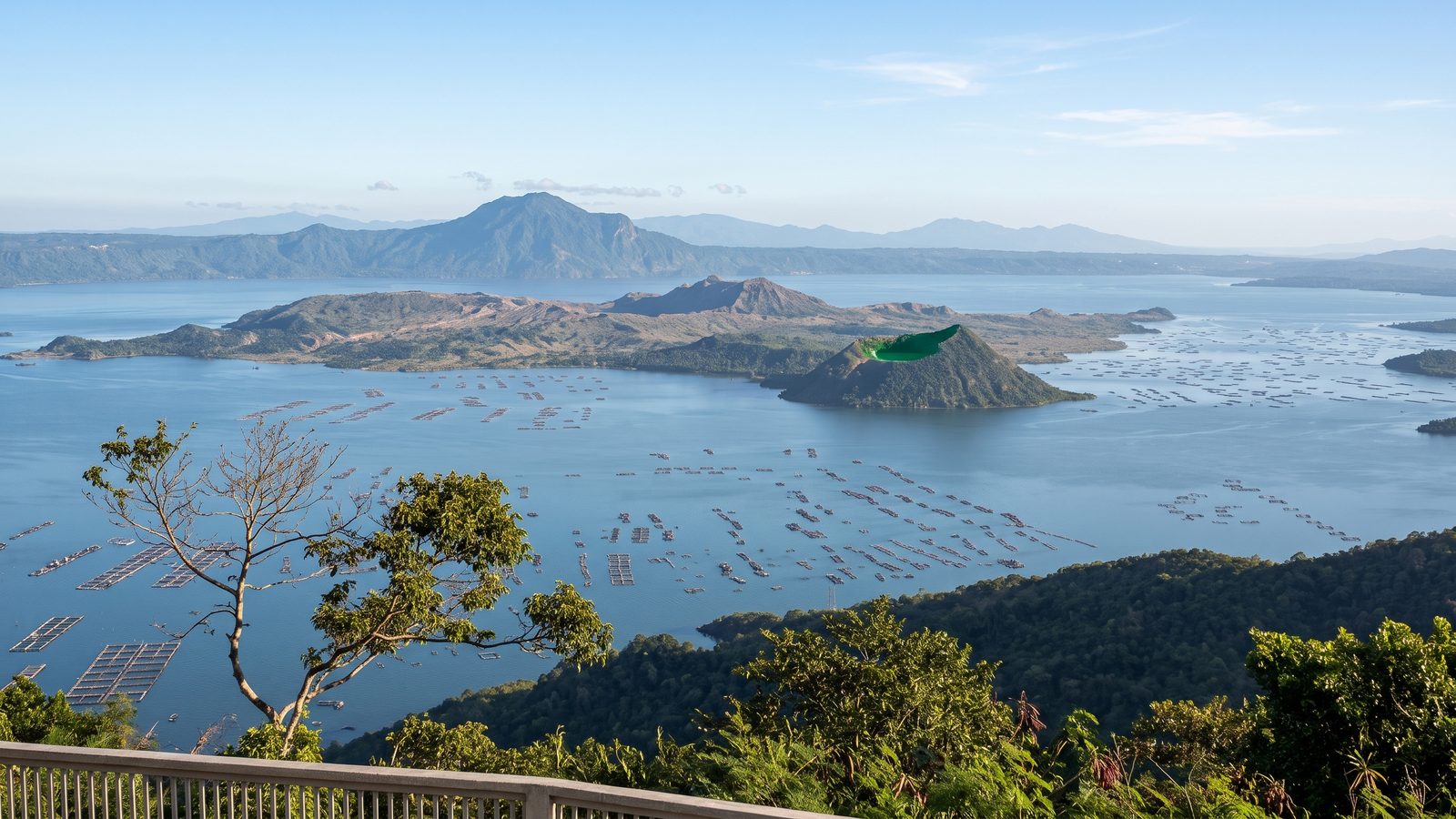
Welcome to Taal Volcano in Talisay, Batangas, one of the most remarkable natural landmarks in the Philippines. As you gaze across Taal Lake toward Volcano Island, you are looking at a geological phenomenon: a volcano inside a lake, inside an ancient caldera. This self-guided audio tour walks you through the violent history, unique freshwater biology, and striking landscapes that make this active complex world-famous.
Whether observing from the high ridge of Tagaytay or hiking along the volcanic trails, you will experience the undeniable power of Earth's forces. Listen closely as you explore the stories of ancient marine life, volcanic eruptions, and local legends that define this sacred, active landscape.
Listen to a sample
The opening of this tour, exactly as AllTours narrates it on site.
What you'll hear on this tour
Stop 1. Panoramic Views of Vulcan Point
You stand at an elevated viewpoint taking in an incredible geographic layer cake. Before you lies the vast expanse of Taal Lake cradling Volcano Island, which holds its own emerald Main Crater Lake. Right inside that crater pool, you spot Vulcan Point, a famous island within a lake within an island within a lake. As you take in the panorama, trace the subtle eruption scars along the crater slopes, etched into the terrain during dynamic past eruptions like the violent 1911 event. Local legends say ancient Tagalog warriors gaze from this exact ridge, guarding the sacred, restless waters stretching below your feet.
Stop 2. Standing Beside the Active Main Crater
You stand directly at the edge of the active main crater, feeling the gentle tremors beneath your feet that reveal the power sleeping below. Below you, the acidic Main Crater Lake shines an otherworldly, vibrant green due to dissolved minerals. You see delicate wisps of steam curling upward from vents along the inner rock walls; these fumaroles are the volcano's continuous breath, signaling intense subterranean heat. With a history of over thirty eruptions, this complex vent constantly reshapes itself through dramatic blasts and flows. Folklore speaks of a fiery giant whose outbursts created these sudden explosions, adding a legendary mystery to this raw active vent.
Stop 3. Walking Upon Volcano Island
You walk across Volcano Island, realizing you are standing on the exposed summit of a massive underwater volcano. Every step you take places you on compressed layers of volcanic ash and hardened lava, accumulated from countless historical eruptions. You feel the subtle warmth rising from the ground below, an enduring reminder of active geothermal energy. The striking green water of the Main Crater Lake showcases a potent mix of volcanic minerals derived from deep active chemistry. Around you, resilient plants cling bravely to the nutrient-rich ash slopes, proving how life continuously regenerates on the largest island within a lake within an island.
Stop 4. A Unique Freshwater Ecosystem
Look across the vast caldera lake, where a former arm of the sea became an isolated freshwater sanctuary. You are visiting the unique home of the tawilis, the world's only freshwater sardine, which evolved after ancient eruptions sealed off the sea. As you explore, note the resilient grasses and hardy shrubs anchoring themselves into the ash-rich soil of the slopes. In the air, you catch a faint scent of sulfur and earth, while steam fumaroles leak gentle plumes from crevices in the terrain. This environment thrives on raw volcanic power, nurturing a delicate yet remarkably adaptable ecosystem against all odds.
Stop 5. Ancient Caldera and Emerald Waters
You look across the wide freshwater expanse of Taal Lake, the massive scar left behind by cataclysmic ancient eruptions. Once a saltwater bay, successive volcanic shifts cut off this basin from the ocean, trapping marine life that adapted over centuries. Tales even tell of marine bull sharks once navigating these deep inland waters. Notice how the lake changes color, reflecting both the shifting sky and the underlying volcanic mood. Nested within the island lies the acidic Crater Lake, a smaller, vibrant pool whose temperature and hue fluctuate constantly as steam vents release the quiet secrets of Earth's burning interior.
Stop 6. Ascending the Red Lava Trail
You step onto the dusty trail known locally as the Red Lava path, walking on pulverized ash and reddish soil that crunches beneath your boots. As you ascend the steady volcanic incline, sparse vegetation grows beside your route, clinging tightly to the rugged ground. The air grows warmer and carries a distinct, sulfur-scented breeze from nearby active vents. Looking around, you spot tiny steam fissures whispering from hidden cracks in the rock. With every upward step, panoramic views of the surrounding lake unfold, rewarding your exertion until you reach the rim and behold the stunning crater lake below.
Planning your visit
- Best time to go
- Early morning during the dry season (December to May) for clear skies and cooler temperatures.
- Approximate duration
- About 2 to 3 hours
- Where to start
- Tagaytay ridge viewpoints or the Talisay lakefront in Batangas.
Access and conditions change seasonally — check the official site before you go.
Frequently asked questions
Is Taal Volcano worth visiting?
Yes, Taal Volcano is famous worldwide for its unique 'nested' geology—an island within a lake within an island—offering stunning scenic panoramas and fascinating geological history.
How long do you need at Taal Volcano?
Most visitors spend around 2 to 4 hours exploring the viewpoints, enjoying a self-guided tour, and taking in the panoramic vistas of the caldera lake.
What is the eruption history of Taal Volcano?
Taal is one of the Philippines' most active volcanoes, with over 30 recorded historical eruptions including a major explosive eruption in 1911 that shaped the current Main Crater Lake.
Keep exploring
Header image is an AI-generated illustration of Taal Volcano. AllTours.ai is an AI audio tour guide — point your camera at any landmark and hear its story.