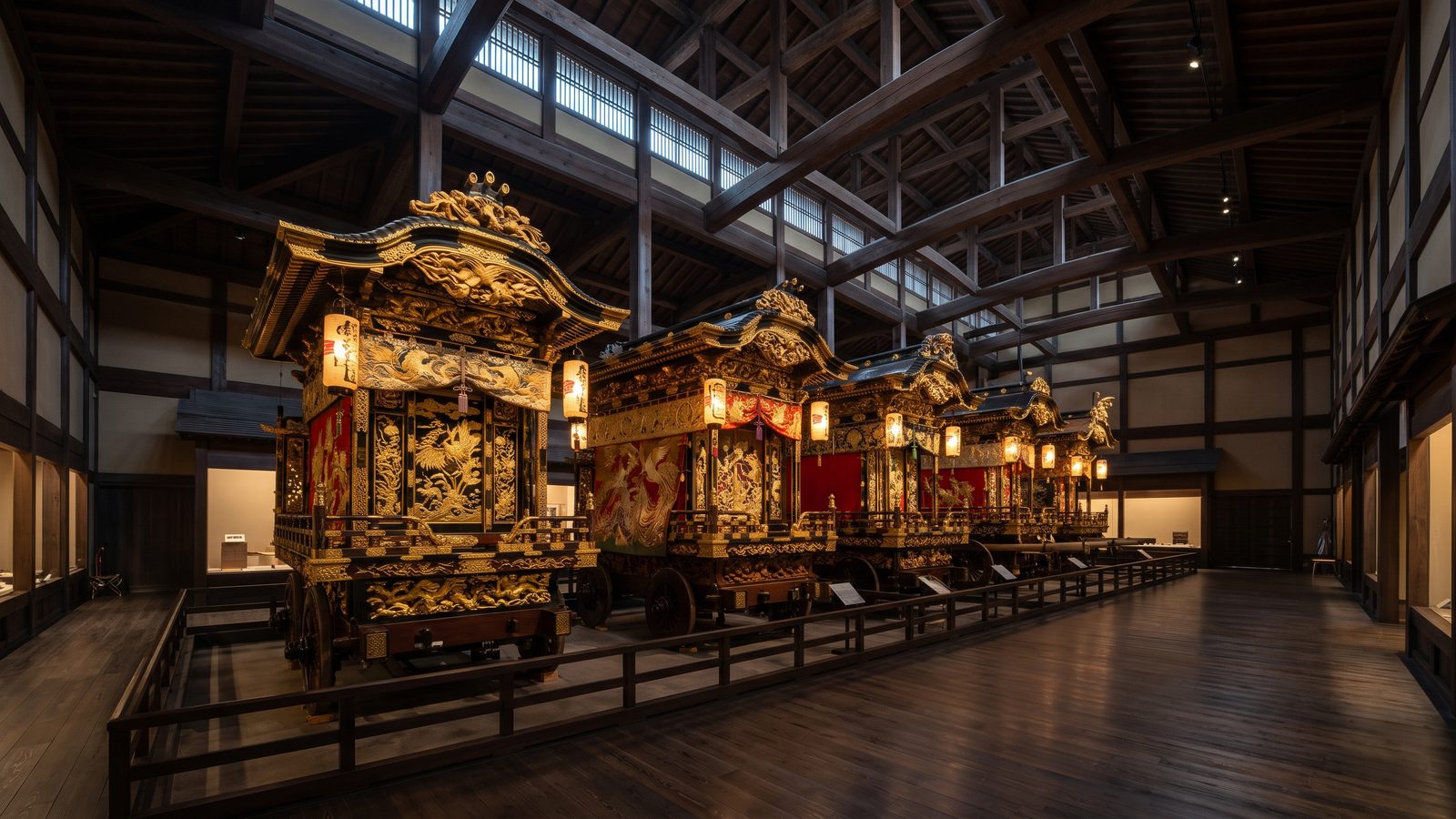
Step into the Takayama Festival Floats Exhibition Hall, where centuries of artistic ambition and spiritual devotion come alive. These magnificent floats, known as yatai, are far more than festival decorations; they are mobile temples crafted by master artisans during the wealthy Edo period. Through this self-guided audio tour, you will discover the intricate wood carvings, gilded details, and mechanical marvels that make these floats a global treasure.
Experience the living heritage of Takayama's biannual festivals without waiting for event season. As you explore these rotating masterpieces, you will uncover the deep community pride, sacred rituals, and delicate restoration efforts that preserve Takayama's world-famous heritage for future generations.
Listen to a sample
The opening of this tour, exactly as AllTours narrates it on site.
What you'll hear on this tour
Stop 1. Edo Period Masterpieces in Gold and Silk
Look closely at the surfaces of these monumental floats to discover a breathtaking gallery of Edo-period techniques. You observe chokoku, deep wooden sculptures carved from single blocks to depict dynamic dragons and phoenixes catching the light. Notice the vibrant urushi lacquer glistening with maki-e, where gold and silver powders form shimmering landscapes upon wet lacquer. You can examine exquisite nishiki-ori brocades woven with gold and silk threads, echoing Kyoto's finest textile traditions. Overhead, delicate kinpaku-oshi gold leaf is meticulously pressed onto carved surfaces, casting an ethereal glow across every corner. Each float unites sculpture, weaving, gilding, and lacquering into one magnificent, moving masterpiece.
Stop 2. Mechanical Marvels and Hidden Joinery
Direct your attention to the extraordinary craftsmanship hidden within every beam and joint. You see the famous karakuri ningyo, intricate mechanical puppets atop the floats that move seamlessly through hidden strings and levers, demonstrating master physics and theatrical artistry. Examine the cypress and zelkova wood carved with remarkable detail down to individual scales and feathers. You notice dozens of micro-thin layers of glowing lacquer alongside hand-forged, hand-engraved metal fittings that anchor the structure. Look beneath the decorative surfaces to appreciate traditional Japanese woodworking: flawless joinery where interlocking wooden beams fit together perfectly without using a single nail. It is an enduring testament to Takayama's master artisans.
Stop 3. Spring Prayers and Autumn Gratitude
Immerse yourself in the living atmosphere of Takayama's world-renowned celebrations. You learn how the city transforms twice each year: during Sanno Matsuri in spring to pray for rich harvests, and Hachiman Matsuri in autumn to give thanks for the bounty. During these events, mechanical karakuri puppets perform centuries-old dances high above packed streets. As night falls during yomatsuri, hundreds of chochin lanterns illuminate the floats in a warm, magical glow. You hear the echoes of traditional hayashi music and energetic cheers as portable shrines march past. Recognized as UNESCO Intangible Cultural Heritage, these grand festivals bind the entire community in shared joy and sacred devotion.
Stop 4. From Simple Processions to Merchant Rivalries
Travel back to the mid-17th century when the Takayama Festival first began. You discover that early processions featured humble floats designed to honor local Shinto deities and pray for protection and harvest bounties. As Takayama's merchant class prospered through the timber and lacquerware trades during the Edo period, a friendly artistic rivalry emerged. Local merchants commissioned elite craftsmen to build increasingly magnificent yatai, attempting to outshine one another. This competitive ambition introduced gilded ornamentations and complex puppet mechanics to the floats. You trace how local families carefully guarded these treasures through changing eras, preserving an unbroken artistic legacy that continues to thrive today.
Stop 5. Sacred Guardians and Living Melodies
Feel the weight of inherited tradition that sustains these sacred floats. You learn that each yatai is not public property, but is faithfully stewarded by a specific neighborhood, or cho-gumi. Within many floats rests the goshintai, a sacred object housing the deity, transforming these ornate vehicles into mobile altars. You observe how pulling the floats is a hereditary privilege carried out by hiki-te families across generations. Even the haunting melodies of hayashi musicians are passed orally from elders to youth. This deep ancestral pact ensures that every movement, song, and ritual remains unchanged, connecting modern residents directly to their ancestors.
Stop 6. Community Devotion and Sacred Storytelling
Reflect on the deep cultural core that defines Takayama's heritage. You realize that these floats represent far more than visual spectacle; they embody an unwavering commitment to community harmony and spiritual respect. The karakuri puppet shows fuse precise mechanical engineering with traditional drama, bringing ancient folklore and divine blessings to life for gathered crowds. Every carved mythical beast and painted historical hero reflects collective beliefs passed down through families. As you stand before these rotating displays, you sense the enduring pulse of Shinto devotion and local pride that unifies the town, keeping centuries of living tradition vibrant and deeply meaningful today.
Planning your visit
- Best time to go
- Morning or early afternoon for peaceful viewing and optimal indoor lighting on float details.
- Approximate duration
- About 45 to 60 minutes
- Where to start
- Inside the main exhibition hall near the entry glass enclosure on the grounds of Sakurayama Hachimangu Shrine.
Access and conditions change seasonally — check the official site before you go.
Frequently asked questions
Is Takayama Festival Floats Exhibition Hall worth visiting?
Yes, it is worth visiting because it allows you to see the real UNESCO-recognized festival floats (yatai) up close year-round, complete with their intricate wood carvings, lacquerwork, and gold leaf details.
How long do you need at Takayama Festival Floats Exhibition Hall?
Most visitors spend about 45 to 60 minutes exploring the rotating float display, examining the intricate details and listening to the accompanying commentary.
What is the history of the Takayama Festival floats?
The float tradition dates back to the mid-17th century. During the Edo period, wealthy local timber and lacquer merchants funded master artisans to build increasingly elaborate yatai to showcase town pride and honor Shinto deities.
Keep exploring
Header image is an AI-generated illustration of Takayama Festival Floats Exhibition Hall. AllTours.ai is an AI audio tour guide — point your camera at any landmark and hear its story.