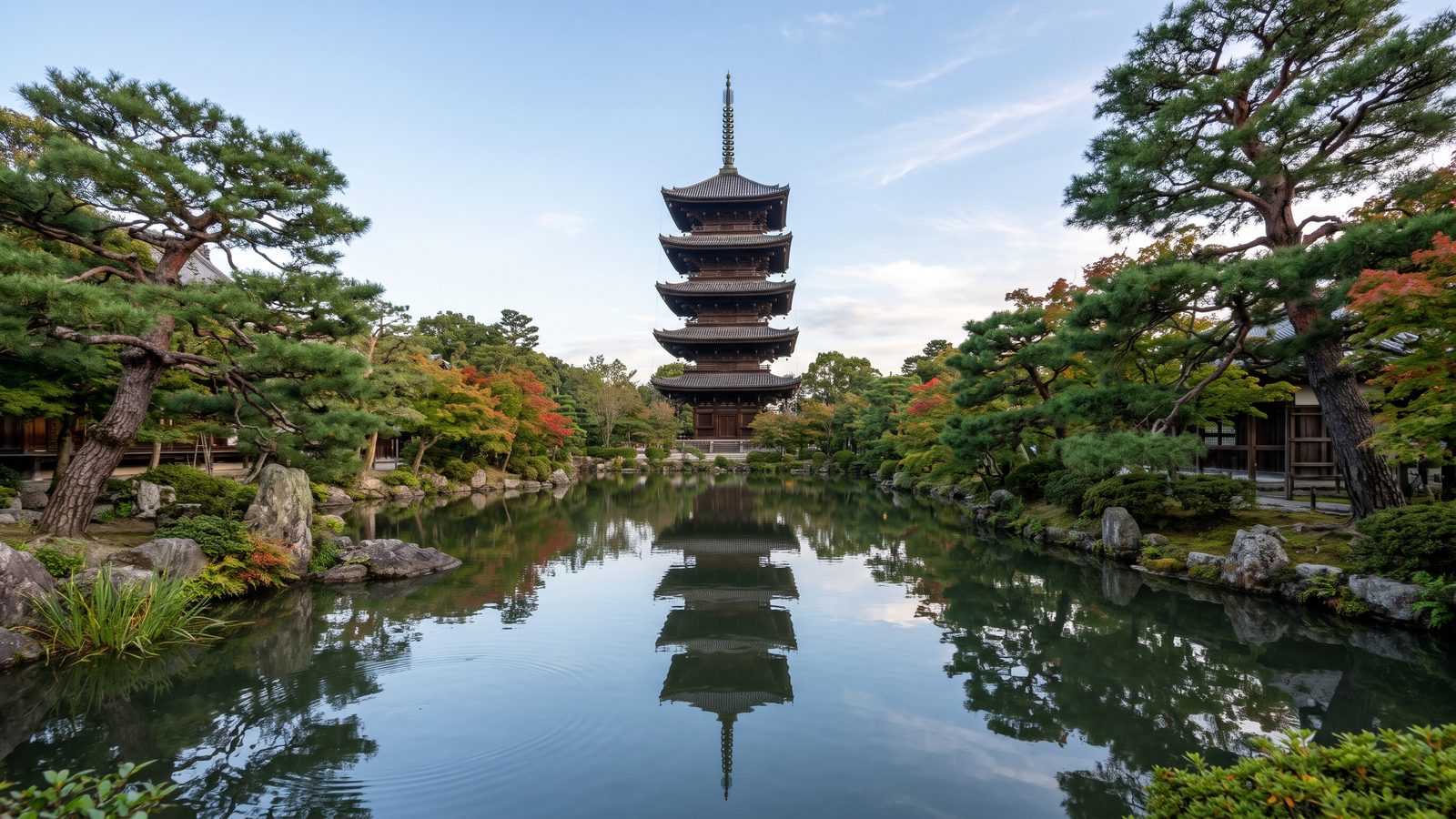
You stand before Tō-ji Temple Pagoda, Kyoto’s iconic five-story wooden landmark and a cornerstone of Shingon Esoteric Buddhism. Founded in 796 as Heian-kyō's eastern guardian temple, it was later entrusted to the famous monk Kūkai. As you explore these sacred grounds, you will discover an architectural masterpiece engineered to withstand earthquakes, embedded with rich Buddhist cosmology, and surrounded by peaceful gardens reflecting centuries of devotion.
This self-guided audio tour walks you around the majestic 1644 pagoda structure, revealing ancient carpentry secrets, cultural traditions like the monthly market, and stunning photo viewpoints. Step onto the grounds, feel the spiritual resonance, and experience a living piece of Kyoto’s heritage at your own pace.
What you'll hear on this tour
Stop 1. Ancient Engineering and Seismic Masterclass
You stand beneath five soaring roofs that dramatically decrease in size as they ascend, creating an illusion of immense height. Notice how intricate interlocking wooden brackets called tokyo support each tier without using a single nail. Inside, a massive central pillar known as the shinbashira hangs like a pendulum, swaying independently to absorb seismic shocks in a brilliant centuries-old earthquake-proofing design. Observe the deep, sweeping curves of the eaves, called mukuri, shedding rain while casting dramatic shadows across the facade. Atop the structure, the bronze sorin finial points toward the sky, its nine rings symbolizing a spiritual ascent through the heavens.
Stop 2. Guardian of the Ancient Capital
You trace the pagoda's origins back to 796, when Emperor Kanmu commissioned Tō-ji to protect Heian-kyō’s eastern gate from spiritual misfortune. In 823, Emperor Saga entrusted the complex to the revered monk Kūkai, transforming it into the headquarters of Shingon Esoteric Buddhism. The structure before you is actually the fifth iteration, standing resilient against a history of devastating fires, including burns during the 1465 Ōnin War and again in 1602. Reconstructed in 1644 under Shogun Tokugawa Iemitsu, this magnificent tower faithfully preserves original Heian-period architectural grandeur while testifying to centuries of endurance.
Stop 3. The Cosmic Pillar of Shingon
As you gaze up at the towering structure, you encounter a physical manifestation of a living mandala—a three-dimensional cosmic diagram central to Shingon Esoteric Buddhism. Kūkai envisioned this site as a monumental gateway to the enlightened universe where wisdom and deities reside. The massive central pillar, the shinbashira, serves as an axis mundi, acting as a sacred conduit that bridges the earthly realm with the heavens above. Here, practitioners seek sokushin jōbutsu, achieving enlightenment within their present physical body. The pagoda acts as a focal point for deep meditation and esoteric rituals, radiating protective energy across Kyoto.
Stop 4. Living Traditions and Sacred Cosmology
You walk around a physical diagram of Buddhist cosmology, where the pagoda’s five stories represent the essential elements: earth, water, fire, wind, and void. Nearby in the Kodo Hall, a three-dimensional mandala of sacred statues invites you into the heart of Heian-era spiritual practice. Tō-ji’s heritage extends beyond silent contemplation into vibrant community life. On the 21st of each month, the grounds host the lively Kobo-san Market. You experience local artisans displaying crafts, antique sellers offering historic treasures, and food stalls sharing traditional Kyoto flavors, all gathering to honor Kūkai's enduring legacy and connect past traditions with present-day life.
Stop 5. Tranquil Paths around Hyotan-ike Pond
Step away from the towering wooden structure and enter the serene temple gardens, designed specifically for deep contemplation. You arrive at Hyotan-ike, or Gourd Pond, whose unique shape echoes the gourd Kōbō Daishi carried during his travels among the common people. As you walk along the winding paths, carefully positioned stones guide your gaze through a space harmonized with Shingon Buddhist cosmology. Gnarled ancient pines stretch overhead to symbolize longevity and resilience, while Japanese maples offer seasonal beauty. This living landscape provides a peaceful sanctuary where you can slow down and absorb the deep spiritual essence of Tō-ji.
Stop 6. Framing Kyoto’s Iconic Landmark
You discover exceptional photographic opportunities by observing how light interacts with this ancient wooden tower throughout the day. Early morning sunlight casts a warm, ethereal glow across the rich copper roofs, while the calm surface of Hyotan-ike pond yields a stunning symmetrical reflection. During spring, cherry blossom petals frame the pagoda, whereas dusk transforms the illuminated structure into a glowing beacon against an indigo sky. Try experimenting with focal lengths—use a wide-angle lens to capture the vast scale against surrounding gardens, or switch to a telephoto lens to isolate the intricate bronze finial and sweeping roof curves.
Planning your visit
- Best time to go
- Early morning for soft light and calm reflections on the pond, or the 21st of any month to visit the Kobo-san Market.
- Approximate duration
- About 1 hour
- Where to start
- The main garden path facing Tō-ji Pagoda and Hyotan-ike Pond.
Access and conditions change seasonally — check the official site before you go.
Frequently asked questions
Is Tō-ji Temple Pagoda worth visiting?
Yes, Tō-ji Temple Pagoda is one of Kyoto's most iconic historic landmarks, famous for being Japan's tallest ancient wooden pagoda and a central site for Shingon Esoteric Buddhism.
How long do you need at Tō-ji Temple Pagoda?
Most visitors spend about 45 to 60 minutes walking through the garden grounds, admiring the pagoda's architecture, and viewing Hyotan-ike pond.
What is the history of Tō-ji Temple Pagoda?
Commissioned in 796 as a guardian temple for Heian-kyō, Tō-ji was given to the monk Kūkai in 823. The pagoda was rebuilt four times due to fires; the current structure dates to 1644 under Shogun Tokugawa Iemitsu.
Keep exploring
Header image is an AI-generated illustration of Tō-ji Temple Pagoda. AllTours.ai is an AI audio tour guide — point your camera at any landmark and hear its story.