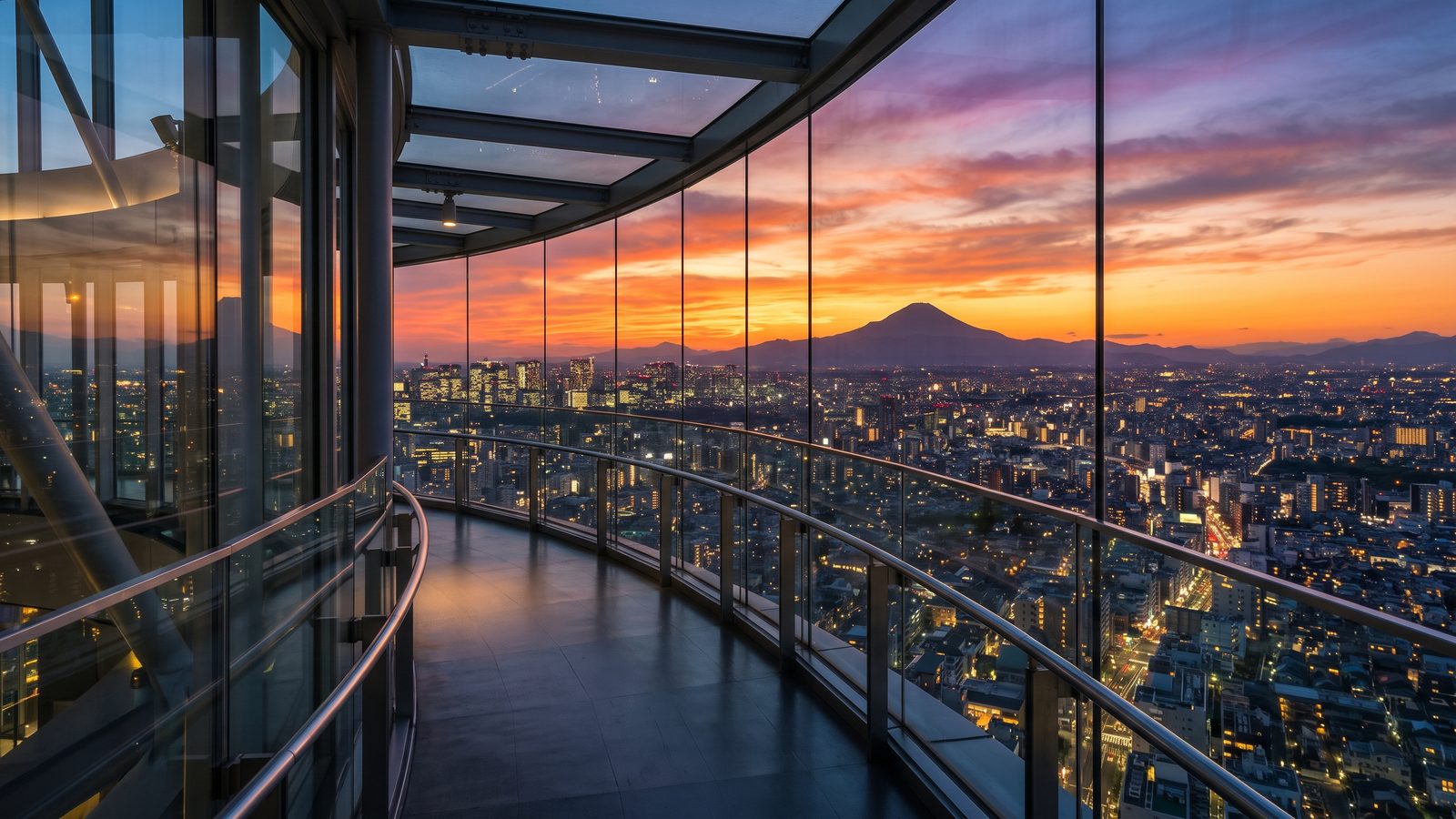
Welcome to the Tokyo Skytree Tembo Galleria, a breathtaking glass-enclosed sky corridor located 450 meters above the sprawling Japanese capital. Built to succeed Tokyo Tower for digital broadcasting, this architectural marvel combines modern structural engineering with classic Japanese design elements. As you walk up its spiraling ramp, you will enjoy shifting 360-degree views across Tokyo's vast urban landscape, historic districts, and distant mountain ranges.
This self-guided audio tour helps you navigate every step along the glass walkway. Learn how to spot legendary landmarks, capture reflection-free photographs of the skyline below, and witness Tokyo transform into a glowing sea of lights as day turns into night.
Listen to a sample
The opening of this tour, exactly as AllTours narrates it on site.
What you'll hear on this tour
Stop 1. Walking Among the Clouds at 450 Meters
You step onto the Tembo Galleria, a spiraling sky corridor suspended 450 meters above the metropolis. Conceived to replace Tokyo Tower for digital broadcasting, construction began in 2008 before its grand opening in 2012. As you walk along this sloped ramp, notice how the tower's design subtly incorporates traditional Japanese aesthetics, echoing the gentle curve of a samurai sword and the traditional roof slopes of ancient temples. You are standing at the absolute pinnacle of modern engineering. Take your time to enjoy the sensation of floating above the city as the surrounding urban tapestry unfolds around you in every direction.
Stop 2. Watch Night Fall Over the Metropolis
As the afternoon turns to evening, you witness an incredible transformation across Tokyo from this breathtaking height. The sky ignites in a vibrant, fiery gradient, framing the dark silhouette of Mount Fuji against the setting sun. Down below, the city gradually awakens for the night. Countless building windows and streetlight grids flicker on, turning the vast urban sprawl into a glowing, intricate circuit board. This golden hour casts an ethereal light across the entire region, giving you an unforgettable view of the capital's infinite energy as day transitions seamlessly into night.
Stop 3. Framing Reflections and Luminous Streaks
You reach prime vantage points designed for shutterbugs looking to capture Tokyo's vast depth. To get clean shots through the panoramic windows, press your camera lens directly against the glass pane to eliminate unwanted internal glare and reflections. This technique works wonders during night shoots when millions of city lights illuminate the horizon. Experiment with long exposure settings to turn the busy traffic moving along distant expressways into brilliant, glowing ribbons of light. On exceptionally clear days, look closely to capture the subtle curvature of the Earth's horizon from this towering height.
Stop 4. A Contrast of Historic and Modern Neighborhoods
Looking down through the glass skywalk, you see Tokyo stretching out like an endless, living mosaic of steel, concrete, and glass. You can easily trace the contrasting architectural textures of the city, from the quaint, low-rise roofs of historic Asakusa directly nearby to the gleaming, high-rise skyscrapers of Shinjuku towering in the distance. Serpentine ribbons of railways and elevated expressways slice through the urban grid, acting as vital arteries pulsing with life. Every distinct neighborhood below tells part of Tokyo's story, blending rich cultural heritage seamlessly with ambitious contemporary development.
Stop 5. 360 Degrees of Unbounded Horizons
As you move along the sloped corridor, a complete 360-degree view opens up around you, showcasing the vast scale of the world's largest urban area. Below, the silver ribbon of the Sumida River winds its way past dense residential sectors and industrial zones toward Tokyo Bay. On clear days, looking west reveals the magnificent, snow-capped peak of Mount Fuji standing tall against the horizon, serving as a peaceful natural counterpoint to the endless metropolitan skyline. The sheer height creates a dizzying visual perspective, making the bustling city beneath you resemble a detailed map brought to life.
Stop 6. Tracing Tokyo's Dynamic Arteries
From this lofty vantage point, you observe how Tokyo continuously evolves across time and space. Look westward across the vast city plain to spot major green oases like the Imperial Palace grounds resting beside densely packed commercial districts. Intricate networks of expressways and rail lines carve pathways through the sprawl, connecting bustling hubs from local stations to Shinjuku's iconic skyline. On clear days, Mount Fuji remains a timeless guardian anchored on the far western horizon. Standing here above it all, you gain a deep appreciation for the dynamic ambition driving this ever-changing metropolis.
Planning your visit
- Best time to go
- Late afternoon before sunset to experience daylight vistas, twilight gradients, and night lights.
- Approximate duration
- About 1 to 1.5 hours
- Where to start
- The entrance to the Tembo Galleria elevator on Floor 350 (Tembo Deck).
Access and conditions change seasonally — check the official site before you go.
Frequently asked questions
Is Tokyo Skytree Tembo Galleria worth visiting?
Yes, the Tembo Galleria takes you to a height of 450 meters, offering higher and more expansive 360-degree views than the lower observation deck, complete with a unique spiraling skywalk experience.
How long do you need at Tokyo Skytree Tembo Galleria?
Most visitors spend around 45 to 90 minutes walking up the sloped skywalk, taking photos, and viewing Tokyo's landmark districts.
What is the history behind Tokyo Skytree?
Construction on Tokyo Skytree began in 2008 to replace Tokyo Tower as the region's primary digital broadcasting tower. It opened in 2012, blending traditional Japanese architectural elements with state-of-the-art engineering.
Keep exploring
Header image is an AI-generated illustration of Tokyo Skytree Tembo Galleria. AllTours.ai is an AI audio tour guide — point your camera at any landmark and hear its story.