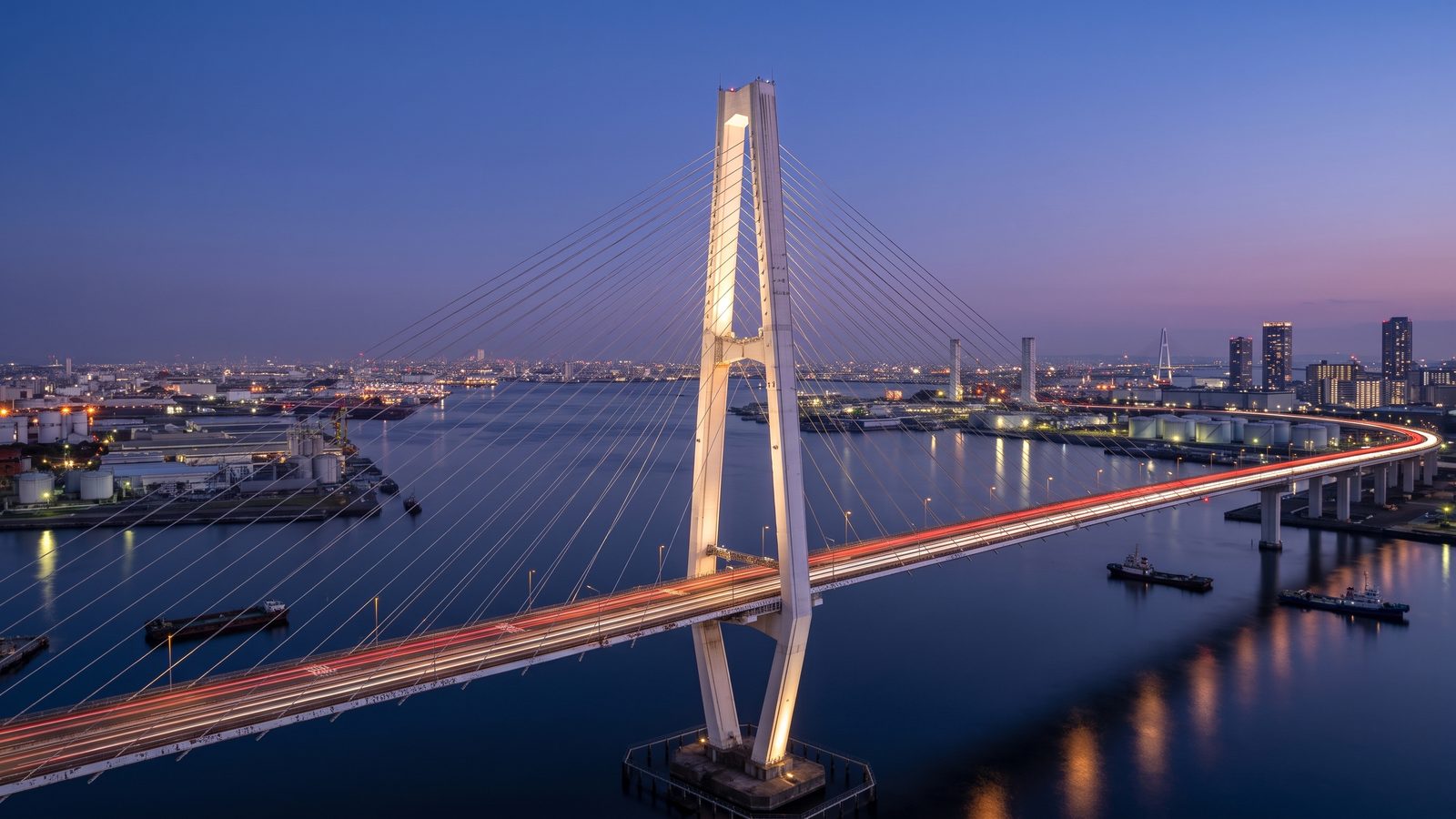
Welcome to Yokohama's waterfront, where the impressive Tsurumi Tsubasa Bridge spans Tokyo Bay as a key segment of the Metropolitan Expressway's Bayshore Route. Opened in September 1994 after years of intensive construction starting in 1987, this cable-stayed landmark links crucial industrial corridors across a 1,020-meter stretch. As you explore this audio guide, you will experience a masterclass in modern Japanese bridge design, structural innovation, and captivating seaside panoramas.
From vantage points like the Daikoku Futo parking area and Uminouen Park, you will discover how form meets function in high-tech infrastructure. Learn about its unique wing-like silhouette, continuous sensor monitoring, and seismic engineering while taking in sweeping views of shipping channels and distant mountain horizons.
Listen to a sample
The opening of this tour, exactly as AllTours narrates it on site.
What you'll hear on this tour
Stop 1. Panoramas of Port and Peak
As you stand before the Tsurumi Tsubasa Bridge, let your eyes sweep across an astounding panorama where land, sea, and sky meet. On a clear morning, look southwest to spot the serene silhouette of snow-capped Mount Fuji rising above Tokyo Bay. To the east, the Pacific Ocean opens up, filled with container ships navigating their ocean routes. Northward lies the busy activity of Yokohama Port. Beneath you, the Daikoku Futo Interchange hums with continuous traffic, creating a dynamic dance of light as dusk arrives. Watching the sunset bleed purple and orange across the water reveals the full visual power of this maritime landscape.
Stop 2. Capturing Blue Hour Luminescence
You step into a photographer's paradise as dusk arrives at Tokyo Bay. During the blue hour, deep indigo skies contrast sharply against the bridge's glowing cable network. Position your camera at the Daikoku Futo parking area to frame a wide panoramic shot of the illuminated structure set against glowing city lights. If you head to Uminouen Park, use the ascending stay cables as leading lines that draw the viewer's eye skyward. Try long exposures to transform highway traffic into vibrant ribbons of light streaming across the bay. With a telephoto lens, you can isolate the intricate diamond patterns where the cables converge, turning heavy infrastructure into delicate geometric art.
Stop 3. The Wing-Like Single-Plane Silhouette
Look closely at the striking aesthetic design that gives the bridge its distinctive identity. Unlike conventional cable-stayed structures supported by dual cable rows, this bridge utilizes a rare single-plane fan system with just one central row of steel stay cables. This audacious engineering choice creates an unusually slender profile, crafting the signature wing-like silhouette reflected in its name, tsubasa. Trace the graceful line of the main tower tapering upwards toward its subtle fin-like cap. As the stay cables splay outward from the central tower to hold the deck, they minimize visual obstruction, presenting a dramatic artistic statement that seamlessly connects form and function across the bay.
Stop 4. Pioneering Single-Pylon Cable Mechanics
You are gazing at an engineering masterpiece built to overcome immense environmental challenges. Featuring a main span of 510 meters and a total length of 1,020 meters, the bridge set records for single-plane cable-stayed design when it opened. Notice how the harp-pattern stay cables efficiently distribute immense structural loads across the deck. To counter powerful ocean winds, engineers sculpted an aerodynamically stable deck profile that minimizes vortex vibrations without heavy external dampers. Underneath, advanced seismic isolation bearings and flexible tower foundations protect the structure against earthquake forces, while individually encased high-strength steel cables guard against salt-air corrosion, ensuring decades of structural resilience.
Stop 5. Embedded Sensors and Modular Assembly
Step closer to appreciate how groundbreaking technological innovation shaped this bridge. Rather than acting as a static mass of steel, the structure functions like a smart bridge, using an embedded sensor network that continuously monitors real-time vibrations, wind movement, and seismic stresses to enable proactive maintenance. During its initial development, engineers created specialized wind tunnel testing methods to analyze its single-plane cable behavior under extreme storms. Construction itself broke new ground in maritime logistics: workers fabricated massive steel deck sections weighing over one thousand tons off-site, floating them precisely into place over Tokyo Bay with custom lifting equipment to complete this high-tech arterial link.
Stop 6. Linking Yokohama's Post-War Coastline
To understand this landmark's creation, you must look back to Japan's post-war economic boom. By the late 1980s, rapid expansion at Yokohama Port demanded an arterial bypass to handle heavy industrial traffic. Planners envisioned a vital link in the Metropolitan Expressway's Bayshore Route to connect a fragmented coastline. Construction began in 1987, requiring bold solutions to cross a heavily navigated shipping channel while enduring frequent regional earthquakes. When the bridge officially opened on September 27, 1994, it instantly transformed logistics across Tokyo Bay, establishing an iconic gateway that continues to carry thousands of vehicles daily through Kanagawa's industrial heartland.
Planning your visit
- Best time to go
- Late afternoon into dusk for clear views of Mount Fuji and the illuminated blue hour.
- Approximate duration
- about 1 hour
- Where to start
- Daikoku Futo Parking Area or Uminouen Park in Yokohama
Access and conditions change seasonally — check the official site before you go.
Frequently asked questions
Is Tsurumi Tsubasa Bridge worth visiting?
Yes, especially for photography enthusiasts, civil engineering fans, and visitors seeking unique industrial views of Yokohama Port and Mount Fuji across Tokyo Bay.
How long do you need at Tsurumi Tsubasa Bridge?
A visit typically takes around 45 to 60 minutes, giving you enough time to explore nearby viewpoints like Uminouen Park, take photos during sunset or blue hour, and listen to the tour.
When was Tsurumi Tsubasa Bridge built and why?
Construction began in 1987 and the bridge opened on September 27, 1994. It was built to serve as an arterial link on the Bayshore Route, alleviating heavy industrial traffic around Yokohama Port.
Keep exploring
Header image is an AI-generated illustration of Tsurumi Tsubasa Bridge. AllTours.ai is an AI audio tour guide — point your camera at any landmark and hear its story.