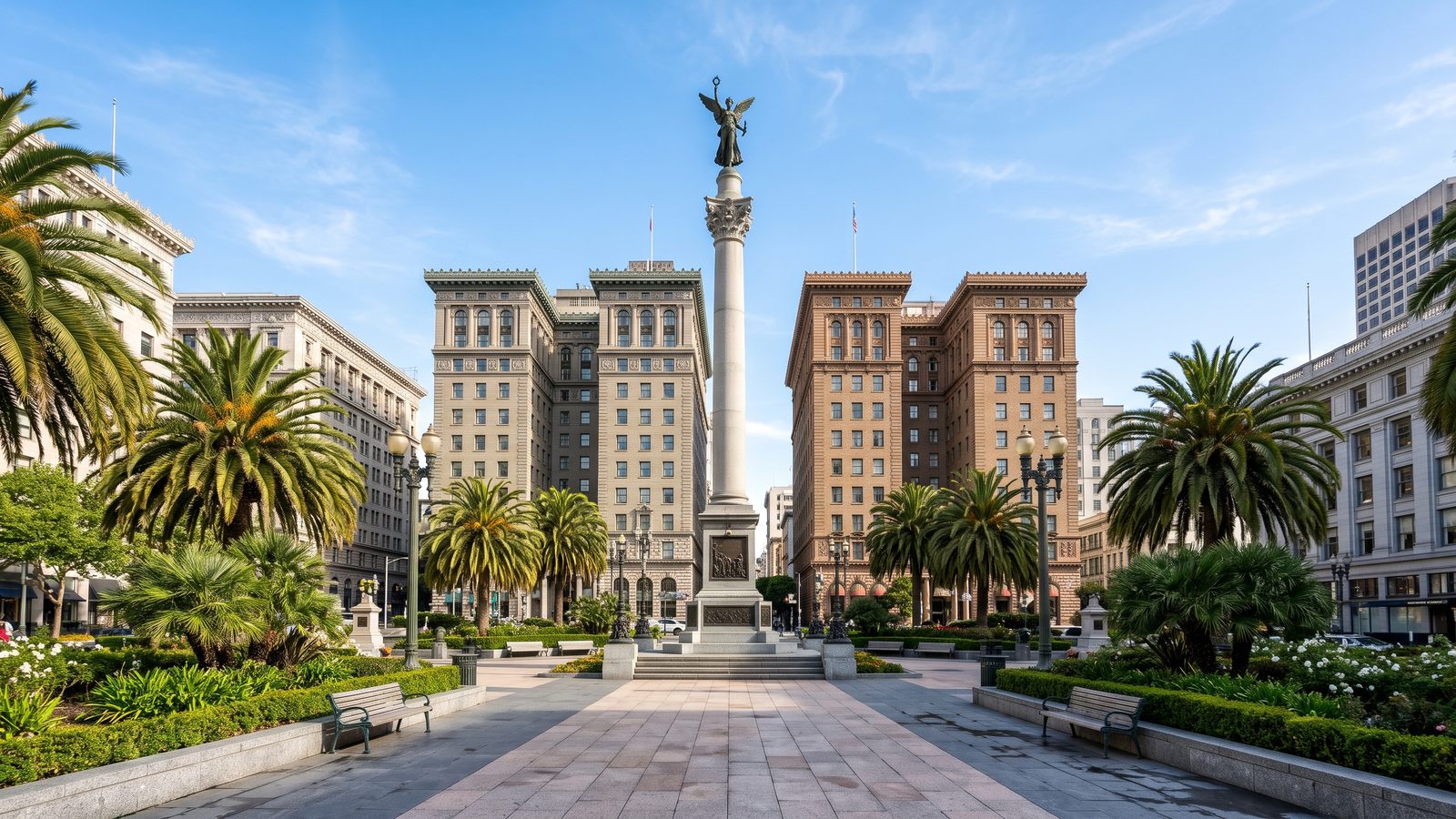
Welcome to Union Square, the lively public plaza nestled in the heart of downtown San Francisco. Originally named in 1850 to honor the Union cause during the Civil War, this former windswept knoll evolved into a bustling center of commerce, culture, and resilience. As you stand here today, you are walking through decades of civic history, surrounding architecture, vibrant art installations, and legendary hospitality that helped shape the city.
On this self-guided walking experience, you will discover historic grand hotels, landmark monuments, world-class dining, and high-end shopping districts. As you explore the plaza, step directly into the compelling story of San Francisco's dramatic rise from a Gold Rush frontier boomtown into a celebrated, enduring global metropolis.
What you'll hear on this tour
Stop 1. A Living Canvas of Monumental Art
As you gaze across Union Square, you stand before a living canvas where creativity meets city life. At the center rises the Dewey Monument, a Beaux-Arts masterpiece whose bronze figures commemorate a historic naval triumph. Beyond this central icon, you discover that the square frequently transforms into an open-air gallery. Temporary installations regularly bloom throughout the plaza, ranging from whimsical interactive sculptures to thought-provoking contemporary works. Look down at the paving stones and up at the surrounding architecture; every element contributes to a carefully curated urban design. Here, art moves beyond hushed museum galleries and becomes woven directly into your daily walk through San Francisco.
Stop 2. From Windswept Knoll to Civic Symbol
You stand on ground that began as a simple windswept knoll when San Francisco was barely a decade old. Designated in 1850, Union Square receives its name to honor the Union cause during the Civil War. You are walking through a vital gathering place that offered civic pride and unity during the city's chaotic boomtown era. Following the devastating 1906 earthquake and fire, this exact plaza serves as a crucial staging ground for emergency relief efforts, showcasing the unyielding resilience of San Franciscans. Today, as you traverse this paved plaza, you trace the remarkable path of a rough frontier outpost transforming into a global metropolis.
Stop 3. Grand Monuments of San Francisco Hospitality
Look around the plaza perimeter, where grand hotels stand as living monuments to San Francisco's high society. You are surrounded by historic sanctuaries that hosted glitterati, politicians, and tycoons throughout the early 20th century. Consider the Westin St. Francis, which opens in 1904 as a beacon of European-style opulence; it famously survives the 1906 earthquake and fire to shelter thousands of displaced residents. Nearby, perched atop Nob Hill, the Mark Hopkins InterContinental represents Gilded Age glamour, famous for its legendary Top of the Mark lounge. These majestic institutions represent far more than lodging; they embody an enduring tradition of world-class hospitality.
Stop 4. An Elegant Interplay of Historic Styles
Observe the striking architectural dialogue taking place around you in Union Square. You see a harmonious blend of historical styles, from ornate Beaux-Arts hotels featuring decorative cornices and classical proportions to sleek modern retail structures. Examine the intricate stonework and stately columns that reflect the grand civic ambitions of early 20th-century architects. In sharp contrast, expansive glass facades on nearby department stores capture natural light while showcasing world-class merchandise for modern shoppers. Even the curated lampposts and street furniture contribute to a cohesive urban environment. As you look up, you experience a dynamic city fabric balancing deep historical reverence with functional modern elegance.
Stop 5. The Beating Heart of City Retail
You are standing at the center of a world-famous retail paradise that shapes San Francisco fashion for over a century. Flagship luxury boutiques and iconic department stores like Macy's line the surrounding streets, continuing a retail tradition born during the Gold Rush. Back then, pioneering merchants catered to fortune seekers looking to establish comfortable new lives. Today, as you peer into gleaming window displays, you feel that same entrepreneurial pulse and vibrant energy. Millions of visitors flock to these sidewalks every year to experience trendsetting fashion, make memorable purchases, and feel the dynamic commercial heartbeat that powers the entire downtown district.
Stop 6. A Crossroads of Global Culinary Heritage
Inhale the enticing aromas drifting across Union Square, placing you at a true culinary crossroads. Upscale perimeter dining rooms serve artfully prepared local delicacies like fresh Dungeness crab, echoing the refined menus of historic San Francisco grand hotels. Just a short walk away lies North America's oldest Chinatown, where generations of families craft delicate dim sum and savory dumplings born from immigration and perseverance. Unassuming neighborhood bakeries nearby offer tangy sourdough bread, celebrating the region's famous baking traditions. As you explore the area, you enjoy a microcosm of San Francisco's food culture, bridging refined fine dining with time-honored community recipes.
Planning your visit
- Best time to go
- Morning or early afternoon on weekdays or weekends for pleasant walking weather and bustling shopping atmosphere.
- Approximate duration
- About 1 hour
- Where to start
- Central Plaza near the Dewey Monument, Union Square, San Francisco.
Access and conditions change seasonally — check the official site before you go.
Frequently asked questions
Is Union Square worth visiting?
Yes, Union Square is one of San Francisco's most iconic central hubs. It offers a vibrant blend of historical landmarks, world-class shopping, public art installations, and notable historic hotels all within a walkable plaza.
How long do you need at Union Square?
Plan to spend about 45 to 60 minutes exploring the square itself, its monuments, and architecture. If you plan to visit nearby shops, dine, or explore adjacent neighborhoods like Chinatown, budget two to three hours.
Why is it called Union Square?
Union Square was officially named in 1850 to honor support for the Union cause prior to and during the American Civil War, when the space was used for pro-Union rallies.
Keep exploring
Header image is an AI-generated illustration of Union Square. AllTours.ai is an AI audio tour guide — point your camera at any landmark and hear its story.