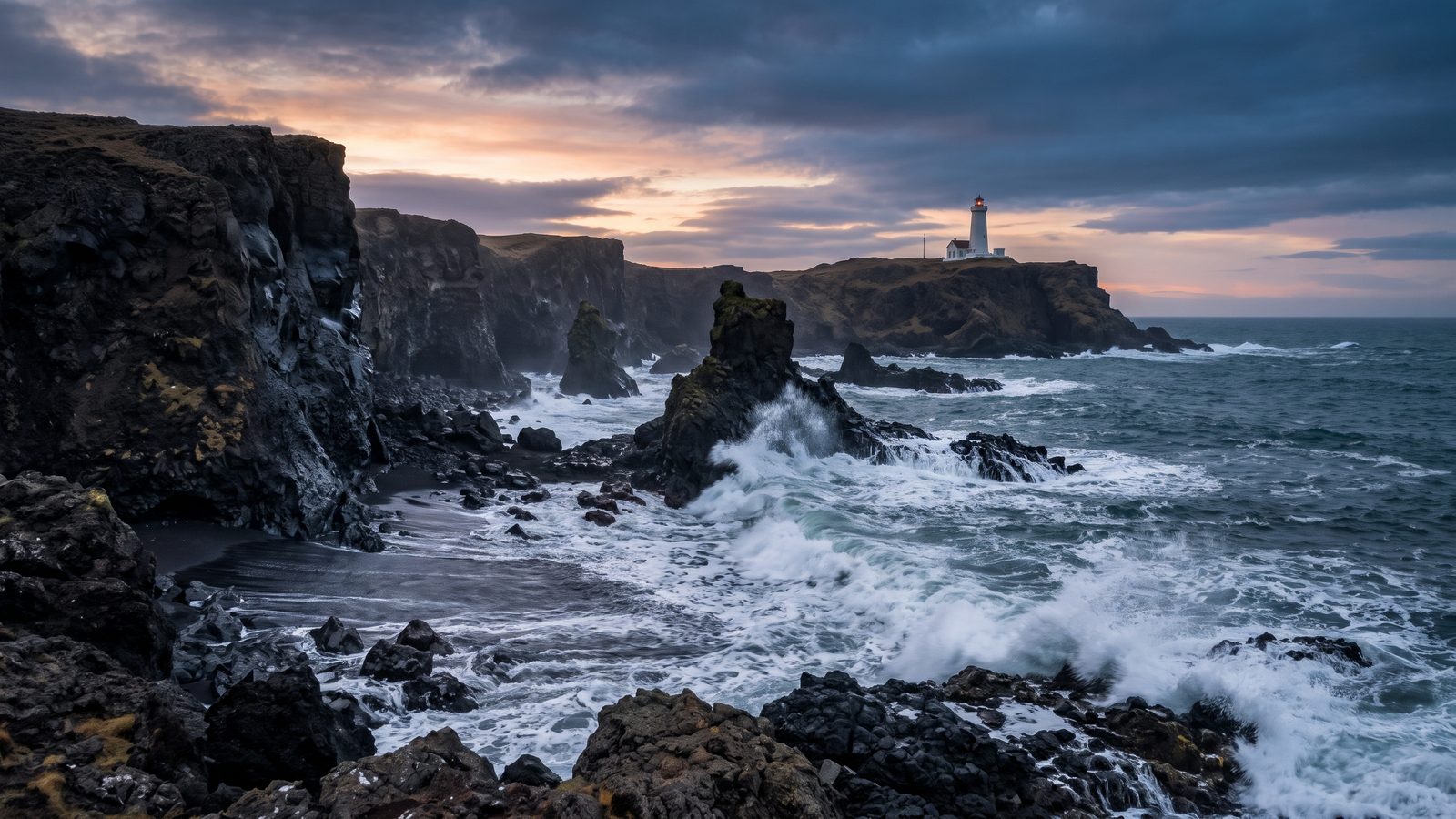
Welcome to Valahnúkamöl on the Reykjanes Peninsula, where the raw forces of nature collide. As you stand on this ancient shoreline, dark lava formations meet the crashing Atlantic Ocean. Listen closely to the roar of churning waves carving rugged basalt cliffs below. Here, along the Mid-Atlantic Ridge, you stand directly on the active boundary where the North American and Eurasian tectonic plates slowly pull apart, creating extraordinary volcanic geology.
Walk along trails above the pounding surf to uncover unique rock structures, smooth volcanic pebbles, and thriving seabird colonies. From dramatic views of Reykjanesviti lighthouse to distant sea stacks like Eldey Island, this self-guided audio tour leads you through one of Iceland's most dynamic coastal spectacles.
Listen to a sample
The opening of this tour, exactly as AllTours narrates it on site.
What you'll hear on this tour
Stop 1. The Exposed Mid-Atlantic Ridge
You stand directly above the Mid-Atlantic Ridge, a vast scar where the North American and Eurasian tectonic plates pull apart. Beneath your feet, molten magma continuously wells up to forge dark tholeiitic basalt. As you gaze at the stratified cliffs, you trace layers of ancient subglacial and submarine eruptions that slowly uplifted above sea level. Observe the rounded pillow lavas, born when molten rock met freezing ocean waters. Even the smooth black pebbles under your shoes are fragments of this volcanic saga, continually polished by Atlantic tides.
Stop 2. Basalt Pillars and Bird Cliffs
Look toward the shoreline to see magnificent hexagonal basalt columns rising from the sea, formed as ancient lava flows rapidly cooled. Further out, pillow lavas reveal an underwater volcanic past, while rounded pebbles, or "möl," line the beach beneath you. As you look up, seabird colonies of kittiwakes and fulmars swirl above towering sea stacks like Karlinn. Their calls echo across the windy headland as they ride the ocean updrafts. Hardy lichens and resilient mosses cling stubbornly to the dark, mineral-rich rocks around you, drawing life directly from the salt spray.
Stop 3. Lighthouses and Solitary Sea Stacks
Look across the cliffs to see Reykjanesviti lighthouse standing stoically on the high ground. As Iceland's oldest lighthouse site, it has guided mariners through treacherous waters since its relocation in 1908. Turn your eyes outward toward the horizon, where Eldey Island rises abruptly from the crashing ocean. This massive, sheer volcanic stack serves as a protected nature reserve and hosts the world's largest gannet colony. As you gaze across the water, you see a flurry of white birds clinging to dizzying cliffs, set against layered rock faces sculpted by thousands of years of volcanic eruptions.
Stop 4. Deep Waters and Dynamic Currents
Stare out at the Atlantic, where the ocean floor drops off dramatically just off the shore. You are looking at a deep underwater environment created by the Mid-Atlantic Ridge. Here, the warm North Atlantic Current merges with arctic waters, bringing nutrient-rich upwellings that sustain massive schools of cod, pollock, and haddock. This rich marine life has supported Icelandic fishermen for centuries, but these treacherous waters come with significant danger. Sudden rogue waves and powerful currents have claimed many vessels over time, leaving silent shipwrecks buried on the deep seabed beneath the waves.
Stop 5. Capturing Raw Volcanic Motion
Framing your shots here allows you to capture the sheer power of Iceland's coast. Use a wide-angle lens to lead from the textured foreground rocks toward distant sea stacks. If you want to freeze explosive spray, set a fast shutter speed to highlight crystal wave drops against dark basalt. To turn the ocean into a silky mist, try a long exposure that softens the movement while holding the rock formations still. Pay attention to light playing across polished volcanic pebbles at golden hour, and protect your camera lens from persistent ocean spray with a cover.
Stop 6. Navigating Trails Along the Shore
Follow the marked path as it climbs gently toward Reykjanesviti lighthouse. You walk over hardened lava flows, feeling volcanic gravel crunch beneath your boots before stepping onto smooth basalt boulders near the surf. As you round exposed headlands, feel the sudden ocean gusts and keep a steady footing on the rugged ground. You can explore smaller paths winding down to hidden tide pools and sculpted rock formations along the water. With every step, you gain sweeping views of churning surf and dramatic cliffs, walking in the footsteps of lightkeepers who once navigated this edge.
Planning your visit
- Best time to go
- Year-round during daylight hours, especially at golden hour or sunset for dramatic photography and lighting.
- Approximate duration
- About 45 to 60 minutes
- Where to start
- Valahnúkamöl coastline parking area near the Reykjanesviti lighthouse on the Reykjanes Peninsula.
Access and conditions change seasonally — check the official site before you go.
Frequently asked questions
Is Valahnúkamöl worth visiting?
Yes, Valahnúkamöl is well worth visiting for its dramatic black basalt cliffs, roaring Atlantic surf, rich birdlife, and clear views of the Mid-Atlantic Ridge meeting the ocean.
How long do you need at Valahnúkamöl?
Most visitors spend between 45 and 60 minutes walking the coastal paths, observing the geological formations, and admiring views of Eldey Island and Reykjanesviti lighthouse.
What is the geological significance of Valahnúkamöl?
Valahnúkamöl sits directly on the active Mid-Atlantic Ridge where the North American and Eurasian tectonic plates pull apart, featuring pillow lavas, tholeiitic basalt cliffs, columnar jointing, and wave-smoothed pebbles.
Keep exploring
Header image is an AI-generated illustration of Valahnúkamöl. AllTours.ai is an AI audio tour guide — point your camera at any landmark and hear its story.