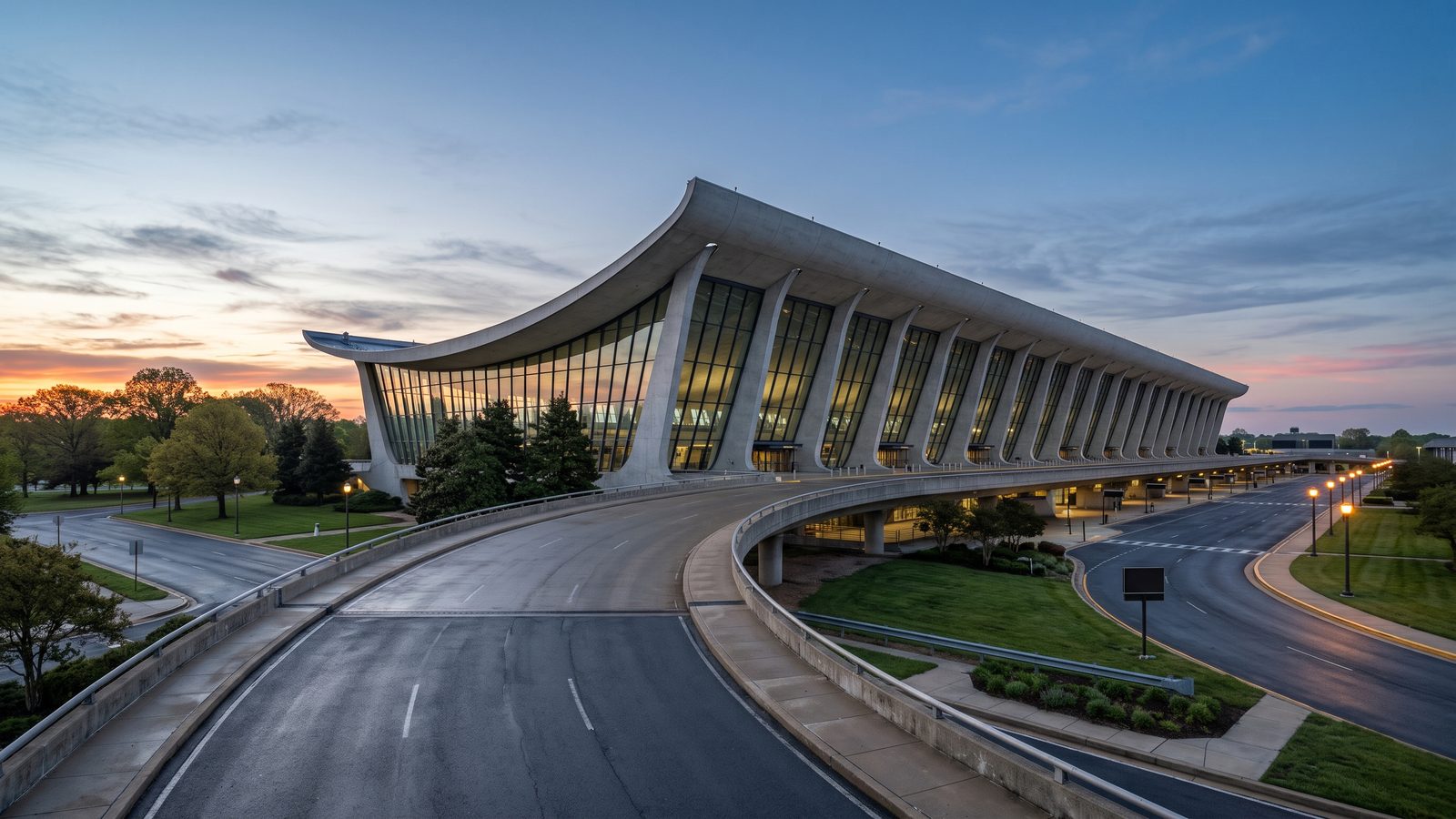
Welcome to Washington Dulles International Airport, a masterwork of mid-century modernism designed by legendary architect Eero Saarinen. Opened in 1962 in Dulles, Virginia, this revolutionary hub was built to capture the exhilaration of the Jet Age. From its soaring, upward-curving concrete terminal roof to its pioneering mobile lounge transit system, Dulles transformed the passenger experience into a grand, uplifting journey through space and light.
This self-guided audio tour walks you through the history, design, and modern operations of one of America's premier international gateways. You will explore the dramatic arrivals and departures halls, learn about supersonic Concorde flights, and see how Saarinen's masterpiece continues to connect the world today.
Listen to a sample
The opening of this tour, exactly as AllTours narrates it on site.
What you'll hear on this tour
Stop 1. Saarinen's Cathedral of the Air
You stand before Eero Saarinen’s iconic main terminal, a mid-century modern masterpiece opened in 1962. Take in the sweeping concrete roof, seemingly suspended in mid-air to evoke the grace of an aircraft in motion. Saarinen designed this grand gateway to give you an uplifting architectural experience rather than a mere utilitarian space. Beneath the dramatic concrete piers, you feel the vast scale and elegant simplicity of his vision. Instead of traditional gate concourses, Dulles pioneered revolutionary Mobile Lounges, nicknamed 'moon buggies.' These unique people movers carry you directly between the terminal and your plane, minimizing walking while maximizing efficiency for the Jet Age.
Stop 2. The Soaring Check-In Hall
As you pivot your gaze towards Departures, you experience the architectural poetry Saarinen poured into this space. The soaring concrete shell creates an unencumbered volume, guiding your eyes naturally towards immense glass walls and distant horizons. Look at the open check-in islands placed beneath the grand canopy, designed to offer an accessible, seamless experience that contrasts sharply with the cramped airport counters of earlier eras. Soft light filters down through skylights, casting a gentle glow over travelers embarking on international adventures. Here in the original heart of Saarinen’s vision, you stand at a symbolic threshold where destinations across continents beckon.
Stop 3. Natural Light and Welcoming Halls
Step into the vast Arrivals hall, where Saarinen’s design envelops you in a sense of welcome and ease. Overhead, the soaring concrete shell roof floats effortlessly, allowing natural light to cascade onto the expansive baggage claim area below. This spacious environment provides psychological comfort, meticulously planned to soothe fatigue after a long flight. Listen to the rhythmic whir of baggage carousels that connect global journeys. Whether you arrive via the AeroTrain or a Mobile Lounge, the intuitive layout guides you smoothly towards ground transportation, demonstrating how Dulles blends aesthetic beauty with pioneering passenger comfort.
Stop 4. Supersonic History and Runway Ballet
Look toward the active runways, where a constant ballet of international connections unfolds daily. Dulles serves as a critical launchpad for diplomatic missions, vital commerce, and global travel. In the past, this airport stood out as one of the exclusive North American destinations for the supersonic Concorde. Today, you can spot the massive tails of Boeing 747s, Airbus A380s, and sleek Dreamliners preparing for long-haul journeys. Air traffic controllers guide hundreds of aircraft through busy airspace every hour, managing flights that connect you to capitals across Europe, Asia, Africa, and South America.
Stop 5. Evolving Vigilance in Aviation Safety
Delve into the security operations that safeguard every journey through Dulles. Following the events of 9/11, this international hub transformed its protocols, becoming a key frontline in national defense. As you pass through, you experience a meticulously engineered system where dedicated TSA teams work around the clock using advanced imaging technology, explosive trace detection, and highly trained canine units. Notice how Saarinen’s original 1962 layout was thoughtfully adapted to integrate these robust modern checkpoints without sacrificing the terminal’s aesthetic flow, ensuring an invisible matrix of vigilance protects every bag and passenger.
Stop 6. Mobile Lounges and Human Connections
Witness the pulse of global movement where cultures converge and personal odysseys unfold daily. At Dulles, the signature mobile lounges serve as far more than simple transport; they create a seamless, futuristic extension of your flight experience between the main terminal and your aircraft. You stand at a crucial nexus where diplomatic missions depart, long-separated families reunite, and international travelers begin exciting new chapters. Every gate acts as an inviting doorway to human connection, illustrating how Saarinen's grand architectural vision continues to orchestrate the continuous, vibrant rhythm of global arrivals and departures.
Planning your visit
- Best time to go
- Daylight hours offer the finest natural illumination through the main terminal's grand glass curtain walls.
- Approximate duration
- about 45 minutes
- Where to start
- Main Terminal, Upper Level Departures Hall
Access and conditions change seasonally — check the official site before you go.
Frequently asked questions
Is Washington Dulles International Airport worth visiting?
Yes, especially for architecture and aviation enthusiasts. Designed by Eero Saarinen and opened in 1962, the main terminal is a mid-century modern landmark featuring a sweeping concrete roof and unique mobile lounges.
How long do you need at Washington Dulles International Airport?
A self-guided tour focusing on the architectural features of the main terminal takes about 45 minutes, making it an ideal layover or pre-flight activity.
Who designed Washington Dulles International Airport and when did it open?
The airport was designed by renowned architect Eero Saarinen, named after Secretary of State John Foster Dulles, and officially opened in 1962.
Keep exploring
Header image is an AI-generated illustration of Washington Dulles International Airport. AllTours.ai is an AI audio tour guide — point your camera at any landmark and hear its story.