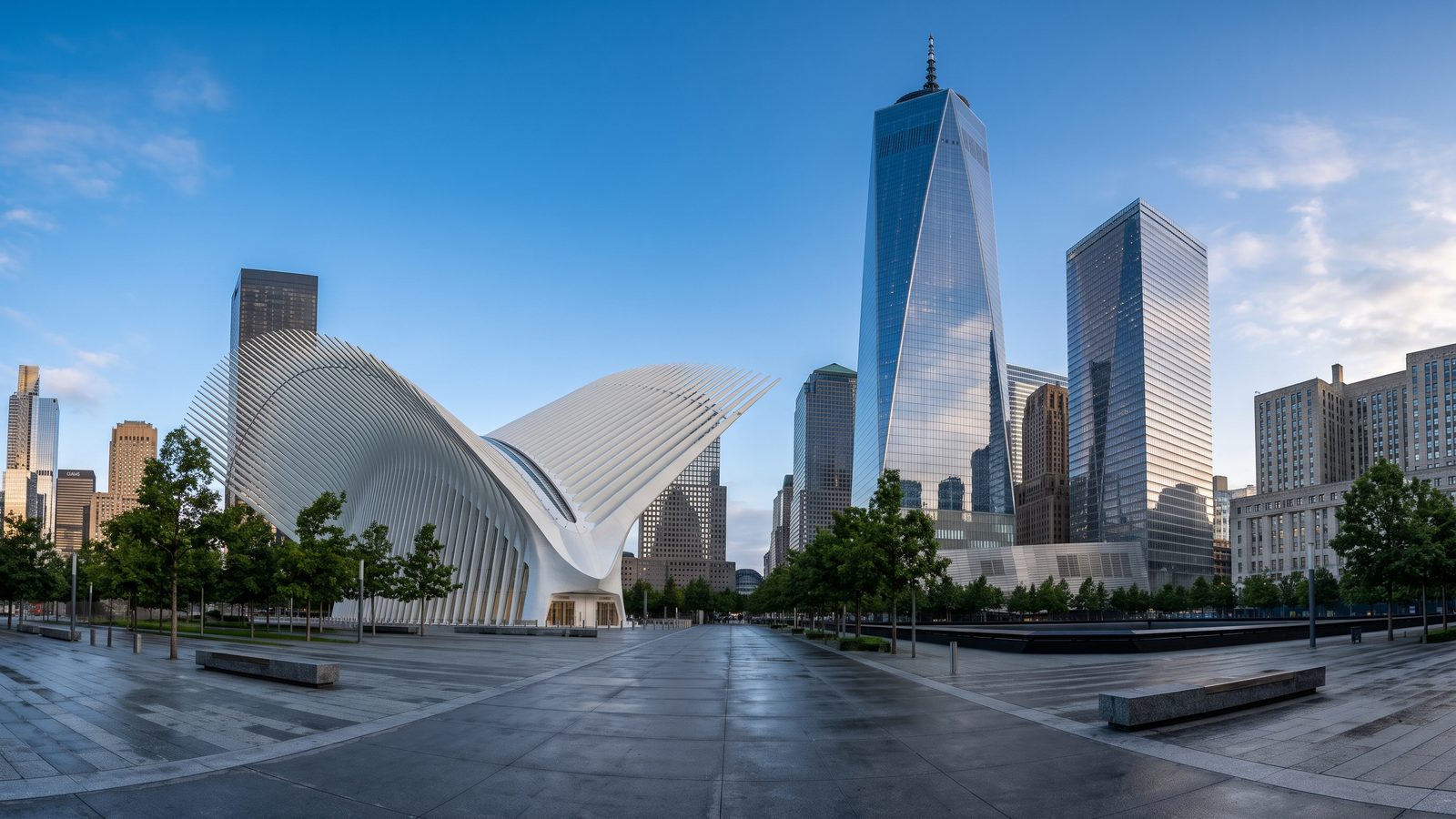
Welcome to the World Trade Center, a place where history, grief, and triumphant architecture converge in Lower Manhattan. As you step onto this sacred yet forward-looking ground, you stand in the shadow of One World Trade Center and beside the solemn 9/11 Memorial Pools. This self-guided audio tour leads you through stories of vision, tragic loss, and unprecedented urban rebirth, revealing how a city healed while shaping a bold future.
You will explore dramatic designs like Santiago Calatrava's Oculus, discover resilient artwork like The Sphere, and reflect upon the deep history etched into every corner. Take your time, walk at your own pace, and immerse yourself in the powerful narrative of America's most poignant cityscape.
What you'll hear on this tour
Stop 1. Reflecting Absence and Enduring Hope
As you step toward the heart of the site, you encounter the 9/11 Memorial, designed by Michael Arad. You stand beside two massive sunken reflecting pools built precisely within the original Twin Towers' footprints. Waterfalls cascade into central voids, muffling the urban hum to create a quiet sanctuary. Along the bronze perimeters, you trace the 2,983 etched names of victims from the 2001 and 1993 attacks, grouped by meaningful adjacencies of shared work, family, or final moments. Nearby, you discover the Survivor Tree, a resilient Callery pear pulled from the wreckage and restored to health. It now thrives with vibrant green leaves, symbolizing life's triumph over devastation.
Stop 2. Soaring Steel and Prismatic Glass
Look up at One World Trade Center, where architect David Childs masterfully blends extreme security with graceful design. You see its dynamic profile twisting from an octagonal base up into a square, then back to an octagon, balancing against high winds. Its fortified base features prismatic glass fins that shatter light across heavy concrete. Next, turn toward Santiago Calatrava’s Oculus, where soaring white steel ribs evoke a bird taking flight. As you step inside its vast, white concourse, natural light pours through the central skylight, transforming a busy transportation hub into a luminous public space where structural innovation meets deep emotional purpose.
Stop 3. Scarred Bronze and Underground Light
As you walk through Liberty Park, you discover "The Sphere," a massive bronze sculpture by Fritz Koenig. Originally positioned between the Twin Towers as a symbol of global peace through trade, it survived 9/11 with severe scars. Left intentionally damaged, it stands today as a poignant, unofficial memorial. Within the Oculus, Calatrava’s architecture acts as living sculpture, casting changing shadows across the white ribbing throughout the day. Below ground in the PATH concourses, artwork like Spencer Finch's "Sky Memory" uses shifting blue panels to evoke the morning sky above. You feel art woven into every corner, transforming memory into quiet contemplation.
Stop 4. From Visionary Towers to Reborn Ground
You stand on ground with a dramatic, multi-layered past. In the 1960s, David Rockefeller envisioned a world trade complex to revitalize Lower Manhattan. Minoru Yamasaki designed the original Twin Towers, completed by 1973 as global economic icons. Tragic history reshaped this space, beginning with the 1993 bombing and culminating in the catastrophic events of September 11, 2001. You feel the profound grief of that day, which forever altered the skyline and the nation. Yet out of unimaginable destruction emerged an unwavering resolve to rebuild. The transformed complex around you tells a continuous narrative of loss, remembrance, and remarkable resilience.
Stop 5. A Global Culinary Tapestry
As you explore the district, you experience a dynamic culinary transformation. The original North Tower once hosted Windows on the World, a legendary restaurant offering aspirational dining with sweeping views. Today, you find a vibrant new gastronomic scene catering to every palate. Inside the Oculus, you can grab quick gourmet bites, or visit Eataly Downtown, an Italian marketplace where artisanal cheeses and fresh pastas create a rich cultural journey. For elevated dining, look up toward restaurants like Manhatta on the 60th floor, where sophisticated menus match panoramic vistas. Every meal here reflects New York's enduring appetite for culinary innovation.
Stop 6. Manhattan Grid and Historic Harbor
From your position in Lower Manhattan, you gaze out across a dramatic urban landscape. You trace the precise grid of the 1811 Commissioners' Plan, which imposed orderly streets over wild terrain. To the west flows the Hudson River, an ancient maritime highway that carried generations of commerce and immigrants to New York. Looking east, you see the Brooklyn Bridge spanning the East River, its 19th-century steel cables linking two vibrant boroughs. To the south, the Statue of Liberty guards the Atlantic harbor, holding her torch high. Every vantage point reveals New York's evolving skyline and indomitable spirit.
Planning your visit
- Best time to go
- Early morning on a weekday for quieter contemplation at the memorial pools, or late afternoon to see the glass towers catch the sunset.
- Approximate duration
- About 2 hours
- Where to start
- Begin at the 9/11 Memorial Plaza near the intersection of Greenwich Street and Liberty Street.
Access and conditions change seasonally — check the official site before you go.
Frequently asked questions
Is the World Trade Center worth visiting?
Yes, visiting the World Trade Center offers a deeply moving mix of historic remembrance, modern architectural innovation, and rich cultural experiences, making it essential for anyone exploring Lower Manhattan.
How long do you need at the World Trade Center?
Most visitors spend between 1.5 to 3 hours exploring the outdoor 9/11 Memorial pools, viewing One World Trade Center, walking through the Oculus, and reflecting at Liberty Park.
What is the history of the World Trade Center site?
Originally envisioned in the 1960s by David Rockefeller and designed by Minoru Yamasaki, the Twin Towers opened in 1973. Following the tragic attacks of 9/11, the site underwent a massive rebuilding effort, creating today's complex with One World Trade Center, the Oculus, and the 9/11 Memorial.
Keep exploring
Header image is an AI-generated illustration of World Trade Center. AllTours.ai is an AI audio tour guide — point your camera at any landmark and hear its story.