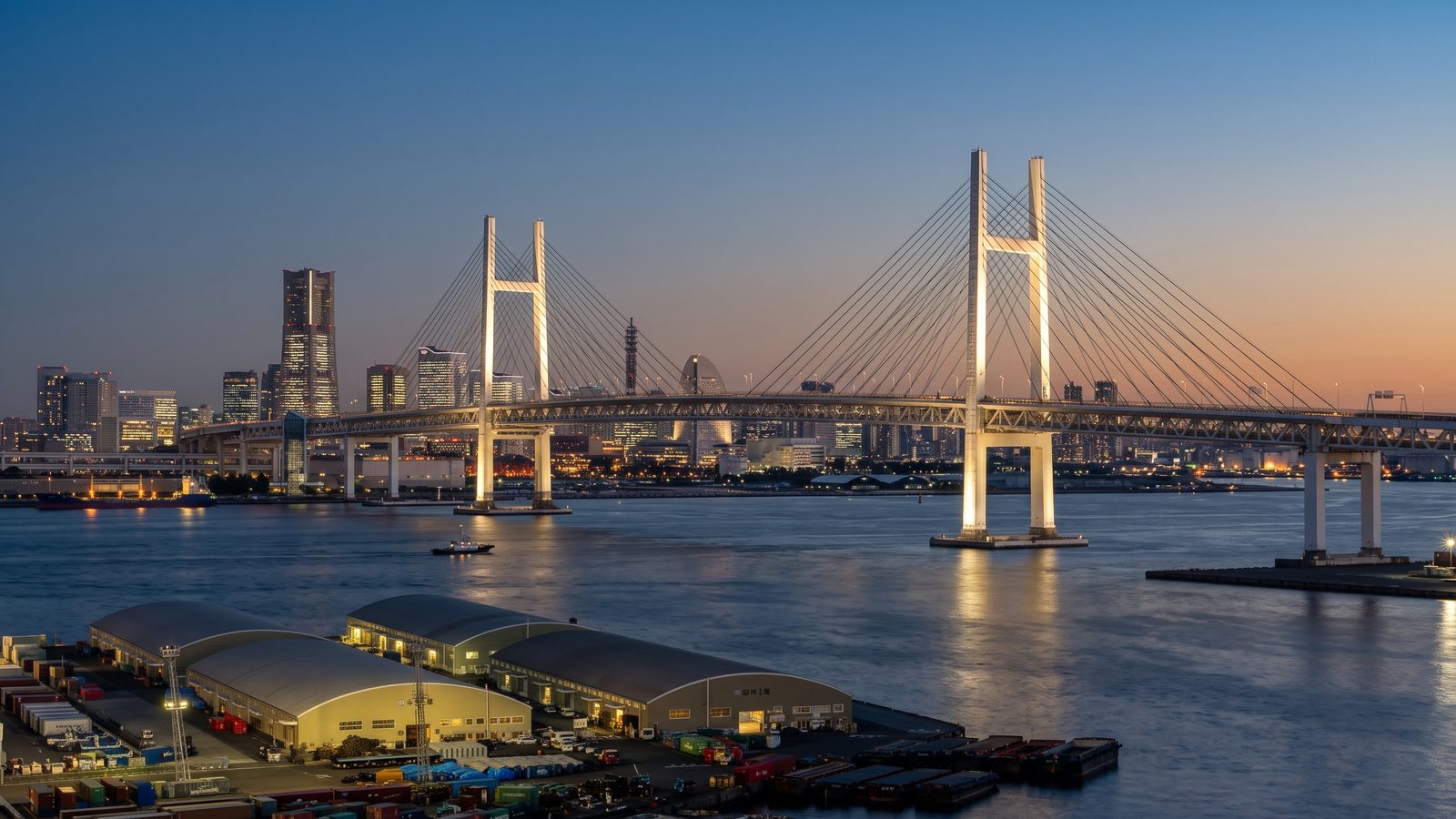
Welcome to Yokohama Bay Bridge, a breathtaking engineering masterpiece spanning Yokohama Port. As you explore this towering cable-stayed landmark, you will uncover the remarkable story behind its construction, its vital role in Japan's transportation network, and the architectural brilliance that allows it to withstand severe earthquakes and typhoons. Prepare to admire stunning coastal panoramas, from the futuristic Minato Mirai 21 skyline to Mount Fuji on clear days.
This self-guided audio tour allows you to experience the bridge at your own pace. Discover secret viewing spots, learn about the majestic cruise ships passing beneath its massive span, and appreciate the innovative design that makes this glowing structure an enduring symbol of modern Japanese infrastructure.
What you'll hear on this tour
Stop 1. Panoramic Splendor Across Yokohama Port
As you step onto the Skywalk, the sweeping expanse of Yokohama Bay captivates your senses with an unprecedented panoramic view. Look north to admire the futuristic Minato Mirai 21 skyline, dominated by the shimmering Landmark Tower. Below you, cargo ships and cruise liners gracefully execute their continuous maritime ballet through the bustling harbor. On exceptionally clear days, you look westward to spot the magnificent silhouette of Mount Fuji rising quietly behind the urban landscape. As dusk settles over the water, millions of city lights ignite across the bay, turning the entire vista into a glowing tapestry while the illuminated bridge appears to float serenely among the stars.
Stop 2. The Elegance of Cable-Stayed Engineering
Look up to take in the impressive architectural mastery of this cable-stayed landmark. You notice majestic white twin pylons soaring 172 meters into the sky, shaped as inverted Ys to distribute deck loads while creating an airy visual silhouette. A delicate web of 360 high-tensile steel cables stretches outward in a modified harp pattern, transferring immense weight straight into the main supports. Beneath the roadway, you observe a double-deck system housed inside an aerodynamic box girder, expertly separating expressway traffic on top from lower transit corridors. This seamless union of advanced industrial engineering and visual grace defines the bridge's unforgettable identity along the Yokohama waterfront.
Stop 3. Seismic Genius and Typhoon Resilience
Look closely at the hidden structural mechanics that make this massive bridge virtually indestructible. Deep beneath your feet, massive seismic isolation bearings featuring multi-directional friction pendulum systems allow the structure to slide smoothly, absorbing violent earthquake forces before they stress the main deck. Inside the high pylons, heavy tuned mass dampers gently sway to counteract fierce wind vibrations from coastal typhoons. You can appreciate the precision required during construction, when giant pre-fabricated steel deck segments were floated into position by specialized cranes and secured with automated welding. Today, delicate internal sensors continuously monitor cable tension with sub-millimeter accuracy, maintaining a balanced symphony of forces.
Stop 4. Capturing Dynamic Lines and Twilight Glow
Position your camera to capture this dynamic architectural masterpiece from its finest angles. During the blue hour, you watch the bridge's bright illumination glow softly against deep indigo skies. From Daikokufuto Pier, you can frame the tall white pylons and harp-like steel cable patterns to emphasize both grand scale and fine symmetry. Moving across to Osanbashi International Passenger Terminal, you capture sweeping wide shots combining the dynamic city skyline with ocean traffic, occasionally photographing grand cruise liners sailing beneath the central span. Set up your tripod for long exposures to turn passing vehicle headlights into continuous streams of light across the night sky.
Stop 5. Yokohama's Grand Gateway for Ocean Liners
Turn your attention to the tranquil waters flowing beneath the central span, where the bridge acts as Yokohama's grand maritime entrance. As you imagine standing on the deck of an international ocean liner arriving at Osanbashi Pier or Daikoku Pier Cruise Terminal, the giant structure marks your entry into Japan. You experience a humbling sensation of immense scale as massive passenger ships glide directly beneath the elevated roadway with only meters to spare. From night cruise boats on the calm bay, you look up to watch the entire bridge radiate light across dark waters, creating an unforgettable memory of this famous port city.
Stop 6. Solving a Post-War Logistics Crisis
Reflect on how this immense structure arose from Japan's dramatic post-war economic expansion during the late 1970s. You learn that Yokohama's bustling port faced overwhelming traffic congestion as international shipping and domestic freight rapidly expanded. To solve this critical transport bottleneck, ambitious planning began in 1980 to build an audacious water crossing over one of the world's busiest maritime channels. Japanese engineers overcome severe historical challenges, navigating complex seismic risks and treacherous ocean currents through pioneering construction methods. When the bridge officially opens in 1989, it fundamentally transforms the transportation network across the entire Kanto region, marking a historic leap in modern infrastructure.
Planning your visit
- Best time to go
- Late afternoon through blue hour for clear views of Mount Fuji followed by dramatic night illumination.
- Approximate duration
- About 1 hour
- Where to start
- Daikokufuto Pier viewing area or Osanbashi International Passenger Terminal.
Access and conditions change seasonally — check the official site before you go.
Frequently asked questions
Is Yokohama Bay Bridge worth visiting?
Yes, Yokohama Bay Bridge is worth visiting for its striking cable-stayed architecture, panoramic views of Minato Mirai and Mount Fuji, and spectacular night illumination.
How long do you need at Yokohama Bay Bridge?
You need about 1 hour to enjoy the views, walk near scenic vantage points like Daikokufuto Pier or Osanbashi Terminal, and take photos.
When was Yokohama Bay Bridge built?
Construction began in 1980 to relieve severe post-war port congestion, and the bridge officially opened in 1989.
Keep exploring
Header image is an AI-generated illustration of Yokohama Bay Bridge. AllTours.ai is an AI audio tour guide — point your camera at any landmark and hear its story.