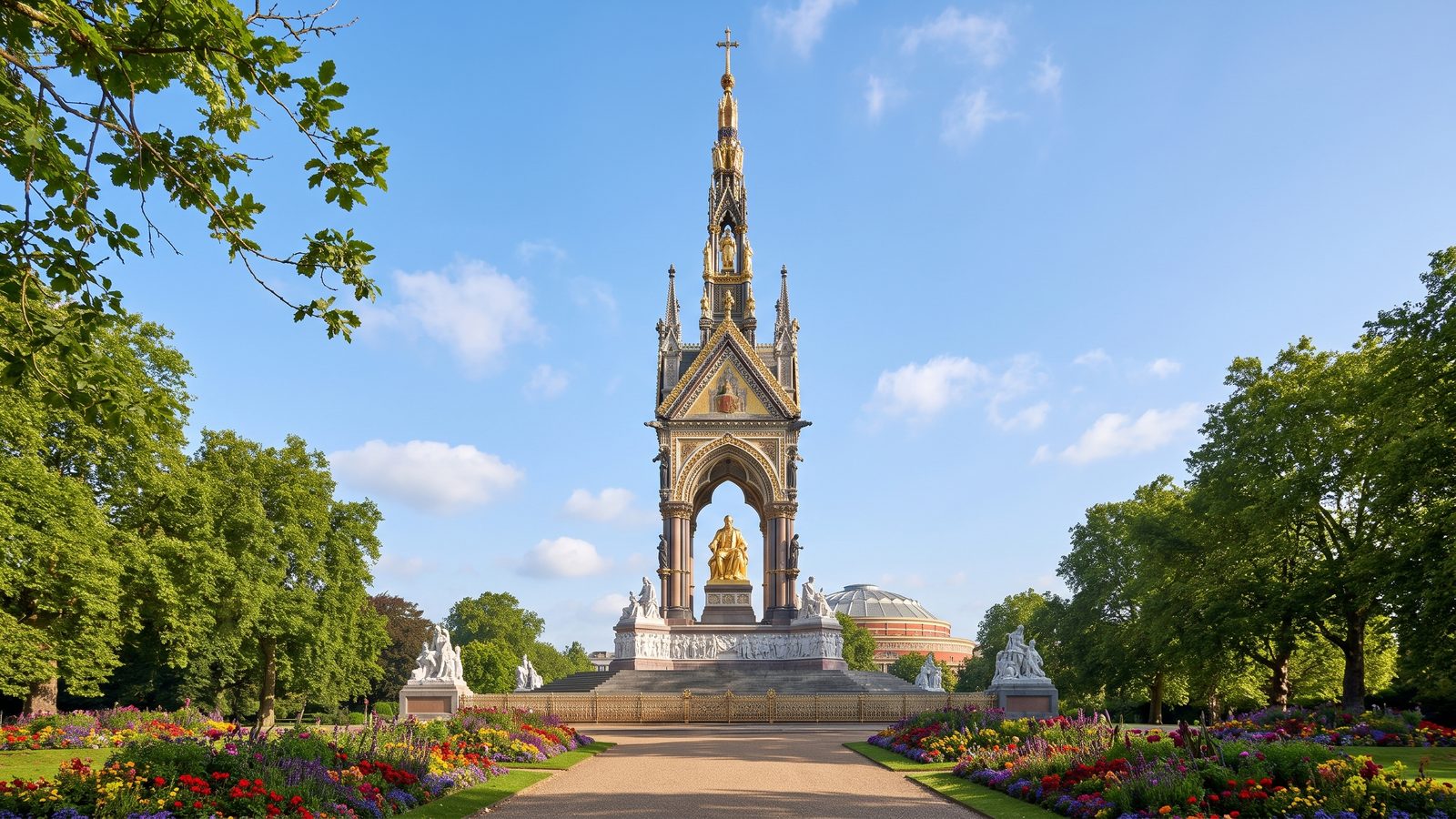
You stand before one of London's most opulent monuments: the Albert Memorial in Kensington Gardens. Commissioned by a heartbroken Queen Victoria after Prince Albert’s sudden death in 1861, this colossal High Victorian Gothic monument celebrates his devotion to art, science, and public service. As you explore its shimmering canopy and detailed reliefs, you will discover a profound story of royal grief, artistic ambition, and nineteenth-century imperial pride.
This self-guided audio tour leads you around the monument's intricate base, colossal allegorical statues, and lush parkland settings. Learn how architect Sir George Gilbert Scott transformed grieving love into a breathtaking shrine that continues to command attention in the heart of London.
What you'll hear on this tour
Stop 1. Grief Carved in Golden Stone
You trace the genesis of this monument back to December 1861, when Prince Albert dies of typhoid fever. You feel the depth of Queen Victoria’s heartbreak as she retreats from public life, determined to build an unprecedented tribute to her consort. A public subscription quickly raises the funds, and architect Sir George Gilbert Scott wins the 1863 design competition. As you look up at the main structure, completed between 1864 and 1872, imagine Queen Victoria arriving in a closed carriage to silently watch the construction. The central gilded bronze statue by John Henry Foley finally arrives in 1875, cementing this site as an enduring symbol of Victoria's devotion.
Stop 2. A High Gothic Jewel Box
You look up at a soaring masterpiece of High Victorian Gothic Revival, designed by Sir George Gilbert Scott to evoke the moral grandeur of medieval cathedrals. Notice the canopy’s 175-foot spire, adorned with delicate crockets and finials reaching toward the sky. As you step closer, observe the deliberate polychromy—a striking blend of colored marbles, polished granite columns, and shimmering metals. You see detailed mosaic friezes wrapped around the upper structure, seamlessly blending narrative art directly into the architecture. Rather than a standard monument, you are standing before a colossal reliquary designed to preserve Albert's legacy in stone and metal.
Stop 3. Enthroned in Gilded Splendor
You gaze at the gilded bronze statue of Prince Albert sitting proudly beneath the high canopy. Sculpted by J. H. Foley, he appears in his ceremonial Garter robes, holding the official catalogue of the 1851 Great Exhibition—a tribute to his intellectual patronage. Looking past the central figure, you discover four colossal allegorical groups at the corners, crafted by artists like MacDowell and Theed to represent Europe, Asia, Africa, and America. Above you, vibrant mosaic tesserae form intricate patterns within the canopy ceiling, while high-relief sculptures surround the base, showcasing an extraordinary level of craftsmanship across every artistic medium.
Stop 4. The Great Canon of Human Genius
You walk along the base to admire the Frieze of Parnassus, a continuous band featuring 169 sculpted figures. Here, you spot history’s greatest poets, architects, painters, and musicians, including Homer, Michelangelo, and Shakespeare. This visual curriculum reflects the Victorian belief in continuous cultural progress. Turning toward the outer corners, you examine the four continent statue groups representing Europe, Asia, Africa, and America. These figures illustrate how Victorians viewed their global empire and its engagement with world cultures. As you explore these carvings, you perceive a complete cultural manifesto embodying Albert's passion for elevating the nation through arts, science, and industry.
Stop 5. Royal Myths and Turning Backs
You encounter a favorite London legend as you look at Prince Albert's seated pose. Local tradition jokingly claims he is turning his back on nearby Kensington Palace and his grieving Queen after a royal spat. However, you soon realize the true design: Albert actually gazes directly across the street at the Royal Albert Hall, looking toward the arts center he championed. You can also imagine the monument's early days, when local folklore described the freshly gilded bronze as so bright it dazzled onlookers across the park. Even today, you still catch glimpses of that original, brilliant shimmer on sunny London afternoons.
Stop 6. Framed by Kensington Gardens
You look beyond the base to see how Kensington Gardens forms a deliberate, living frame around the memorial. Notice how the surrounding lawns undulate gently; workers meticulously engineered these sightlines so the towering structure remains framed from every angle. Mature trees act as green sentinels, guiding your eyes directly toward the gilded spire. As you stroll around the perimeter, you notice seasonal flowerbeds bursting with color, reflecting the Victorian passion for horticulture and symbolic floral language. These peaceful parklands provide a quiet sanctuary, allowing you to reflect on the monument’s grandeur while shielded from London’s bustling city noise.
Planning your visit
- Best time to go
- Morning or late afternoon on a clear day, when sunlight makes the gilded statue shimmer.
- Approximate duration
- about 45 minutes
- Where to start
- In Kensington Gardens along Kensington Gore, directly opposite the main entrance of the Royal Albert Hall.
Access and conditions change seasonally — check the official site before you go.
Frequently asked questions
Is Albert Memorial worth visiting?
Yes, the Albert Memorial is one of London's most impressive examples of High Victorian Gothic Revival architecture, featuring 169 carved figures on the Frieze of Parnassus and a iconic gilded statue of Prince Albert.
How long do you need at Albert Memorial?
Most visitors spend about 30 to 45 minutes taking in the detailed base reliefs, allegorical corner sculptures, and the surrounding scenery of Kensington Gardens.
When was the Albert Memorial built and why?
Commissioned by Queen Victoria following Prince Albert's death in 1861, construction ran from 1864 to 1872, with the main gilded statue installed beneath the canopy in 1875.
Keep exploring
Header image is an AI-generated illustration of Albert Memorial. AllTours.ai is an AI audio tour guide — point your camera at any landmark and hear its story.