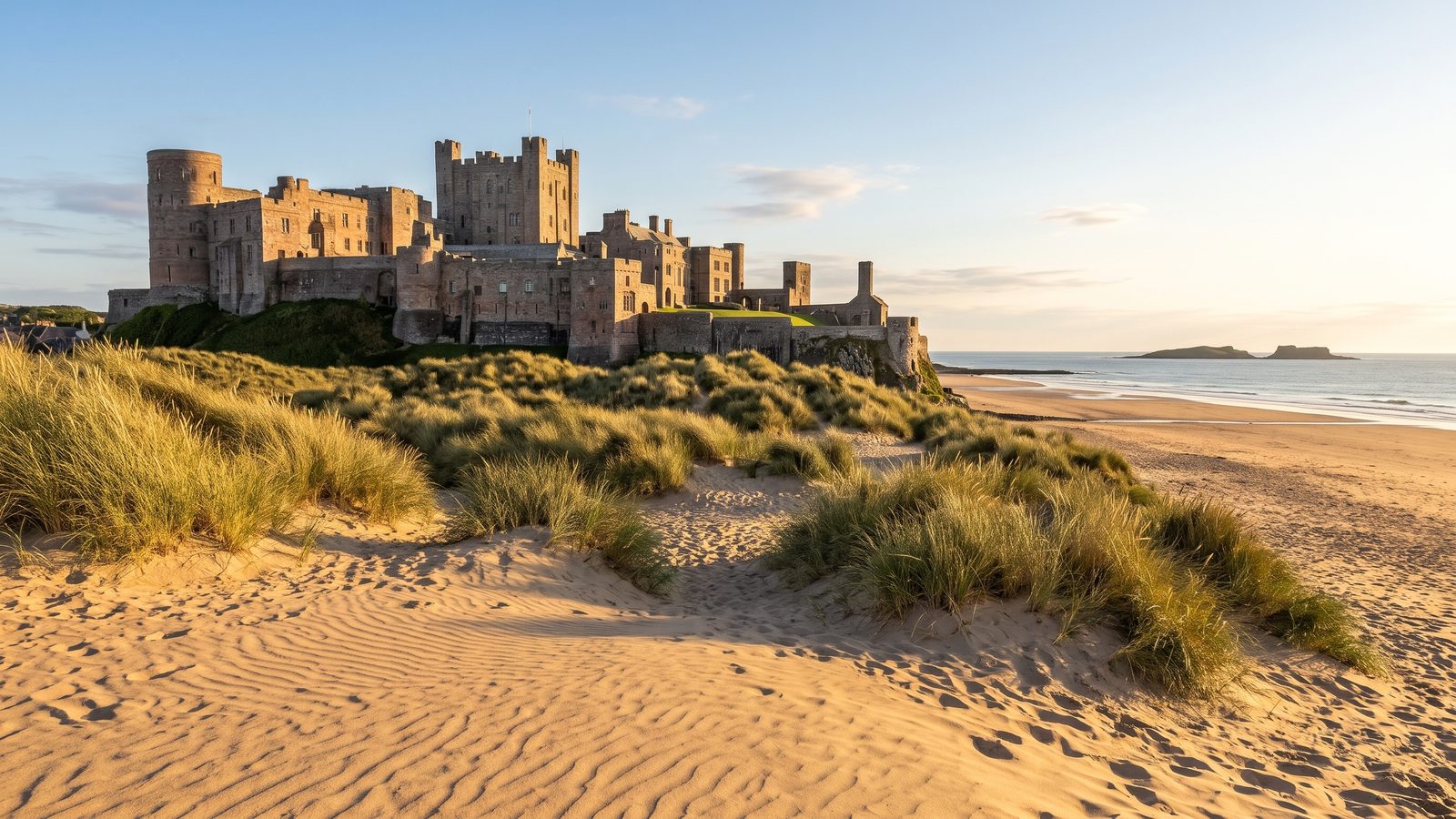
Perched dramatically upon a high volcanic crag above the wild North Sea, Bamburgh Castle stands as one of Britain's most spectacular historic strongholds. For over 1,400 years, this towering fortress served as a seat of power, evolving from an Anglo-Saxon royal capital into a formidable Norman bastion. As you walk its ancient grounds, you tread where kings, saints, and warriors once shaped the turbulent destiny of early England.
Famous as the real-life Bebbanburg from Bernard Cornwell's 'The Last Kingdom,' Bamburgh combines deep history with sweeping coastal vistas. This self-guided audio tour leads you through towering stone keeps, defensive battlements, and centuries of architecture, bringing Northumbria's ancient heritage vividly to life at your own pace.
Listen to a sample
The opening of this tour, exactly as AllTours narrates it on site.
What you'll hear on this tour
Stop 1. The Iconic Seat of Bebbanburg
You stand before a colossal fortress perched upon a sheer volcanic crag, gazing out across the wild North Sea. This is Bebbanburg, the ancient Anglo-Saxon capital of Northumbria and the legendary inspiration for Bernard Cornwell's 'The Last Kingdom.' For over 1,400 years, this site commands power over the coastline. As you take in its immense scale, feel the weight of centuries pressing against the stone. From early royal rulers to starring roles in modern films, Bamburgh's dramatic profile captures the imagination. You are stepping directly into a living epic, where nature and human history collide on an grand scale.
Stop 2. An Impregnable Rock and Gunpowder War
Look down at the dark, natural dolerite outcrop beneath your feet. This volcanic foundation provides a virtually insurmountable defense, supporting massive eleven-foot-thick walls and corner turrets built to withstand fierce sieges. Notice how arrow slits throughout the fortress were later adapted into gun loops as military technology evolved. During the Wars of the Roses, Bamburgh earned a grim place in history by becoming the first castle in England to fall to gunpowder artillery. Yet despite the devastating destruction of cannon fire, this defiant bastion rose again, maintaining its iron grip over the surrounding land and sea for generations.
Stop 3. From Ancient Celtic Fort to Norman Keep
You are walking on ground that has witnessed millennia of human conflict and power. Before stone walls existed, Celtic tribes fortified this rock as Din Guardi. In the 6th century, the Angle king Ida established the kingdom of Bernicia here, and his grandson Æthelfrith named it Bebbanburgh after his wife, Bebba. It grew into a thriving capital that once housed the sacred Lindisfarne Gospels before Viking longships repeatedly raided these shores. Look up at the mighty stone keep before you; it was William the Conqueror's half-brother, Robert de Mowbray, who began constructing this Norman stronghold, transforming the ruined wooden capital into an enduring royal bastion.
Stop 4. Coastal Views, Holy Island, and Heroines
Step onto the high battlements and gaze out across the sweeping panorama. To the east, the vast North Sea unfolds, once scanned constantly by sentries watching for treacherous Viking sails. Looking out to sea, you can spot the distant Farne Islands, where Grace Darling performed her famed 1838 rescue of shipwrecked sailors. Turning your eyes northward, the sacred outline of Holy Island, Lindisfarne, rises above the water, revealing its isolated position as both a cradle of Christianity and a target for Norse raiders. In every direction, these ocean vistas and rolling countryside tell dramatic stories of England’s coastal history.
Stop 5. Whin Sill Stone and Victorian Ingenuity
Examine the formidable stone of the Norman Keep, rising nearly sixty feet above the volcanic Whin Sill bedrock. Constructed from incredibly tough dolerite, its dark walls showcase characteristic rounded Romanesque arches that blend brute defensive power with medieval elegance. As you explore further, you observe how later medieval curtain walls created concentric defenses to trap invaders. In the Victorian era, Lord Armstrong restored the castle, pioneering a remarkable fusion of ancient preservation and modern engineering. He seamlessly integrated advanced water systems and central heating directly into these medieval structures, crafting a unique architectural masterpiece that spans nearly a thousand years.
Stop 6. Anglo-Saxon Kings and Hidden Treasures
Immerse yourself in the profound heritage of early England. This very site formed the heart of Northumbria, where powerful monarchs like Saint Oswald held court and helped establish Christianity across the land. Beneath these stones, ongoing archaeological excavations continue to unearth astounding artifacts from a sophisticated Anglo-Saxon culture. Discoveries like the famous Bamburgh Sword and ancient royal burials reveal that long before the Normans built their heavy keep, a golden age flourished here. As you walk through these courtyards, you are walking in the footsteps of ancient kings whose legacy remains etched into the fabric of the castle.
Planning your visit
- Best time to go
- Morning or early afternoon for optimal coastal light and clearer views across to Holy Island and the Farne Islands.
- Approximate duration
- about 2 hours
- Where to start
- Begin at the main castle entrance gate at the foot of the volcanic crag.
Access and conditions change seasonally — check the official site before you go.
Frequently asked questions
Is Bamburgh Castle worth visiting?
Yes, Bamburgh Castle is widely considered one of the most magnificent coastal fortresses in Britain. Perched on a volcanic crag overlooking golden beaches and the North Sea, it offers over 1,400 years of rich history, striking architecture, and breathtaking panoramic views.
How long do you need at Bamburgh Castle?
Most visitors spend between 2 to 3 hours exploring the castle grounds, inner keep, staterooms, and high battlements, as well as taking in the surrounding coastal views.
What is the history of Bamburgh Castle?
Bamburgh Castle originated as an ancient Celtic fort before becoming the 6th-century Anglo-Saxon capital of Northumbria, known as Bebbanburg. Rebuilt as a stone fortress by the Normans, it endured centuries of border conflicts and sieges before being restored in the Victorian era by Lord Armstrong.
Keep exploring
Header image is an AI-generated illustration of Bamburgh Castle. AllTours.ai is an AI audio tour guide — point your camera at any landmark and hear its story.