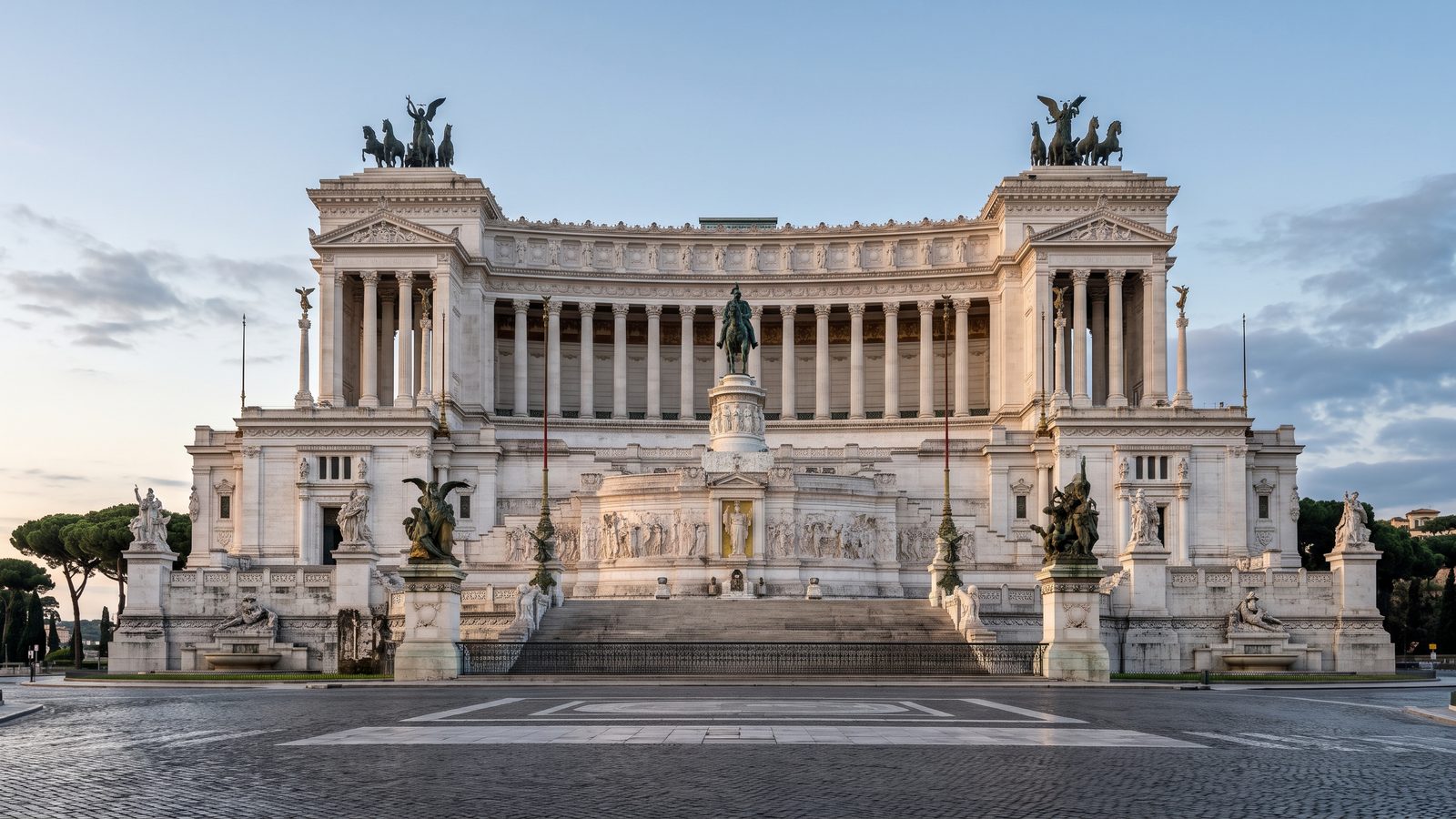
Welcome to the Altare della Patria, Rome's monumental tribute to a unified Italy and its first monarch, Victor Emmanuel II. Dominating Piazza Venezia, this breathtaking neoclassical landmark soars 81 meters above the city. As you ascend its grand staircases, you encounter centuries of history carved into luminous Botticino marble. From solemn national memorials to dramatic bronze statues, the site stands as a powerful symbol of national identity.
This self-guided audio tour leads you through the landmark's architectural highlights, magnificent sculptures, and rich history. You will explore the sacred Tomb of the Unknown Soldier and finish with panoramic views overlooking ancient forums, iconic domes, and the sprawling rooftops of the Eternal City.
Listen to a sample
The opening of this tour, exactly as AllTours narrates it on site.
What you'll hear on this tour
Stop 1. Panoramic Vistas of the Eternal City
You stand at the highest terraces of the Vittoriano, taking in an incredible tapestry of Roman history stretching beneath you. Looking eastward, you see the iconic Colosseum and the vast archaeological grounds of the Roman Forum and Palatine Hill, where ancient emperors once ruled. To your left, you admire Michelangelo’s masterfully designed Piazza del Campidoglio gracing the Capitoline Hill. Following Via dei Fori Imperiali, you spot Trajan’s Column celebrating imperial victories. In the distance, the legendary dome of the Pantheon and the soaring dome of St. Peter’s Basilica rise above Rome’s endless red roofs, providing you with an unforgettable perspective on the city.
Stop 2. Masterpieces in Bronze and Marble
As you explore the monument's façade, you encounter a remarkable array of monumental artwork. Dominating the main axis is Enrico Chiaradia's colossal 50-ton bronze equestrian statue of Victor Emmanuel II. Beneath it, two striking bronze Winged Victories guard the solemn Tomb of the Unknown Soldier. Moving further inside, you face Angelo Zanelli's magnificent gilded bronze Goddess Roma standing watch above the crypt. High above on the propylaea, dramatic bronze quadrigae depict Unity and Freedom, each pulled by four galloping horses. These expressive sculptures combine marble and gilded bronze to narrate Italy's unification through triumphant allegorical imagery.
Stop 3. Imperial Grandeur and Neoclassical Design
You walk along a colossal design conceived by Giuseppe Sacconi, who combined Neoclassical grandeur with classic Roman Imperial influences. You ascend a massive staircase toward an imposing portico lined with sixteen towering Corinthian columns. Above you, the monumental structure features two flanking propylaea crowned with bronze chariots driven by allegorical figures of Patria Unity and Liberty. Decorative sculptural friezes and gilded bronze accents adorn every level, showcasing symbolic figures that represent Italy's varied regions and virtues. As you admire the scale and classical symmetry around you, you experience a bold architectural statement created to celebrate a newly united nation.
Stop 4. A Nation Born from Struggle
You trace the origins of this national shrine back to 1878 following the death of King Victor Emmanuel II. Architect Giuseppe Sacconi won the national design contest in 1885, launching decades of ambitious construction on the Capitoline Hill. Although Sacconi passed away in 1905, building continued, leading to a partial inauguration in 1911 for the 50th anniversary of Italian unification. In 1921, the site acquired a profound new purpose when officials consecrated the Tomb of the Unknown Soldier, honoring fallen troops from World War I. Today, as you walk these grounds, you step through the defining moments of Italy's 19th-century Risorgimento.
Stop 5. The Radiant White Botticino Stone
You notice immediately how the monument glows brightly against Rome’s ancient skyline. Architect Giuseppe Sacconi selected brilliant white Botticino marble from Brescia in Lombardy to clad the entire structure. Chosen to symbolize purity, grandeur, and modern national aspirations after 1861, thousands of cubic meters of stone traveled across Italy to reshape the historic Capitoline Hill. As you touch the smooth columns and examine grand fountains dedicated to the Adriatic and Tyrrhenian Seas, you appreciate the stark visual impact. This uniform, luminous white marble contrasts dramatically with the traditional ochre tones and aged travertine found throughout the rest of Rome.
Stop 6. A Monument to Royal Leadership
You stand before a grand tribute erected to celebrate the Italian monarchy and its pivotal role in national unification. Conceived after the death of Victor Emmanuel II, who served as the first king of unified Italy from 1861 to 1878, the site legitimizes the royal House of Savoy. The center of this tribute features the monarch on horseback, cast in imposing gilded bronze. Throughout the late nineteenth and early twentieth centuries, this massive white structure reinforced royal authority and national pride, serving as an enduring symbol of a kingdom forged through the nineteenth-century Risorgimento movement.
Planning your visit
- Best time to go
- Early morning or late afternoon for gentle sunlight on the white marble and clear views across Rome.
- Approximate duration
- About 1 to 1.5 hours
- Where to start
- Piazza Venezia at the bottom of the grand central staircase.
Access and conditions change seasonally — check the official site before you go.
Frequently asked questions
Is Altare della Patria worth visiting?
Yes, the Altare della Patria is well worth visiting. It offers magnificent Neoclassical architecture, rich national history, and exceptional panoramic views over the Roman Forum and Colosseum.
How long do you need at Altare della Patria?
Most visitors spend about 1 to 1.5 hours exploring the grand staircases, eternal flame, Tomb of the Unknown Soldier, and panoramic terraces.
When was the Altare della Patria built and why?
Construction began in 1885 to honor Victor Emmanuel II, the first king of unified Italy. It was partially inaugurated in 1911 and completed in 1935, incorporating the Tomb of the Unknown Soldier in 1921.
Keep exploring
Header image is an AI-generated illustration of Altare della Patria. AllTours.ai is an AI audio tour guide — point your camera at any landmark and hear its story.