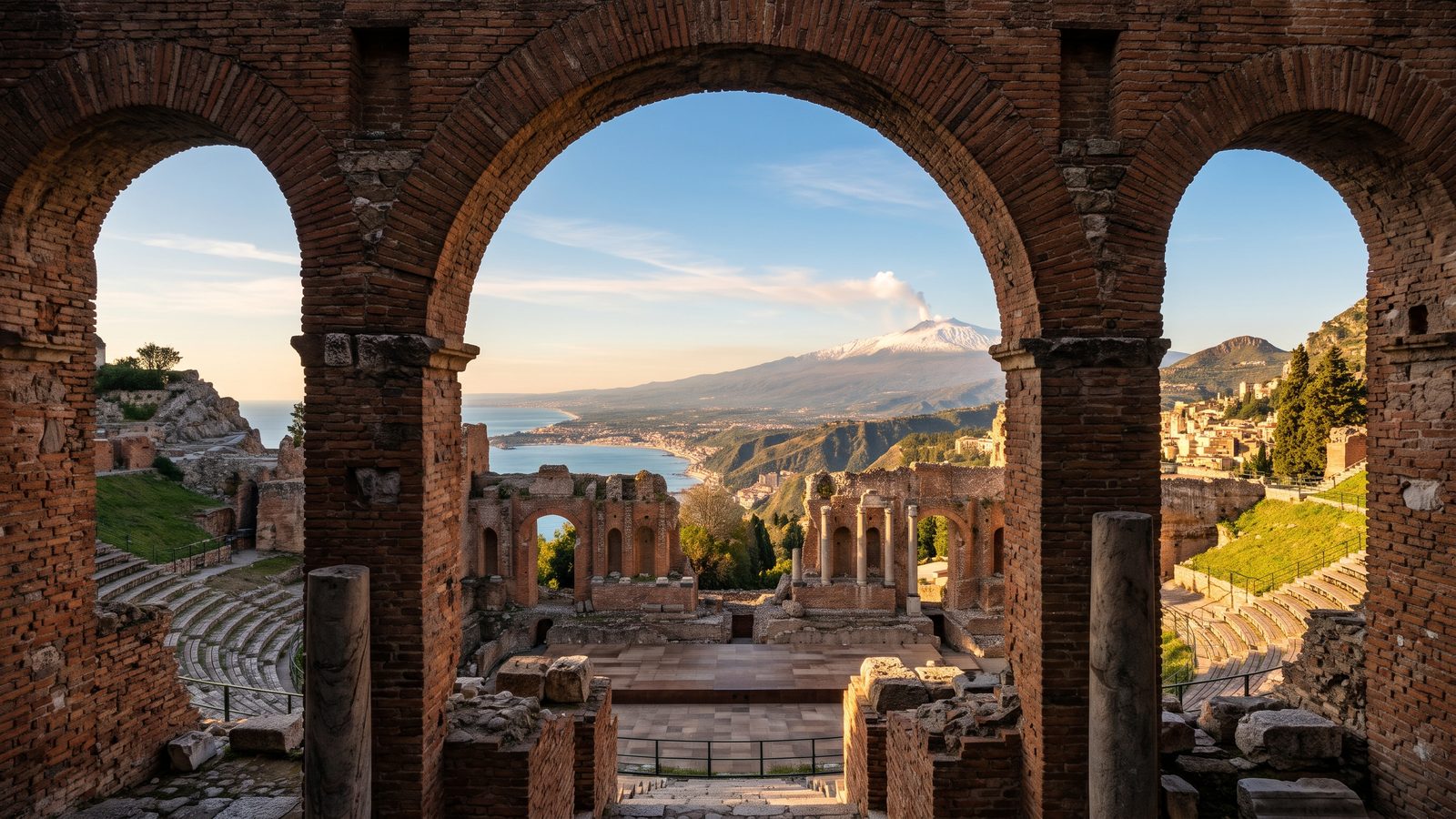
Step into the spectacular ruins of the Ancient Theatre of Taormina, where history meets drama high above the Ionian Sea. Carved directly into the Sicilian mountainside by the Greeks in the 3rd century BC and later expanded by Roman engineers, this ancient venue offers an unmissable journey through centuries of performance, conflict, and engineering brilliance set against the dramatic, smoking backdrop of nearby Mount Etna.
This self-guided audio tour walks you through the magnificent tiers of volcanic stone, detailing how ancient audiences experienced theatrical masterpieces, gladiatorial spectacles, and sweeping Mediterranean vistas. Experience the enduring wonder of one of Italy’s most breathtaking historical treasures at your own pace.
Listen to a sample
The opening of this tour, exactly as AllTours narrates it on site.
What you'll hear on this tour
Stop 1. Centuries of Spectacle and Empire
You stand on ground carved out by Greek craftspeople around the 3rd century BC, where Syracusan citizens once gathered to listen to the tragedy of Sophocles and Euripides. As you look around the tiers, imagine the sheer transformation when Roman conquerors took over. They expand this slope into a massive arena, adapting the Greek design to suit dramatic Roman spectacles, speeches, and gladiatorial clashes. Layer upon layer of history settles into these ancient stones. As you listen closely, you can almost hear the roar of Latin-speaking crowds echo across the centuries, celebrating the triumphs and dramas of an empire that remade this theater into the iconic masterpiece before you today.
Stop 2. Sapphire Waters and Mount Etna
Turn your eyes away from the central stage and gaze out at the sweeping panorama expanding before you. You are looking directly down at the shimmering sapphire surface of the Ionian Sea, a crucial ancient sea highway where traders and conquerors navigated for centuries. Off in the distance, the smoldering peak of Mount Etna stands guard against the sky. Local legends whisper that its fiery eruptions were the anger of a sleeping giant trapped within the earth. Notice how these stone seats curve intentionally to frame this majestic landscape, offering you the very same jaw-dropping vista that mesmerized ancient Greek theatergoers and Roman elites alike.
Stop 3. Masterwork of Roman Engineering
Observe how Roman architects skillfully layered their grand designs directly over the original Greek foundations. You can see the remarkable scale of the central stage, built to host vast public productions. Behind the stage area stands the remaining structure of the scaenae frons, once a multi-storied backdrop decorated with grand statues and towering columns that gave dramatic depth to every play. As you sit upon the preserved stone seats, imagine the hidden corridors, machinery, and backstage chambers functioning beneath your feet. Roman ingenuity transformed a natural hillside into a complex theatrical machine capable of enthralling thousands of spectators under the warm Sicilian sky.
Stop 4. Carved from Volcanic Fire
Take a closer look at the gray stone beneath your feet. You are sitting on ancient volcanic tuff, a remarkably sturdy yet porous material formed by past explosive eruptions of Mount Etna. Ancient builders did not merely construct this theater; they extracted stone directly from consolidated layers of ash and lava, using their deep understanding of local rock formations. Notice how the curved tiers fit naturally along the slope of the hillside. By taking advantage of the mountain’s natural topography, workers minimized the need for deep foundations, creating an extraordinary harmony between human engineering and the raw geological power of Sicily's volcanic heart.
Stop 5. A Canvas of Changing Culture
As you move through this stone arena, you walk through the artistic evolution of Mediterranean culture. Here, Greek tragic poetry once inspired philosophical debate among ancient audiences. Later, the same space filled with the fierce energy of Roman gladiatorial games, reflecting a society obsessed with power and public spectacle. Centuries later, during the 18th century, Sicilian noblemen filled these terraces to watch grand opera productions under the night sky. You are standing in a living cultural monument where poetry, blood sport, and classical music have sequentially shaped human thought and community life across thousands of years.
Stop 6. Gladiators, Assemblies, and Sacred Rites
Imagine standing in the sand-strewn arena during the height of the Roman era. You are surrounded by cheering spectators as gladiators fight for their lives and wild animals are brought out for dramatic hunts. Yet this versatile theater held far more than violent entertainment. At different points in time, you would find citizens assembling here to debate vital civic laws, or priests conducting solemn religious ceremonies seeking favor from the gods. As power shifted across empires, this theater transformed again and again, acting as the political, spiritual, and social heart of Taormina through centuries of turbulent history.
Planning your visit
- Best time to go
- Early morning or late afternoon to avoid peak sun and crowds while enjoying warm light over the coast.
- Approximate duration
- About 1 to 1.5 hours
- Where to start
- Begin at the main entrance gate near Via Teatro Greco, facing the upper cavea tiers.
Access and conditions change seasonally — check the official site before you go.
Frequently asked questions
Is Ancient Theatre of Taormina worth visiting?
Yes, the Ancient Theatre of Taormina is widely considered one of Sicily's top attractions. It combines remarkably preserved Greco-Roman ruins with unmatched panoramic views of the Ionian Sea and Mount Etna.
How long do you need at Ancient Theatre of Taormina?
Most visitors spend between 1 and 1.5 hours exploring the stone seating tiers, the scaenae frons stage backdrop, and taking in the coastal viewpoints.
When was the Ancient Theatre of Taormina built?
The theater was originally constructed by the Greeks around the 3rd century BC. It was later renovated and significantly expanded by the Romans in the 2nd century AD for gladiatorial games.
Keep exploring
Header image is an AI-generated illustration of Ancient Theatre of Taormina. AllTours.ai is an AI audio tour guide — point your camera at any landmark and hear its story.