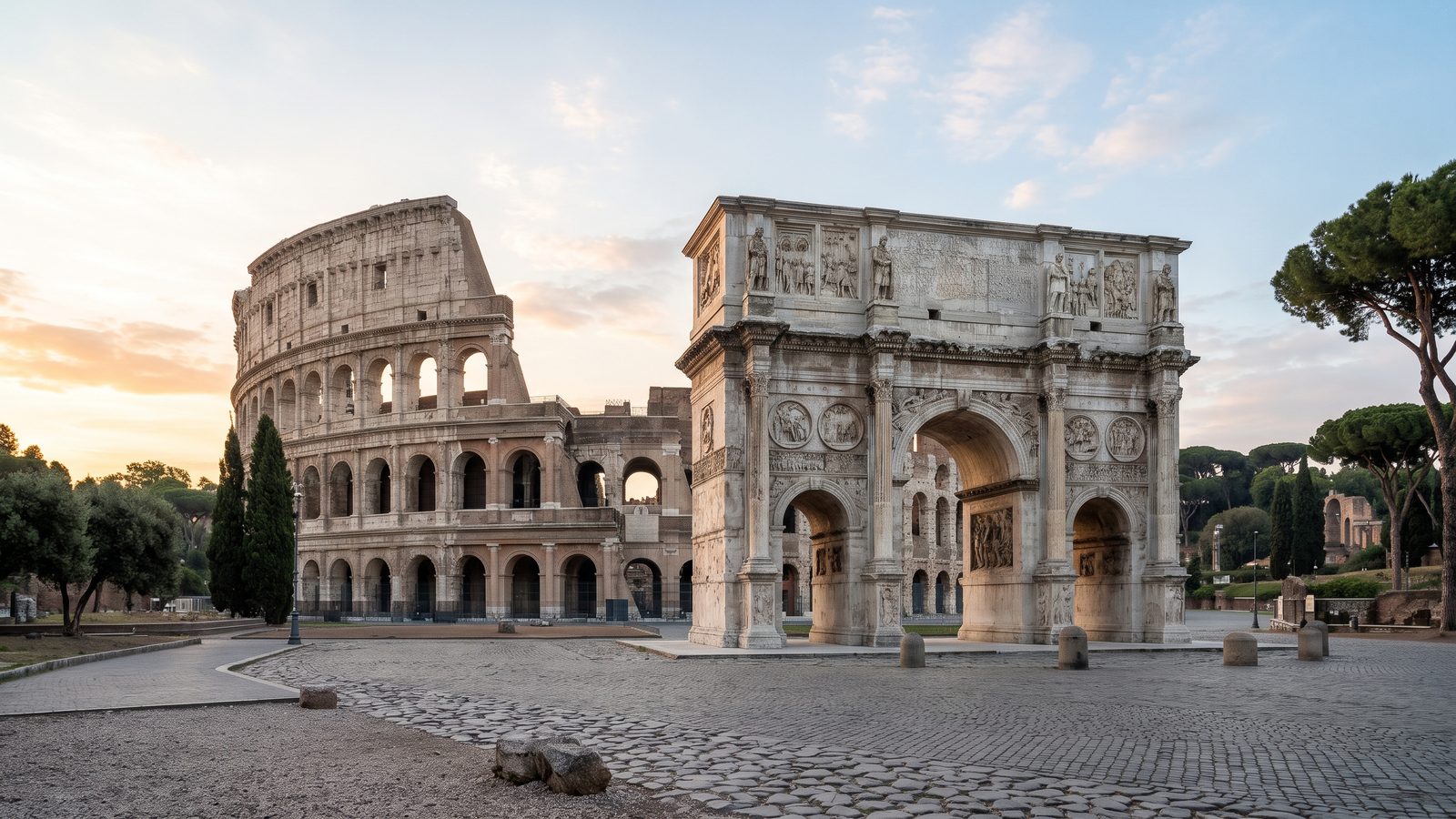
Standing proud between the Colosseum and Palatine Hill, the Arch of Constantine is Rome's largest surviving triumphal arch. Built in 315 AD to honor Emperor Constantine's victory at the Battle of Milvian Bridge, this stunning monument marks a monumental turning point in the history of the Western world. With this self-guided audio tour, you will discover the intricate carvings, recycled reliefs, and propaganda behind its three imposing archways.
As you walk around the monument, our narration unveils the arch's unique blend of artistic styles and political symbolism. You will explore how ancient emperors inspired Constantine's vision, turning salvaged stone into a timeless declaration of power, victory, and legitimate rule in ancient Rome.
Listen to a sample
The opening of this tour, exactly as AllTours narrates it on site.
What you'll hear on this tour
Stop 1. A Monumental Turning Point
You stand before Rome's largest surviving triumphal arch, positioned dramatically between the Colosseum and Palatine Hill. Dedicated in 315 AD by the Roman Senate, this massive monument celebrates Emperor Constantine's victory over Maxentius at the Battle of Milvian Bridge in 312 AD. As you gaze at its triple-arched structure, you are witnessing a turning point in history: the rise of Christianity across the Roman Empire. Look closely at the reliefs carved into the stone; many were recycled from earlier monuments honoring Trajan, Hadrian, and Marcus Aurelius. This practice, known as spolia, intentionally links Constantine to Rome's revered "good emperors" in a striking historical collage.
Stop 2. Architectural Genius and Spolia
You examine the architectural genius that turns this arch into a living museum of Roman art. Notice the grand Corinthian columns framing the entrances; workers repurposed these towering marble shafts directly from a forgotten Flavian monument. As you look higher, you contrast the classical elegance of the Hadrianic roundels with the starker, flatter style of the Constantinian frieze running just below them. This deliberate architectural juxtaposition creates a visual dialogue across centuries. Instead of discarding the past, the designers integrate distinct eras into a single, cohesive triumphal form, demonstrating how recycled materials can forge an entirely new expression of imperial propaganda.
Stop 3. Commanding Imperial Power
You look up at the sheer scale of the largest surviving Roman triumphal arch, a monument designed to command your complete attention. Its towering triple-archway makes a bold statement of triumph and authority. By deliberately incorporating magnificent sculptural pieces from past emperors, Constantine uses stone to assert his rightful succession and political continuity. You see a physical mosaic of repurposed grandeur, where ancient craftsmanship fuses with new imperial messaging. This monumental arch does not merely celebrate a battle; it monumentalizes a seismic shift in imperial ideology, announcing a new era of Roman power to every traveler passing through its shadow.
Stop 4. The Clash at Milvian Bridge
You trace the origins of this grand structure back to a desperate clash for imperial power. In 312 AD, Emperor Constantine defeated his rival Maxentius at the famous Battle of Milvian Bridge, securing absolute control over the Western Roman Empire. Just three years later, in 315 AD, the Roman Senate dedicated this monumental arch to honor his triumph. As you inspect the relief panels, you recognize sculptures salvaged from the golden ages of Trajan and Hadrian. Through this strategic reuse of stone, Constantine explicitly ties his victory to Rome's most glorious moments, heralding a transformative imperial age.
Stop 5. A Visual Dialogue in Stone
You let your gaze sweep across the magnificent triple archway, absorbing one of Rome's most impressive sightseeing highlights. As you scan the exterior reliefs, you can easily discern the artistic evolution of the Roman world. Look closely to distinguish the refined sculptures taken from monuments of Trajan, Hadrian, and Marcus Aurelius from the distinct, flatter Constantinian friezes carved centuries later. This artistic side-by-side placement creates an incredible visual dialogue etched in marble. Standing here, you peel back the layers of Rome's history, discovering how different imperial generations left their permanent mark on a single breathtaking structure.
Stop 6. Legitimacy and Ancient Borrowings
You step back to feel the immense historical weight of 315 AD, the year the Senate and Roman People dedicated this grand arch. Observe how the ancient reliefs—borrowed from monuments honoring Trajan, Hadrian, and Marcus Aurelius—deliberately weave Constantine's legitimacy into the fabric of Rome's golden past. As you compare these recycled classical masterpieces with the freshly carved Constantinian panels, you sense a powerful message of imperial continuity. This deliberate borrowing of ancient glory assured citizens that, despite changing times, the authority and grandeur of the empire remained steadfast under Constantine's leadership.
Planning your visit
- Best time to go
- Early morning or late afternoon for gentle lighting on the reliefs and fewer crowds near the Colosseum.
- Approximate duration
- about 20-30 minutes
- Where to start
- In the open plaza between the Colosseum and the Arch of Constantine, facing the arch's northern side.
Access and conditions change seasonally — check the official site before you go.
Frequently asked questions
Is the Arch of Constantine worth visiting?
Yes, the Arch of Constantine is definitely worth visiting. As Rome's largest surviving triumphal arch, it offers a fascinating look at ancient imperial architecture, art recycling (spolia), and the historical shift toward Christianity under Emperor Constantine.
How long do you need at the Arch of Constantine?
Most visitors spend about 15 to 30 minutes admiring the detailed reliefs, exploring its history, and taking photos, making it an easy addition to a tour of the adjacent Colosseum.
Why was the Arch of Constantine built?
The Roman Senate erected the arch in 315 AD to commemorate Emperor Constantine's victory over Maxentius at the Battle of Milvian Bridge in 312 AD.
Keep exploring
Header image is an AI-generated illustration of Arch of Constantine. AllTours.ai is an AI audio tour guide — point your camera at any landmark and hear its story.