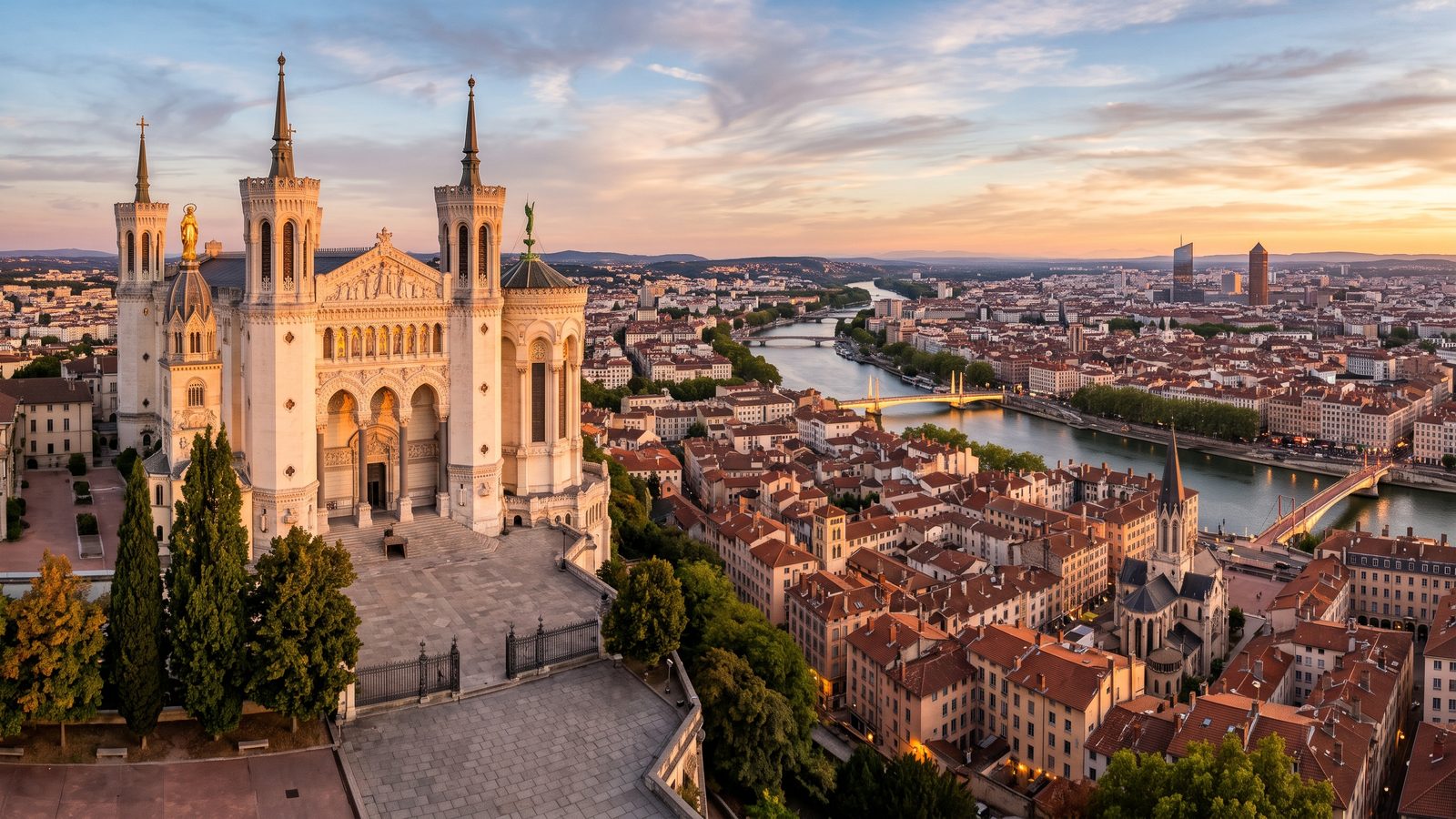
Welcome to the Basilica of Notre-Dame de Fourvière, the spiritual heart perched high above Lyon. Combining Romanesque fortress-like strength with opulent Byzantine Revival artistry, this 19th-century marvel stands as a testament to the city's enduring faith. Built in gratitude to the Virgin Mary, the basilica captivates visitors with its shimmering golden mosaics, intricate stained glass windows, and commanding presence overlooking the historic urban landscape below.
As you walk through these sacred halls and scenic terrace viewpoints, you discover centuries of dramatic vows, sacred traditions, and vibrant cultural celebrations. Step inside to experience a harmonious blend of architectural brilliance, deep-rooted local history, and breathtaking vistas stretching all the way to the French Alps.
Listen to a sample
The opening of this tour, exactly as AllTours narrates it on site.
What you'll hear on this tour
Stop 1. Two Stacked Churches of Byzantine Artistry
You stand before an extraordinary architectural marvel designed as two stacked churches. Look closely at the exterior, where Romanesque influences reign supreme with four imposing octagonal towers and rugged, fortress-like battlements built to convey strength. As you step inside, the sanctuary completely transforms into an opulent Byzantine Revival masterpiece. Gilded details and intricate mosaics dazzle your eyes, creating a striking visual dialogue between Western structural solidity and Eastern ornamental beauty. Every surface inside glimmers with artistic devotion, inviting you to marvel at the sheer craftsmanship required to harmonize these contrasting aesthetic styles into a single cohesive, holy sanctuary high above Lyon.
Stop 2. A Sacred Promise Born from War
You are standing on hallowed ground where a chapel dedicated to Mary has existed for centuries. The genesis of this grand landmark traces back to 1643, when Lyon's citizens made a solemn vow to erect a monument if the Virgin Mary protected them from the plague. Centuries later during the Franco-Prussian War of 1870, the city dramatically renewed this ancient promise. Having been spared once again from total devastation, the citizens fulfilled their vow by completing this magnificent basilica in 1884. As you explore the grounds, you trace the history of a community bound by centuries of resilience and faith.
Stop 3. Panoramic Vistas Across Lyon's Rivers
Step out onto the Esplanade to behold Lyon's grand urban narrative unfolding far below you. From this commanding hilltop vantage point, you observe where the Rhône and Saône rivers dramatically converge, shaping the natural identity of the city. Your gaze sweeps across the terracotta rooftops of historic Vieux Lyon, crosses into the lively Presqu'île district, and moves up toward the distinct red roofs of the Croix-Rousse neighborhood. On clear days, the distant snow-capped peaks of the French Alps majestically frame the horizon, offering you an unforgettable panoramic view that captures Lyon's strategic geography and timeless architectural beauty.
Stop 4. Birthplace of the Fête des Lumières
You are visiting the very birthplace of Lyon's world-famous Fête des Lumières. This extraordinary cultural festival originated right on this hill as a spontaneous expression of community gratitude. To honor the ancient vow made to the Virgin Mary for protecting the city from war and deadly pestilence, local residents placed lit candles in their windows. That simple, heartwarming tradition gradually evolved into the global spectacle celebrated today. As you walk around the plaza, imagine thousands of glowing candles turning this hilltop into a beacon of hope, uniting spiritual faith with creative light art in an enduring annual tradition.
Stop 5. Sanctuary of Deep Marian Devotion
Inside this sacred sanctuary, you grasp the deep Marian devotion that shapes Lyon's spiritual character. Following the miraculous protection during the Franco-Prussian War of 1870, local citizens dedicated this majestic basilica entirely to the Virgin Mary. As you look around the interior, vibrant stained-glass windows and elaborate wall mosaics visually depict significant moments from her life. Pilgrims and visitors alike have gathered here across centuries to offer prayers and seek solace. Every piece of art in this sacred hall reflects generations of fervent faith, turning this hilltop church into an enduring spiritual refuge for the entire region.
Stop 6. Capturing Golden Hour Hilltop Views
Your camera lens faces a thrilling challenge as you navigate the dynamic light surrounding Fourvière. Indoors, the vibrant mosaic work requires careful exposure bracketing or high ISO settings, allowing you to capture intense colors without using a flash, which is prohibited to respect the holy space. Step outside to the terrace during golden hour, when warm sunlight bathes the white limestone facade and casts a brilliant glow over the city spread below. Angle your camera to frame the basilica's distinct octagonal towers against the sprawling cityscape, striking a perfect balance between intricate architectural details and dramatic sky.
Planning your visit
- Best time to go
- Late afternoon leading into golden hour for illuminated interior mosaics and optimal outdoor photography views.
- Approximate duration
- About 1 to 1.5 hours
- Where to start
- The main outer terrace on the Esplanade de Fourvière.
Access and conditions change seasonally — check the official site before you go.
Frequently asked questions
Is Basilica of Notre-Dame de Fourvière worth visiting?
Yes, it is one of Lyon's top sights, celebrated for its unique stacked architecture, shimmering Byzantine interior mosaics, deep local history, and sweeping views over the city.
How long do you need at Basilica of Notre-Dame de Fourvière?
Most visitors spend between 1 and 1.5 hours exploring the upper basilica, admiring the lower church levels, and taking in the panoramic views from the esplanade.
Why was the Basilica of Notre-Dame de Fourvière built?
It was built to fulfill a sacred civic vow made to the Virgin Mary during the Franco-Prussian War of 1870, building upon a historical tradition of town vows dating back to 1643.
Keep exploring
Header image is an AI-generated illustration of Basilica of Notre-Dame de Fourvière. AllTours.ai is an AI audio tour guide — point your camera at any landmark and hear its story.