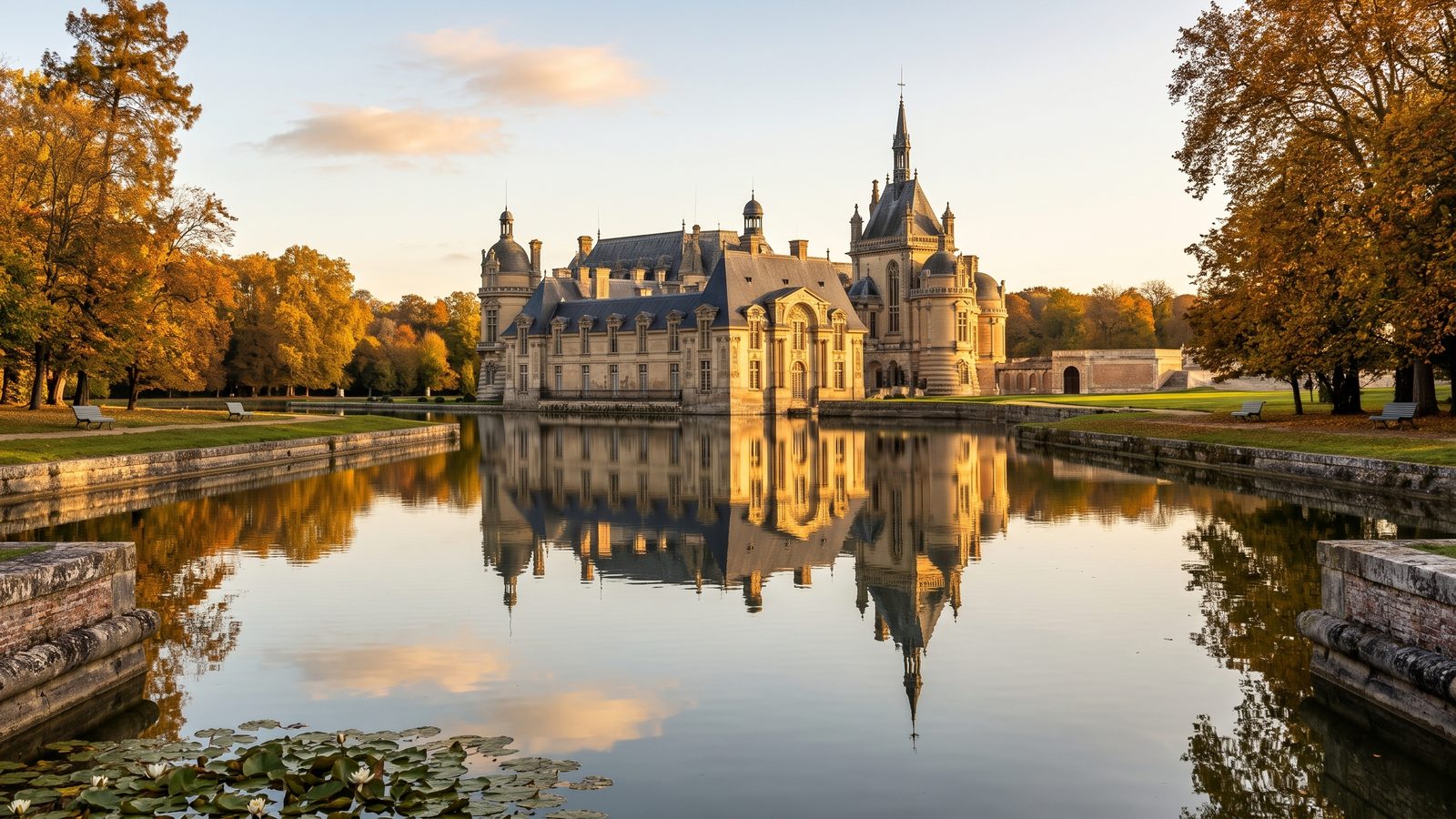
Welcome to Château de Chantilly, a breathtaking estate in Hauts-de-France where royal history and world-class art meet. Rebuilt in the nineteenth century by Henri d'Orléans, Duke of Aumale, this magnificent complex features two distinct structures: the sixteenth-century Petit Château and the grand nineteenth-century revival château. Surrounded by shimmering moats and expansive French formal gardens, Chantilly offers an intimate encounter with France's aristocratic and cultural splendor.
As you walk through these opulent halls and manicured grounds, this self-guided audio tour reveals the legacy of the Princes of Condé and the Duke's legendary art collection. Experience an unforgettable journey through centuries of architectural beauty, master paintings, and tranquil forest trails.
Listen to a sample
The opening of this tour, exactly as AllTours narrates it on site.
What you'll hear on this tour
Stop 1. Masterpieces of the Grand Appartements
You step into the Grand Appartements, surrounding yourself with the profound artistic vision of the Duke of Aumale. Before you hangs Raphael's exquisite Three Graces, displaying delicate Renaissance beauty alongside his poignant Madonna of Loreto. The Duke meticulously arranged every painting here, leaving strict instructions that nothing ever change. This gives you an intimate look into nineteenth-century aristocratic taste rather than a standardized museum display. Moving past Italian masterpieces like Botticelli's Autumn, you encounter captivating works by Poussin, Delacroix, and Ingres. Your journey through this private temple of art offers rare access to world-renowned treasures and illuminated medieval manuscripts.
Stop 2. The Grand Canal and Le Nôtre's Vision
You emerge into the breathtaking expanse of Chantilly’s gardens, designed by André Le Nôtre for the Grand Condé. Before you lies the Grand Parterre, where precise geometric patterns of boxwood create a dramatic illusion of infinite depth. As you gaze further, the two-and-a-half-kilometer Grand Canal stretches into the horizon, reflecting the open sky and the castle’s majestic silhouette. Beyond this classical French symmetry, you discover the charming eighteenth-century Anglo-Chinese garden and the Hameau de Chantilly. These rustic cottages famously inspired Marie Antoinette’s hamlet at Versailles, offering a picturesque, pastoral retreat within the royal estate.
Stop 3. A Tale of Two Châteaux
You stand before a striking architectural duality where the sixteenth-century Petit Château meets the grand nineteenth-century edifice. While the Renaissance Petit Château survived intact, the original Grand Château fell during the French Revolution. You witness the passion of Henri d'Orléans, Duke of Aumale, who rebuilt the estate from its medieval ashes to display his magnificent art collection. Notice how the intricate stone turrets and soaring spires appear to float upon the peaceful moat below. Today, this living legacy houses the Condé Museum, operating under the Duke's permanent order that its priceless treasures never leave Chantilly.
Stop 4. Inside the Renowned Musée Condé
You enter the Musée Condé, a remarkable time capsule preserving the exact arrangement established by the Duke of Aumale. Holding a collection of pre-1850 French paintings second only to the Louvre, this intimate space allows you to view masterpieces up close. You stand face-to-face with legendary works by Raphael, Ingres, and Delacroix, feeling the Duke's personal devotion in every room. Nearby, the Cabinet des Livres safeguards medieval illuminations, including pages from the famous Très Riches Heures du Duc de Berry. Here, surrounded by centuries of scholarly and artistic genius, you experience a truly personal gallery created by a true royal patron.
Stop 5. Centuries of Power and Transformation
You walk upon land shaped by medieval fortifications, Renaissance princes, and revolutionary turmoil. You trace the story from the Montmorency family, who built the Petit Château, to the Princes of Condé, who transformed Chantilly into a cultural center hosting Molière and La Fontaine. Though the French Revolution leveled the original main château and scattered its contents, the Duke of Aumale devoted his life to restoring the grounds and gathering its lost treasures. As you explore, you feel the resilience of an estate rebuilt through extraordinary vision and ultimately gifted to the Institut de France for all to admire.
Stop 6. Into the Ancient Forêt de Chantilly
You step into the shaded canopy of the Forêt de Chantilly, a vast woodland spanning over six thousand hectares. Once the private hunting domain of kings and princes, these ancient glades of oak and beech echo with centuries of royal history. As you tread upon the cool earth, you move beyond manicured lawns into a wild landscape that once provided timber and shelter for the estate. These quiet trails hid secret duels and romantic meetings while serving as a strategic natural barrier. Walking beneath the towering canopy, you connect directly with the untamed, natural heart of this historic domain.
Planning your visit
- Best time to go
- Morning to early afternoon, ideally in spring or autumn when the Le Nôtre gardens are vibrant and crowd levels are moderate.
- Approximate duration
- about 2 to 3 hours
- Where to start
- In front of the main entrance gates, looking across the moat toward the Petit Château and Grand Château.
Access and conditions change seasonally — check the official site before you go.
Frequently asked questions
Is Château de Chantilly worth visiting?
Yes, Château de Chantilly is highly worth visiting. It houses the Musée Condé—which boasts France's largest collection of antique paintings outside the Louvre—alongside spectacular Le Nôtre gardens, historic stables, and a fairy-tale castle surrounded by water.
How long do you need at Château de Chantilly?
Most visitors need between 2 and 4 hours to explore the Grand Appartements, the Musée Condé art galleries, and the extensive formal French and Anglo-Chinese gardens.
Who built Château de Chantilly and what is its history?
Originating as a medieval fortress, Chantilly was transformed by the Montmorency family in the 16th century and expanded by the Princes of Condé. After being largely destroyed in the French Revolution, the Grand Château was meticulously rebuilt in the 19th century by Henri d'Orléans, Duke of Aumale, who gifted it to the Institut de France.
Keep exploring
Header image is an AI-generated illustration of Château de Chantilly. AllTours.ai is an AI audio tour guide — point your camera at any landmark and hear its story.