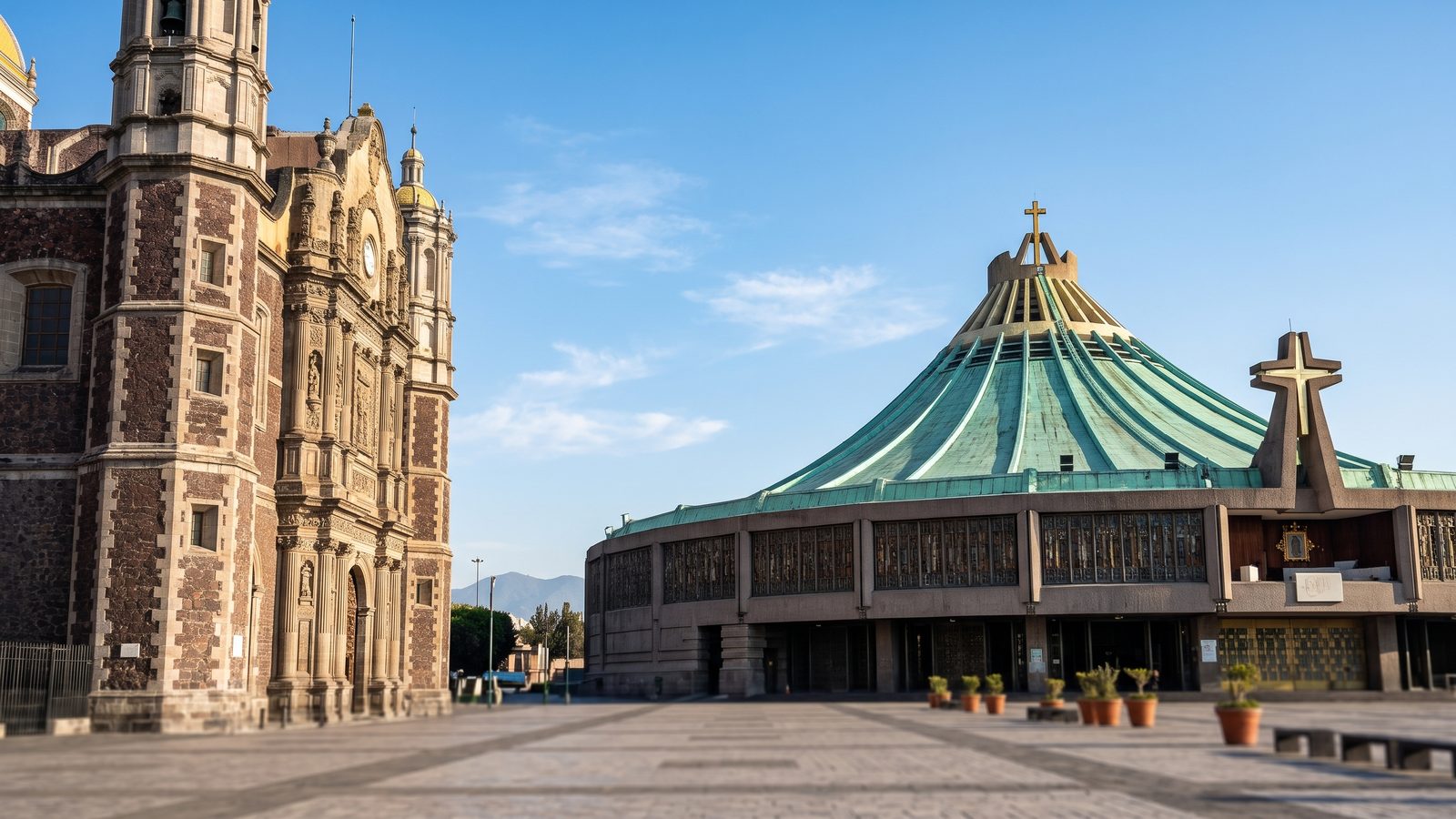
Welcome to the Basilica of Our Lady of Guadalupe, the most visited Marian shrine in the world and the spiritual heart of Mexico. Standing at the foot of Tepeyac Hill, you enter a sacred space where ancient indigenous traditions and Catholic faith seamlessly intertwine. Here, millions of pilgrims gather each year to venerate the miraculous image of the Virgin Mary imprinted on the sixteenth-century cloak of Saint Juan Diego.
On this self-guided audio tour, you will discover the dramatic history behind the 1531 apparitions, admire the striking contrast between the tilting Baroque Old Basilica and the modern circular New Basilica, and uncover the secret artistic symbols woven into the sacred tilma that continues to inspire a nation.
Listen to a sample
The opening of this tour, exactly as AllTours narrates it on site.
What you'll hear on this tour
Stop 1. The Sinking Shrine and Modern Marvel
You stand between two centuries of architectural ingenuity. Look toward the Old Basilica and notice its pronounced tilt. This seventeenth-century Baroque masterpiece struggles against the soft, unstable subsoil of Mexico City, standing as a stabilized testament to historical engineering. Turn around to face the New Basilica, designed by architect Pedro Ramírez Vázquez in the twentieth century. Its revolutionary circular shape completely eliminates internal pillars, guaranteeing you an unobstructed view of the sacred cloak from anywhere inside. Notice the sweeping, tent-like copper roof, weathered to a vivid green verdigris, which bathes the sanctuary in natural light. Beneath the main altar, an ingenious moving walkway allows steady streams of pilgrims to pass seamlessly beneath the relic.
Stop 2. Hidden Secrets of the Sacred Tilma
You gaze upon the sacred tilma of Saint Juan Diego, an artistic and spiritual masterpiece woven from coarse cactus fibers. Look closely at the Virgin's gentle, downward gaze, reflecting quiet humility. Her rose-tinted tunic features intricate floral patterns that subtly integrate indigenous symbols of the land and cosmos. Her celestial blue-green mantle displays gold stars arranged precisely as the constellations appeared in the morning sky over Tepeyac Hill in December 1531. Observe the black sash around her waist, indicating pregnancy, and the crescent moon beneath her feet. Every detail of this iconographic treasure bridges divine symbolism with human art, defying traditional artistic techniques and inspiring centuries of profound devotion.
Stop 3. Miraculous Apparitions on Tepeyac Hill
You step onto grounds where history transformed an entire continent. In December 1531, a humble indigenous man named Juan Diego experiences miraculous apparitions of the Virgin Mary on Tepeyac Hill, a site previously sacred to the Aztec mother goddess Tonantzin. Speaking in Nahuatl, the Virgin requests a church in her honor. When skeptics demand proof, she causes fresh Castilian roses to bloom on the frozen hillside out of season. Juan Diego gathers the blossoms in his coarse woven cloak. As he unfurls the tilma before the bishop, the miraculous image of Our Lady of Guadalupe reveals itself on the fabric, permanently shaping the spiritual landscape of New Spain.
Stop 4. The Syncretic Heart of Mexican Identity
You feel the vibrant cultural pulse that defines this sanctuary, where indigenous worldviews and Catholic devotion merge into a unified identity. Look closely at the Virgin's image to spot the nahui ollin sun disk on her sash—an ancient symbol of cosmic order now integrated into a sacred Christian icon. Her image extends far beyond church walls; you find her in homes, businesses, and political banners across the nation. Outside, you witness traditional danzas, vibrant indigenous attire, and joyful mañanitas sung at dawn. This sacred site serves as the living bedrock of Mexican heritage, reinforcing deep familial bonds and a shared memory across generations.
Stop 5. A Living Journey of Unwavering Faith
You observe the living heart of this sanctuary through the constant flow of pilgrims arriving from around the globe. Watch as individuals and entire families complete mandas—sacred vows made in moments of profound gratitude or deep need. Many travel vast distances on foot, ending their arduous journey by advancing across the plaza on their knees. Step onto the moving walkway below the sacred image, where endless lines of visitors fix their eyes on Our Lady to whisper heartfelt prayers. The sheer determination, exhausted smiles, and collective energy create a powerful atmosphere of hope, solace, and enduring spiritual connection that defines this holy ground.
Stop 6. Spiritual Epicenter of the Americas
You stand at the ultimate epicenter of Mexican Catholicism, where millions seek solace and intercession from the Empress of the Americas. Enshrined inside the New Basilica, the miraculous tilma serves as a divine bridge between ancient indigenous spiritualities and Christian belief. Devotees interpret the Virgin's dark skin and Aztec-inspired mantle as a direct message of cosmic love and affirmation for the indigenous people. As you walk through the hall, you hear a continuous chorus of quiet petitions, tears of gratitude, and fervent prayers. Faith fills the air, celebrating a divine mother figure believed to grant miracles of healing and conversion to all who approach her.
Planning your visit
- Best time to go
- Early weekday mornings offer the quietest experience. Visit around December 12th to witness vibrant feast day celebrations, though expect massive crowds.
- Approximate duration
- about 2 hours
- Where to start
- Begin at the main plaza (Plaza de las Américas) between the Old and New Basilicas.
Access and conditions change seasonally — check the official site before you go.
Frequently asked questions
Is Basilica of Our Lady of Guadalupe worth visiting?
Yes, the Basilica of Our Lady of Guadalupe is immensely worth visiting. As one of the most visited Marian shrines in the world, it offers a fascinating combination of history, modern and Baroque architecture, and profound cultural significance as the spiritual heart of Mexico.
How long do you need at Basilica of Our Lady of Guadalupe?
Most visitors spend about 1.5 to 2.5 hours exploring the complex. This gives you ample time to view the miraculous tilma from the moving walkway, compare the Old and New Basilicas, walk up Tepeyac Hill, and absorb the vibrant atmosphere.
What is the history behind the Basilica of Our Lady of Guadalupe?
The site's history dates back to December 1531, when the Virgin Mary appeared to an indigenous man named Juan Diego on Tepeyac Hill. After she caused roses to bloom out of season, her image miraculously appeared imprinted on Juan Diego's tilma (cloak), leading to the construction of a series of shrines and churches on the site.
Keep exploring
Header image is an AI-generated illustration of Basilica of Our Lady of Guadalupe. AllTours.ai is an AI audio tour guide — point your camera at any landmark and hear its story.