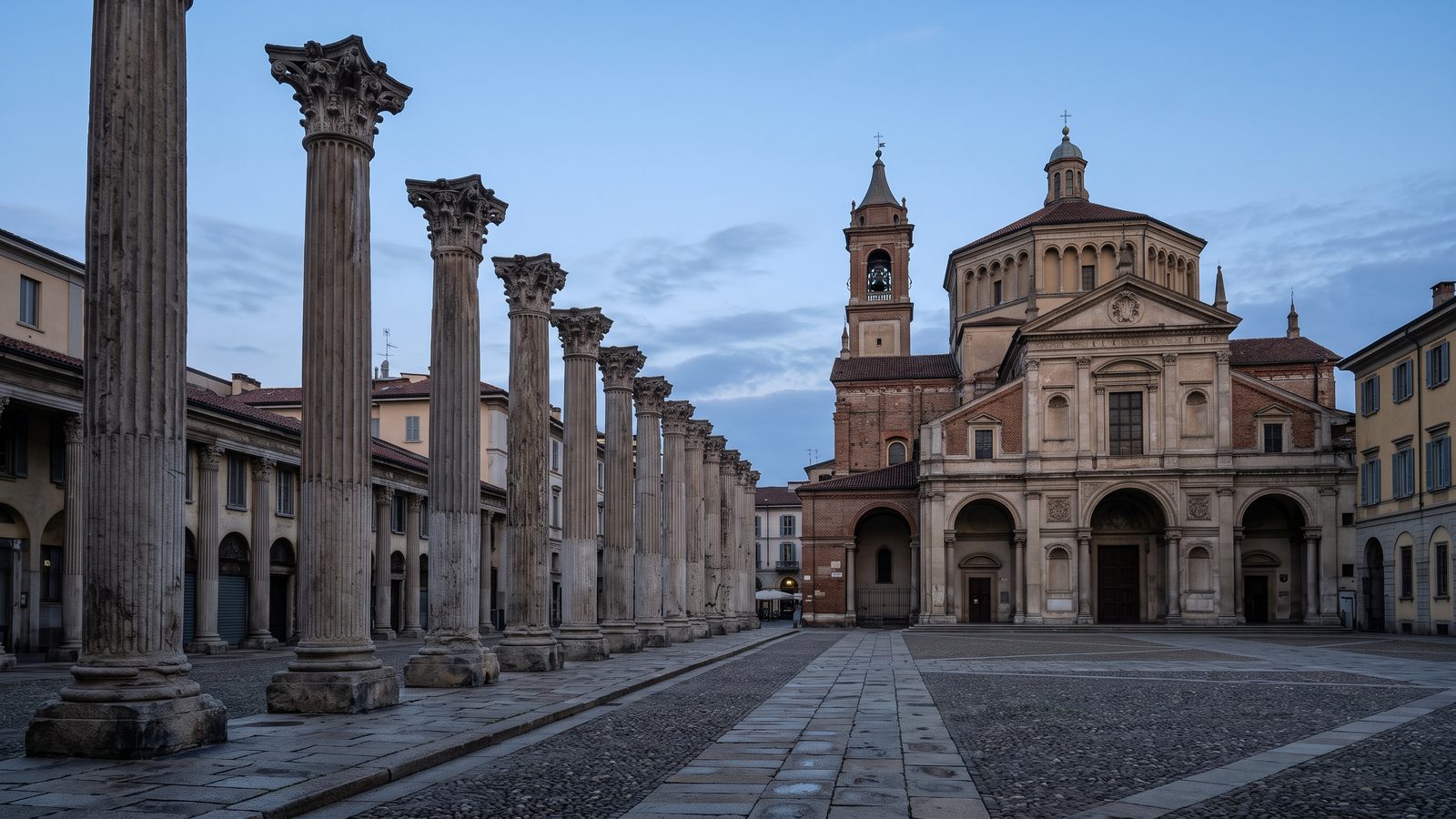
Welcome to the Basilica di San Lorenzo Maggiore, Milan's oldest church and a profound connection to its Roman past. Built in the late 4th century when Mediolanum was at its zenith, this monumental basilica blends early Christian, Byzantine, and later architectural styles. Standing before its striking Roman colonnade, you step into a living timeline where emperors, saints, and generations of Milanese have left their enduring mark.
As you explore its expansive interior and sacred chapels, you encounter rare 4th-century mosaics, resilient architecture rebuilt through the ages, and sixteen centuries of continuous faith. Prepare to discover the ancient soul, rich history, and civic spirit preserved inside this architectural masterpiece.
Listen to a sample
The opening of this tour, exactly as AllTours narrates it on site.
What you'll hear on this tour
Stop 1. The Golden Mosaics of Sant'Aquilino
Let your eyes ascend to the extraordinary 4th-century mosaics adorning the Chapel of Sant'Aquilino. Here, you witness a rare, vivid tapestry of early Christian artistry predating much of the art in Milan. You observe the majestic Christ Pantocrator flanked by apostles, their serene expressions rendered in intricate tesserae. These Byzantine-influenced masterpieces glow with vibrant blues and golds, offering you an unparalleled glimpse into the nascent visual language of faith and early Christian devotion. As you study these ancient patterns, you connect directly with the spiritual and artistic roots of ancient Mediolanum.
Stop 2. Rare Tetraconch Design and Ancient Columns
You stand before the monumental Roman colonnade framing the entrance, salvaged from a 2nd-century imperial building. Stepping inside, you see the original tetraconch plan unfold before you—a rare early Christian design where four apses radiate from a central dome to create an expansive, harmonious space. This Byzantine-influenced layout defines the interior's ancient grandeur. Though devastating fires forced historic rebuilds and the grand dome was reconstructed in the 16th century, the foundational harmony and architectural brilliance of the original late Roman engineering remain profoundly visible to you today.
Stop 3. Imperial Mediolanum and Centuries of Resilience
You stand on ground where Milan's imperial story unfolded in the late 4th century during Mediolanum's golden age. Built as a daring feat of late Roman engineering, this basilica originally served as a palatine chapel directly connected to the imperial palace. Throughout the centuries, you witness its remarkable resilience as it rose from catastrophic fires, including a major blaze in 1071. The magnificent central dome you admire today represents a 16th-century reconstruction replacing its medieval predecessor, linking ancient imperial ambition with Renaissance craft.
Stop 4. The Imperial Columns of the Piazza
As you approach the basilica, your gaze immediately fixes upon the majestic Roman columns standing sentinel across the piazza. These sixteen Corinthian columns were salvaged from a 2nd-century Roman temple, providing you with a breathtaking view into ancient Mediolanum. As you inspect the detailed carvings on their weatherworn capitals, you contemplate their imperial origins and the layered history of Milan. They form an iconic framing for the church facade, inviting you to cross the threshold from a modern city into an ancient world.
Stop 5. Sixteen Centuries of Continuous Faith
You experience a profound connection to early Christianity as you walk through a structure embodying faith's enduring power. Inside the octagonal Chapel of Sant'Aquilino, a historical martyrium, you stand where early Christian martyrs' remains were venerated by devoted pilgrims. The unbroken line of liturgical life here spans sixteen centuries, testifying to the basilica's unwavering spiritual significance. As you reflect in this sacred space, you feel how it helped shape Milan's religious identity from Roman antiquity through the centuries into an enduring beacon of Christian worship.
Stop 6. The Living Soul of Milan
Surrounding the ancient columns and open piazza, you feel the vibrant pulse of Milan's enduring civic spirit. For centuries, this historic nexus has served as a gathering place where generations of Milanese have met, debated, and celebrated. The basilica's early Christian art and monumental scale have influenced local aesthetic sensibilities across centuries, leaving an indelible imprint on Milanese identity and artistic expression. As you take in the lively atmosphere today, you realize this ancient landmark remains a vital, living center of public life.
Planning your visit
- Best time to go
- Morning or late afternoon for natural light on the facade and a quieter experience inside the chapel.
- Approximate duration
- About 45 minutes to 1 hour
- Where to start
- In the piazza in front of the Roman colonnade.
Access and conditions change seasonally — check the official site before you go.
Frequently asked questions
Is Basilica of San Lorenzo worth visiting?
Yes, as one of Milan's oldest churches, it features iconic 2nd-century Roman columns and magnificent 4th-century early Christian mosaics in the Chapel of Sant'Aquilino.
How long do you need at Basilica of San Lorenzo?
Plan for about 45 to 60 minutes to view the exterior colonnade, explore the central octagonal interior, and visit the Chapel of Sant'Aquilino.
When was the Basilica of San Lorenzo built?
The original basilica was constructed in the late 4th century during the Roman period, with its central dome rebuilt in the 16th century following historical fires.
Keep exploring
Header image is an AI-generated illustration of Basilica of San Lorenzo. AllTours.ai is an AI audio tour guide — point your camera at any landmark and hear its story.