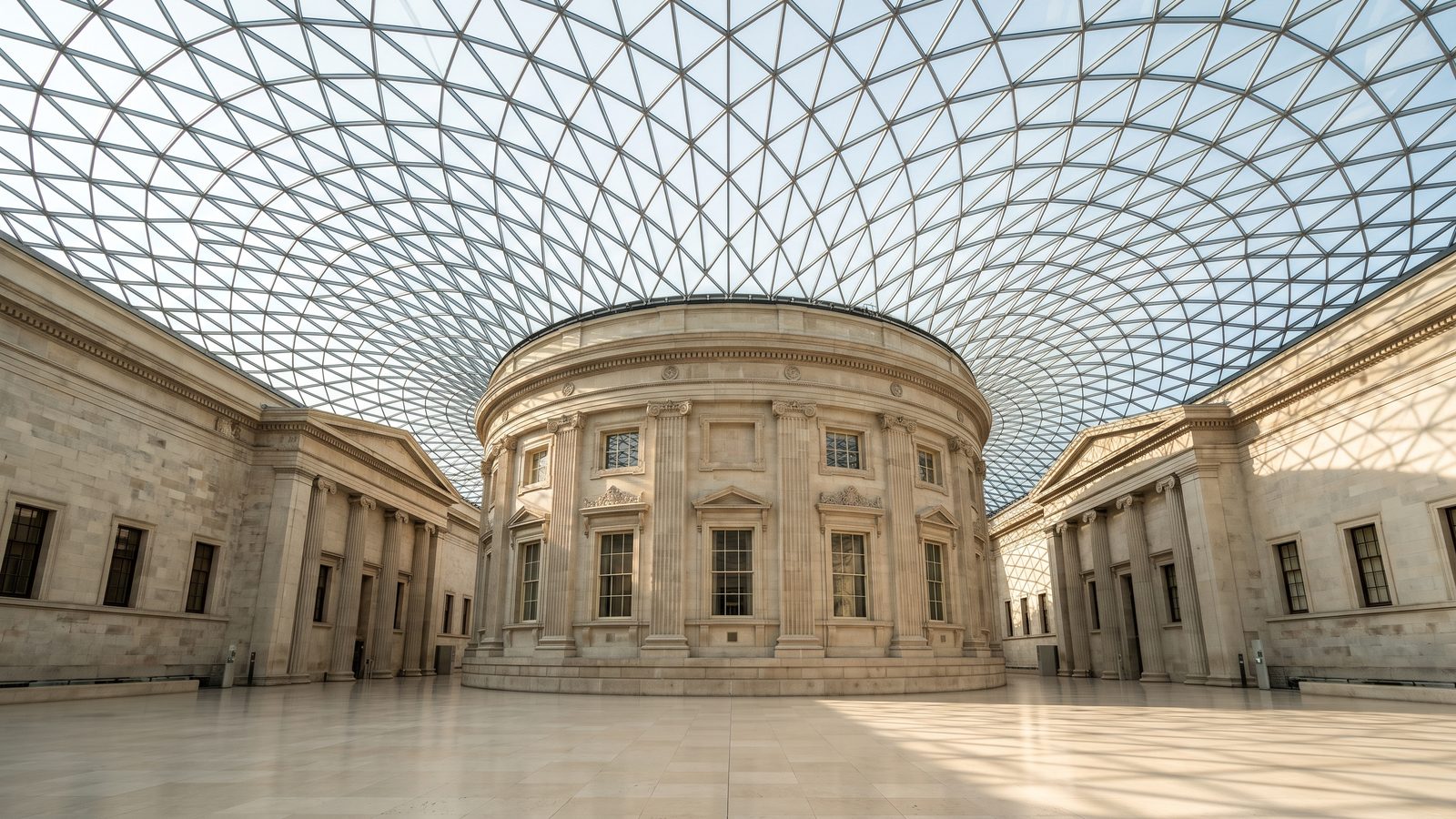
Step into the British Museum, a grand monument dedicated to human history, art, and culture. Founded in 1753 as the world's first national public museum, this iconic institution houses millions of works spanning thousands of years. As you walk through its magnificent halls, you trace the story of global civilization from early stone tools and Mesopotamian cuneiform to classical sculptures and intricate royal treasures, all under one extraordinary roof.
This self-guided audio tour leads you through key highlights and hidden details of the museum's most celebrated spaces. You will encounter world-changing discoveries like the Rosetta Stone, marvel at modern and classical architecture, and gain deeper insight into the extraordinary creative spirits that shaped our shared global heritage.
What you'll hear on this tour
Stop 1. Unlocking Ancient Decrees and Royal Tombs
You stand before iconic masterpieces of discovery that redefined our understanding of the past. First, you encounter the famous Rosetta Stone, a granite slab bearing a trilingual decree that served as the key for deciphering Egyptian hieroglyphs. Imagine the intellectual triumph as scholars unlocked a long-silent ancient civilization. Nearby, you gaze upon the formidable Sutton Hoo helmet, the striking face of an Anglo-Saxon warrior king buried within a royal ship. Its elaborate garnet and gold cloisonné craftsmanship dispels old myths about the Dark Ages, revealing a sophisticated world of early English royalty, artistic brilliance, and complex international trade networks.
Stop 2. Classical Grandeur Meets Floating Glass Canopy
Look around at the dramatic architectural evolution framing your journey. Outside, twenty-two colossal Ionic columns in Portland stone form a Greek Revival portico designed by Robert Smirke in the nineteenth century, establishing a monumental temple dedicated to universal learning. As you step into the Queen Elizabeth II Great Court, the atmosphere transforms completely. Above you, Norman Foster's breathtaking glass and steel roof floats effortlessly, bathing the central square in radiant natural light while encircling the famous historic Reading Room. You feel an inspiring tension between Smirke's solid classical stonework and Foster's modern, airy transparency, uniting centuries of bold architectural vision.
Stop 3. Voices of Civic Pride and Royal Courts
Moving through these galleries, you connect directly with the cultural identity and spiritual beliefs of ancient societies. As you examine the Parthenon Sculptures, you observe the dynamic Panathenaic procession carved into stone, capturing Athenian civic pride, religious devotion, and democratic ideals in honor of Athena. Turning your gaze to the intricate Benin Bronzes, you explore relief plaques created for the Edo royal court. These works depict complex hierarchies, spiritual rituals, and sophisticated artistic traditions that sustained a powerful African kingdom. Beyond pure aesthetics, each artifact reflects how distant cultures celebrated their values, organized their societies, and shared their enduring stories.
Stop 4. The Genesis of the World's First Public Museum
You are walking through an institution born from a revolutionary Enlightenment idea. In 1753, an Act of Parliament established the museum following the death of Sir Hans Sloane, who bequeathed his massive collection of over 71,000 items for the public good. Originally opened inside Montagu House for all studious and curious persons, the rapidly expanding collection eventually outgrew its home. Smirke's grand Greek Revival building arose to house global arrivals like the Rosetta Stone and Parthenon sculptures. Though its natural history collections later moved to South Kensington, this site remains dedicated to telling the grand narrative of human culture.
Stop 5. Masterpieces of Reliefs, Mosaics, and Scrolls
Here, you explore how different cultures translated artistic vision into profound physical expressions. You trace the intricate tesserae of Roman mosaics, where tiny, meticulously placed stones bring mythology and daily villa life into vibrant perspective. Nearby, dramatic Assyrian wall reliefs depict high-stakes lion hunts and royal processions with fierce stylistic energy, utilizing detailed musculature to convey imperial power and divine favor. You also encounter delicate Chinese scroll paintings, where subtle brushwork merges poetry, calligraphy, and nature into a meditative landscape. Each artwork invites you to appreciate the deliberate choices, master craftsmanship, and unique aesthetic philosophies that shaped human creativity.
Stop 6. The Ancient Birth of Systematic Knowledge
You pause before ancient Mesopotamian cuneiform tablets, witnessing the very origins of recorded scholarship. These modest clay fragments hold the birth of systematic human knowledge, featuring carefully inscribed wedge marks made by scribes thousands of years ago. You observe early astronomical observations that mapped the heavens with impressive accuracy, alongside complex mathematical calculations, legal codes, and epic literature. Rather than simple record-keeping, these tablets represent humanity's first organized attempts to analyze, store, and transmit wisdom across generations. By establishing structured academic inquiry, these ancient scholars built the foundation for modern fields of study, sparking an enduring global quest for understanding.
Planning your visit
- Best time to go
- Weekday mornings right at opening offer the quietest experience in popular galleries like the Rosetta Stone.
- Approximate duration
- about 2 to 3 hours
- Where to start
- Great Russell Street entrance, beginning inside the Queen Elizabeth II Great Court.
Access and conditions change seasonally — check the official site before you go.
Frequently asked questions
Is the British Museum worth visiting?
Yes, the British Museum is one of the world's premier cultural institutions, housing iconic historical treasures such as the Rosetta Stone, the Parthenon Sculptures, and the Sutton Hoo artifacts.
How long do you need at the British Museum?
Most visitors spend between 2 to 3 hours exploring the main highlights, though history enthusiasts could easily spend a full day viewing the extensive collections.
How was the British Museum founded?
The museum was established in 1753 through an Act of Parliament after Sir Hans Sloane bequeathed his collection of over 71,000 objects to the nation, creating the world's first national public museum.
Keep exploring
Header image is an AI-generated illustration of British Museum. AllTours.ai is an AI audio tour guide — point your camera at any landmark and hear its story.