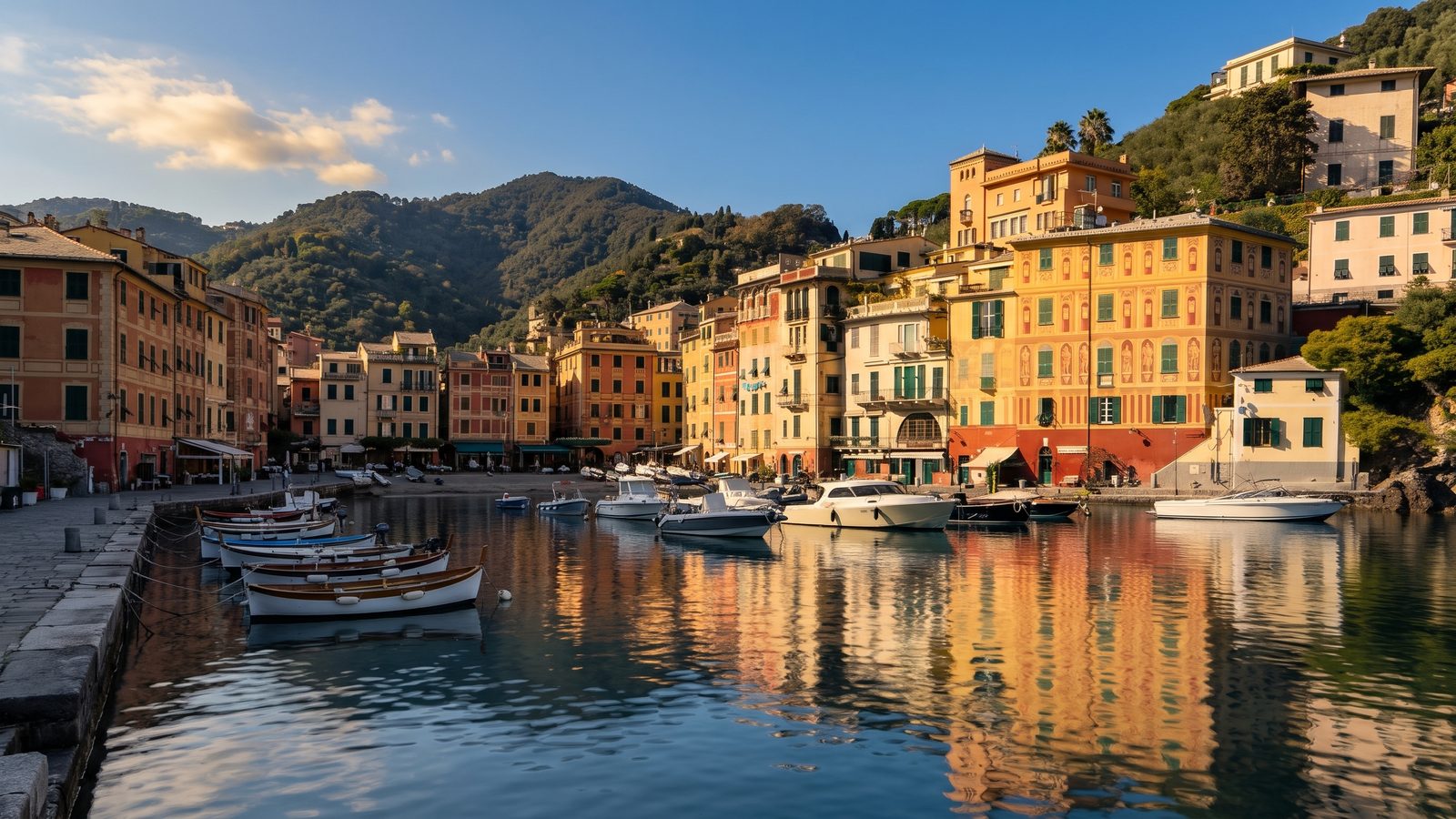
Welcome to Camogli, a colorful Ligurian jewel tucked along the Italian Riviera. Famous for its tall pastel houses cascading down to the sapphire sea, this historic town blends rich maritime history with authentic coastal living. As you walk past medieval fortresses, lively harbors, and elegant trompe l'oeil facades, you will discover why this former shipbuilding powerhouse was once celebrated across the Mediterranean as the city of a thousand white sails.
This self-guided audio tour leads you through Camogli's scenic waterfront, historic harbor, and steep alleyways. You will uncover hidden architectural details, learn about age-old fishing festivals, and savor traditional Ligurian flavors. Put on your headphones and let the stories of mariners, artisans, and sailors guide your journey through this vibrant village.
Listen to a sample
The opening of this tour, exactly as AllTours narrates it on site.
What you'll hear on this tour
Stop 1. Visual Harmony Between Sea and Cliffs
You stand before Camogli's breathtaking panorama, where tall, slender houses cling to dramatic cliff faces. Sun-drenched ochres, deep terracottas, and soft roses form a vibrant mosaic against the sapphire waters of the Ligurian Sea. You notice how these stacked buildings create a theatrical backdrop, their bright shades historically serving as vital visual beacons for returning mariners. Above, the verdant slopes of Monte di Portofino Natural Park embrace the town, contrasting with the crystal-clear depths below. As Mediterranean light reflects off the pastel facades, you feel the salty breeze and witness a spectacular landscape where rugged mountains meet the sea.
Stop 2. The Secrets of Trompe l'Oeil
Look closely at these pastel facades to discover the clever architectural craftsmanship of Camogli. You see elaborate stone cornices, grand pilasters, and balustraded balconies, but many are actually trompe l'oeil paintings—an ingenious trick that gave homes grand appearances on modest budgets. Notice how buildings stack vertically with narrow proportions to maximize living space along the steep terrain. Deep shared courtyards sit behind stout stone foundations built to withstand sea storms, transitioning to stuccoed upper floors capped with terracotta coppo roof tiles. Below, shadowed ground-level arcades offer shelter while blending private domestic life with the public seaside promenade.
Stop 3. Life at the Historic Waterfront
As you walk onto the Molo di Ponente, the protective breakwater curves around Camogli's active harbor. Traditional gozzi and colorful leudi fishing boats bob in the basin, sheltering from the open Ligurian Sea. You observe the ground floors of the seaside buildings, where ancient arched openings mark former magazzini—workshops where fishermen once mended nets and prepped their gear. The scent of salt and drying rope hangs in the air, connecting you directly to generations of mariners. Even as modern ferries navigate the entrance, this small basin remains the living heart of a dedicated maritime community.
Stop 4. Maritime Traditions and Lantern Lit Bays
You step into the spirited world of Camogli's local celebrations. Every May, the town fires up the famous Sagra del Pesce, frying tons of fresh catch in a giant multi-meter pan to celebrate community resilience. In August, you experience the serene beauty of the Stella Maris festival honoring the Virgin Mary, protector of sailors. As dusk falls, a solemn procession carries her statue to the water, while a flotilla of boats adorned with flickering lanterns glides across the bay. You watch as glowing candles float on the dark waters, illuminating the deep faith and maritime heritage that define this coastal haven.
Stop 5. Flavors of the Ligurian Sea
Prepare your appetite for a cuisine defined by fresh catch and local hillsides. You taste acciughe fritte—crispy, lightly floured anchovies caught hours earlier and served with simple olive oil and lemon. Next, sample pansoti, delicate pasta parcels stuffed with wild borage and bathed in a rich, velvety walnut sauce. You also encounter authentic Ligurian focaccia, golden-crusted and soft, infused with olive oil or local onions. Every dish reflects the harmony between sea and land, where fresh ingredients move directly from local boats and herb gardens straight to your table.
Stop 6. From Pirate Raids to Sailing Fleets
You trace Camogli's origins back to ancient times, beyond its famous medieval era. The name likely stems from Ca a Mugi, meaning houses piled up, describing its vertical growth along steep cliffs. You discover how Saracen pirate raids forced residents to fortify these seaside homes. Over centuries, Camogli grew into the Republic of Genoa's essential shipyard, supplying skilled mariners and formidable fleets that earned it the nickname city of a thousand white sails. Though the arrival of steamships eventually ended the era of wooden sailing vessels, you still feel the enduring maritime legacy carved into every stone.
Planning your visit
- Best time to go
- Spring through early autumn, especially late afternoon when golden sunlight hits the pastel facades.
- Approximate duration
- About 1 to 2 hours
- Where to start
- Piazza Colombo along the harbor breakwater
Access and conditions change seasonally — check the official site before you go.
Frequently asked questions
Is Camogli worth visiting?
Yes, Camogli is well worth visiting for its authentic Ligurian atmosphere, dramatic cliffside pastel houses, historic harbor, and fresh seafood cuisine.
How long do you need at Camogli?
A half-day to a full day gives you enough time to explore the harbor, walk through the historic town center, and enjoy a traditional seaside meal.
Where does the name Camogli come from?
While popular legend ties it to 'Casa delle Mogli' (house of wives), the ancient etymology likely comes from 'Ca a Mugi,' meaning 'houses piled up' along the steep cliffs.
Keep exploring
Header image is an AI-generated illustration of Camogli. AllTours.ai is an AI audio tour guide — point your camera at any landmark and hear its story.