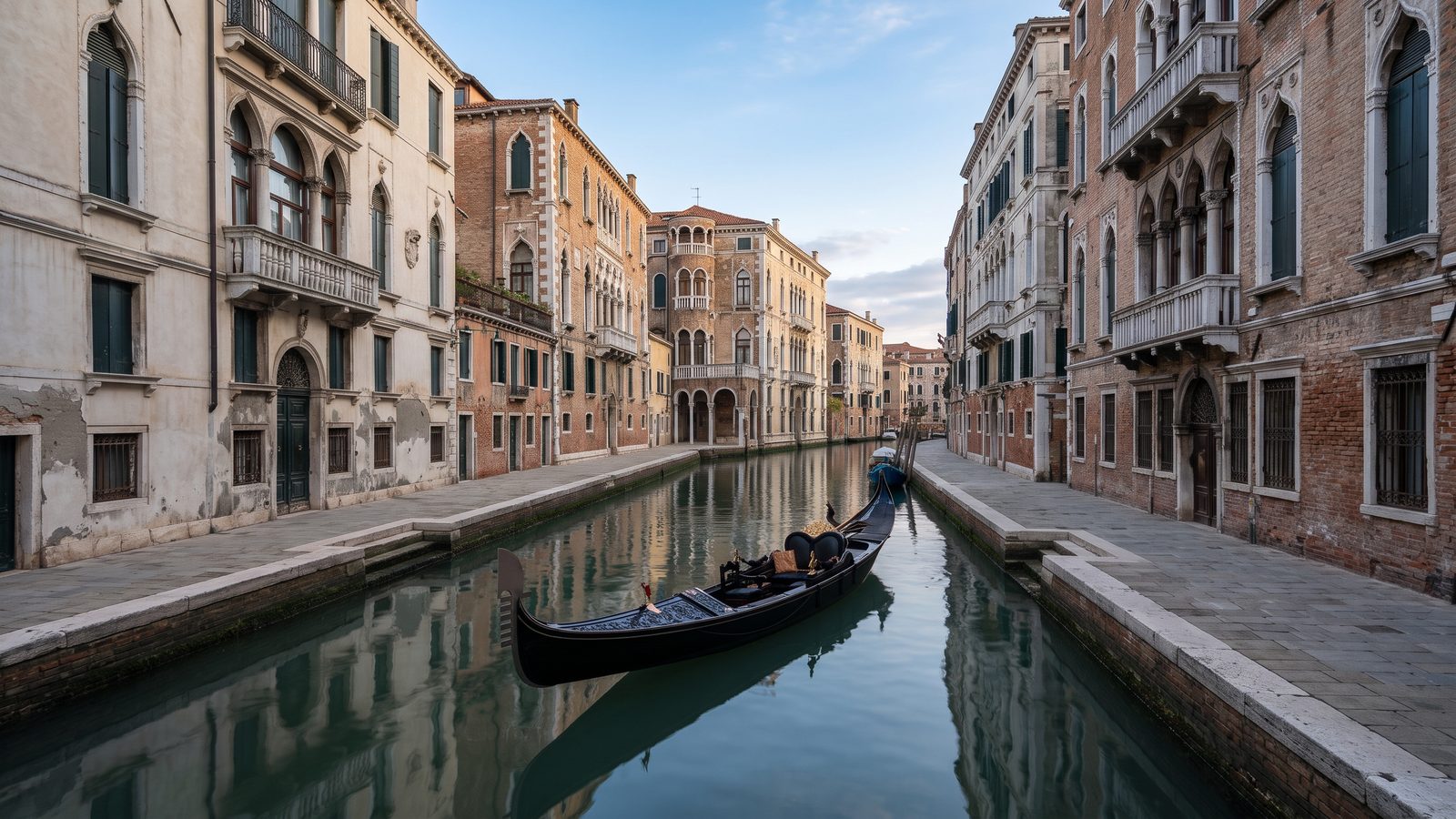
Welcome to Venice, a breathtaking city floating upon a marshy lagoon where shimmering canals replace busy streets. Built centuries ago on millions of wooden piles driven into the mud, Venice evolved from a humble lagoon refuge into a formidable maritime republic. As you drift along these historic waterways, you witness magnificent palazzi rising directly from the water, showcasing a unique blend of Venetian Gothic, Byzantine, and Renaissance architectural masterworks.
This self-guided audio tour reveals the living history and hidden details behind the Queen of the Adriatic. From the iconic Grand Canal lined with over 170 historic palazzi to the intricate design of traditional gondolas and Istrian stone bridges, prepare to immerse yourself in an unforgettable, floating open-air museum.
Listen to a sample
The opening of this tour, exactly as AllTours narrates it on site.
What you'll hear on this tour
Stop 1. The Secrets of the Asymmetric Gondola
You look down at the sleek black craft gliding beside you and notice its surprising shape. The gondola is intentionally built asymmetrical, with its left side longer than its right, allowing a single gondolier to propel and steer straight with a single oar. As you examine the flat-bottomed hull designed to navigate shallow lagoon canals, your eyes drift to the metallic front prow called the ferro. This carved iron ornament carries deep symbolism: six forward-pointing teeth represent Venice's six historic sestieri, one rear tooth honors the island of Giudecca, and the curving top reflects the official hat of the Doge.
Stop 2. Venetian Gothic Façades Floating on Water
You stand before majestic palazzi where stone seems to float weightlessly above the shimmering water. You are admiring Venetian Gothic architecture, a unique stylistic blend born from Venice’s extensive trade connections between Eastern and Western cultures. Notice the delicate, pointed ogee arches framing the windows and the intricate marble tracery adorning the upper levels. Each grand facade features a spacious ground-floor water entrance designed for merchants arriving by boat. Through open loggias and slender stone columns, master builders achieved an illusion of structural lightness, making these massive stone palaces appear to hover effortlessly above the canals.
Stop 3. Istrian Stone Arches Connecting Island Communities
You gaze up at a sculpted arc of Istrian stone spanning a narrow waterway, one of hundreds linking Venice's 118 individual islands. You notice the bridge's surprisingly steep incline, deliberately engineered so high-prowed gondolas can glide effortlessly underneath. Many of these ancient crossings were originally built without handrails or parapets, requiring pedestrians to tread carefully and trust their footing above the canal. As you step across these historic stones, you walk upon the vital structural sinews that have held Venetian daily life together across centuries, serving as silent witnesses to the city's long maritime history.
Stop 4. An Improbable Republic Born From Lagoon Mud
You trace your footsteps back to the 5th century, when mainland refugees fled barbarian invasions and sought refuge in these remote, marshy lagoons. To construct a permanent home upon soft ground, builders drove millions of solid alder and oak piles deep into the mud, forging the sturdy underground foundations that still support the city today. From this defiant act of human engineering, Venice grew into a dominant maritime republic that ruled Mediterranean trade routes for over a millennium. You stand upon an aquatic empire whose independent golden age finally came to a close under the conquest of Napoleon.
Stop 5. Living Alongside the Dynamic Saline Tides
You feel the gentle, persistent sway of the lagoon beneath you, realizing that water is both Venice's lifeblood and its constant challenge. The Adriatic Sea's saline waters continuously wash against the stone foundations, demanding ongoing human ingenuity to preserve the city. As you look out across the open channels, you spot weathered wooden posts called bricole standing in clusters above the waves. These wooden markers guide boat traffic safely through the shifting currents and unseen mudbanks. From architectural design to daily travel, every aspect of life here is governed by this continuous, delicate dance with the tide.
Stop 6. A Vibrant Heritage Sculpted by Lagoon Life
You listen carefully to the echoing call of a gondolier reverberating off stone walls, experiencing a living cultural tradition woven directly into the water. In Venice, life on the canals is not merely a tourist attraction but the authentic heartbeat of a unique aquatic civilization. This water-bound lifestyle cultivated a profound artistic legacy across the lagoon, inspiring the dramatic, light-filled brushstrokes of Tintoretto and driving the delicate lacework traditions of nearby Burano. As you travel these historic channels, you encounter an enduring creative spirit shaped entirely by centuries of life along the water.
Planning your visit
- Best time to go
- Early morning or late afternoon for calm waters, softer light, and fewer tour boats.
- Approximate duration
- About 2 to 3 hours
- Where to start
- Piazza San Marco or near the Rialto Bridge along the Grand Canal.
Access and conditions change seasonally — check the official site before you go.
Frequently asked questions
Is Canals of Venice worth visiting?
Yes, the Canals of Venice offer a globally unique urban experience, featuring centuries-old palazzi, historic stone bridges, and a vibrant car-free water culture recognized as a UNESCO World Heritage site.
How long do you need at Canals of Venice?
A dedicated 2 to 3 hour walk or boat tour covers the major Grand Canal landmarks and picturesque side canals, though spending a full day allows you to explore quiet backwater corridors.
How were the Venice canals and foundations built?
Starting in the 5th century, Venetians drove millions of wooden alder and oak piles deep into the marshy lagoon mud, creating solid timber foundations topped with stone to support heavy brick and marble palazzi.
Keep exploring
Header image is an AI-generated illustration of Canals of Venice. AllTours.ai is an AI audio tour guide — point your camera at any landmark and hear its story.