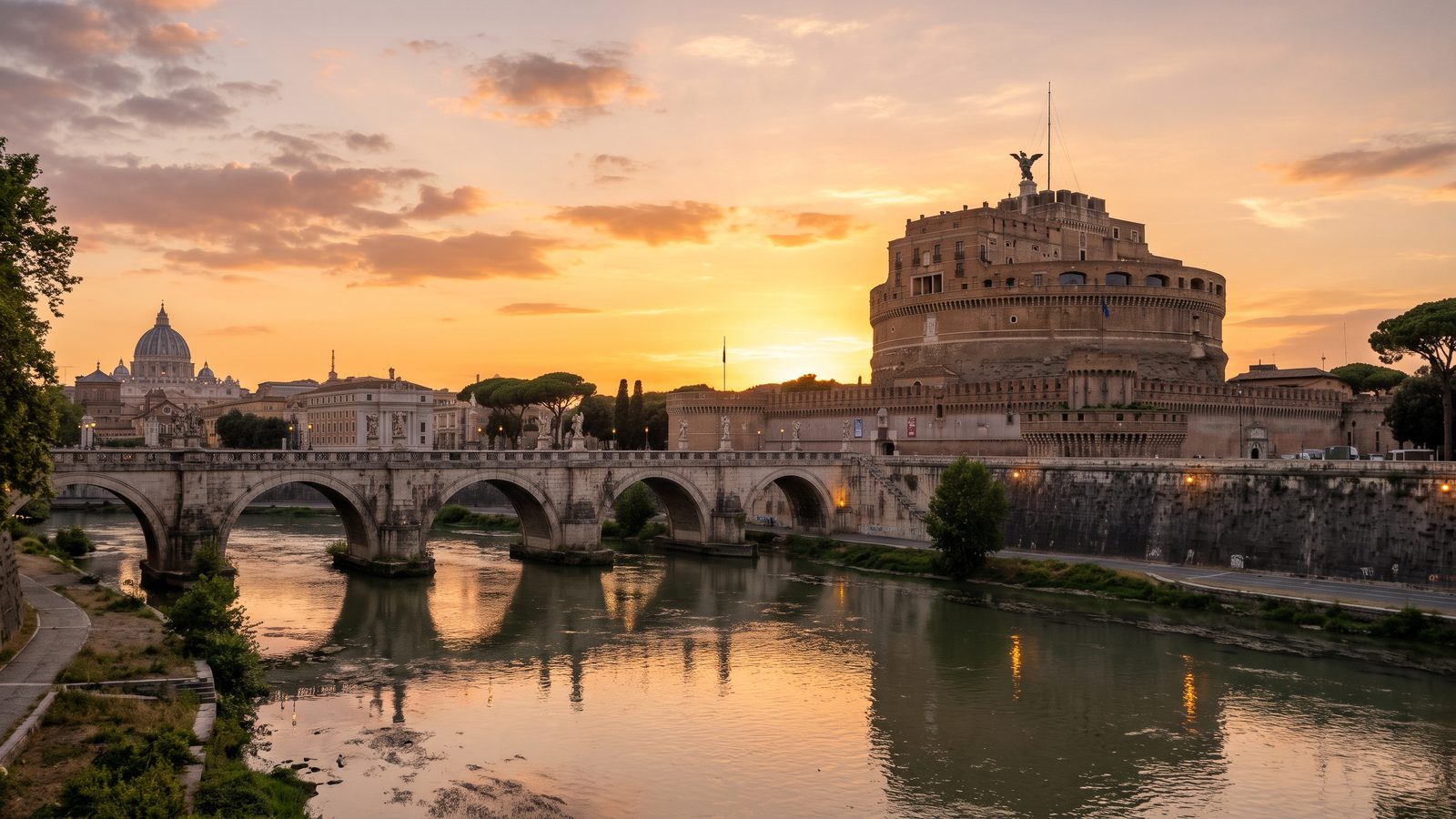
Standing along the Tiber River, Castel Sant'Angelo embodies nearly two millennia of Roman history. Originally built as Emperor Hadrian’s grand mausoleum, this monumental landmark evolved from an imperial tomb into a formidable papal fortress, a grim prison, and a lavish Renaissance palace. With your self-guided audio tour, you uncover secret corridors like the Passetto di Borgo and explore spectacular papal apartments crowned by the iconic Archangel Michael.
As you walk through its ancient corridors and scale its upper terraces, breathtaking panoramic views of Rome and St. Peter’s Basilica unfold before you. Immerse yourself in stories of divine visions, papal escapes, and timeless Baroque art as you navigate one of the city’s most captivating strongholds.
Listen to a sample
The opening of this tour, exactly as AllTours narrates it on site.
What you'll hear on this tour
Stop 1. The Vision of the Sheathed Sword
You stand beneath the grand fortress and travel back to 590 AD, a somber year when a devastating plague grips Rome. As Pope Gregory the Great leads a penitential procession near Hadrian’s ancient mausoleum, you imagine the sudden, miraculous vision above the monument. The Archangel Michael appears in glory, sheathing his fiery sword to signal the end of the pestilence. This divine gesture transforms a pagan tomb into Castel Sant’Angelo. Look up toward the summit, where a majestic 18th-century bronze statue of the Archangel crowns the castle, forever marking the moment heavenly grace saved the city.
Stop 2. Angels along the Ancient River Gateway
As you cross the Tiber toward the castle, you walk along Ponte Sant'Angelo, originally constructed by Emperor Hadrian in 134 AD as the Pons Aelius. Built from sturdy travertine marble, this ancient bridge serves as the sacred pathway for pilgrims visiting St. Peter’s Basilica. Look around at the ten exquisite Baroque angels lining the parapets, designed under Pope Clement IX in the 17th century. Created primarily by Gian Lorenzo Bernini’s workshop, each angel carries an instrument of Christ’s Passion. Though copies replace Bernini’s original carvings today, you experience a striking masterwork bridging ancient Roman engineering and Baroque grandeur.
Stop 3. The Papal Refuge and Secret Escape Route
You trace the formidable outer walls of a structure that evolved from an imperial tomb into Rome’s ultimate papal sanctuary. Look toward the Passetto di Borgo, an elevated fortified corridor constructed in 1277 by Pope Nicholas III to link the castle directly to St. Peter’s Basilica. You feel the tension of history knowing this secret passage saved Pope Clement VII during the terrifying Sack of Rome in 1527. Reinforcing bastions and heavy cannon emplacements designed by Renaissance architects like Antonio da Sangallo the Younger surround you, demonstrating how popes continuously fortified this giant cylinder into an impenetrable military stronghold.
Stop 4. Renaissance Splendor in the Papal Apartments
Step into the opulent papal apartments commissioned by Pope Paul III Farnese in the 16th century, where military defense yields to breathtaking Renaissance art. As you enter the magnificent Sala Paolina, vibrant frescoes painted by Perino del Vaga and his workshop surround you with scenes celebrating Alexander the Great and Emperor Hadrian. Look closely at the delicate stucco work on the ceilings, masterfully crafted by Giovanni da Udine with classical grotesques and mythological figures. Nearby, you observe intricate ancient Roman sculptures and urns discovered during excavations, culminating in Peter Anton von Verschaffelt's stunning 1753 bronze Archangel soaring above.
Stop 5. An Emperor's Monumental Final Resting Place
You encounter the very foundations of Castel Sant'Angelo, conceived around 135 AD by Emperor Hadrian as a grand mausoleum for his imperial dynasty. Envision the original massive cylindrical core clad in gleaming white Parian marble and crowned with a bronze quadriga, mirroring the splendor of Augustus’s tomb. Hadrian personally shapes the architectural design using robust tuff, peperino, and concrete. Following his death in 138 AD, his ashes rest within these thick walls alongside his wife Sabina and subsequent emperors up through Caracalla. As you walk through these ancient imperial chambers, you connect directly with Hadrian’s enduring ambition.
Stop 6. From Imperial Sepulcher to National Museum
As you explore the castle's layered history, you see how this monument adapted to every major era of Rome. Incorporated into the Aurelian Walls during the 5th century, it shifted from an imperial tomb into a vital military defense fortress. Later, as papal power grew, it served as both a lavish residence and a feared prison, holding notable historical figures within its dark cells up through the 19th century. Today, as you wander its historic halls converted into a national museum in 1925, you walk through nearly two thousand years of continuous transformation, preserving Rome’s dramatic journey from empire to modern nation.
Planning your visit
- Best time to go
- Early morning or late afternoon to avoid midday crowds and catch the golden sunlight along the Tiber.
- Approximate duration
- about 2 hours
- Where to start
- At the foot of Ponte Sant'Angelo on the south side of the Tiber River.
Access and conditions change seasonally — check the official site before you go.
Frequently asked questions
Is Castel Sant'Angelo worth visiting?
Yes, Castel Sant'Angelo offers a unique mix of ancient Roman architecture, lavish Renaissance papal rooms, and panoramic views of Rome and St. Peter's Basilica from its top terrace.
How long do you need at Castel Sant'Angelo?
Most visitors spend between 1.5 to 2 hours exploring the fortress ramparts, papal apartments, ancient mausoleum core, and rooftop views.
Why was Castel Sant'Angelo originally built?
It was originally built between 135 and 139 AD as an imperial mausoleum for Emperor Hadrian and his family, later housing the remains of subsequent Roman emperors.
Keep exploring
Header image is an AI-generated illustration of Castel Sant'Angelo. AllTours.ai is an AI audio tour guide — point your camera at any landmark and hear its story.