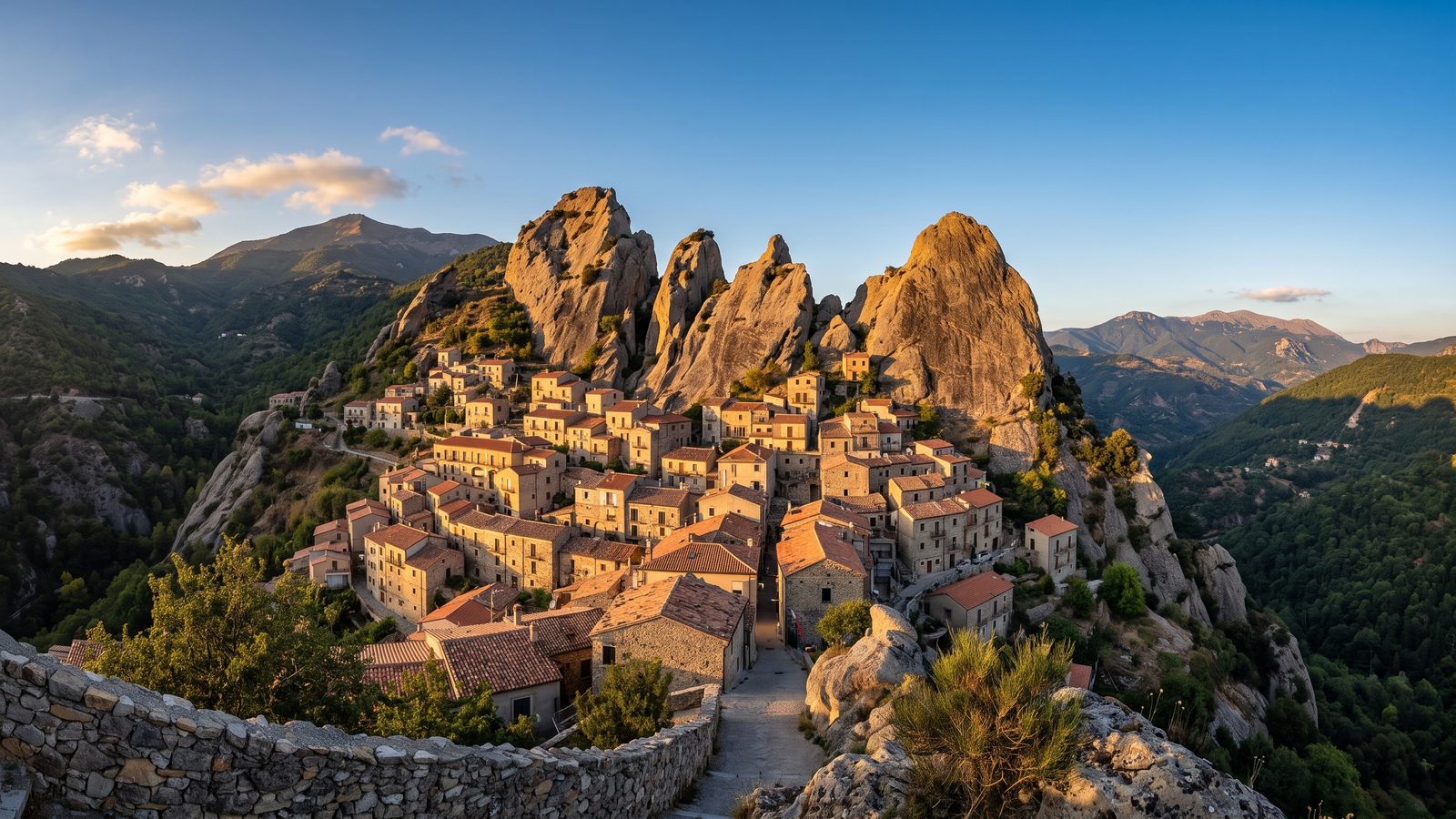
Welcome to Castelmezzano, an extraordinary village nestled high within Italy's dramatic Lucanian Dolomites in Basilicata. Sculpted by time and human determination, this historic settlement features homes built directly into towering sandstone cliffs and narrow alleyways winding like ancient veins. As you explore this living stronghold, you will discover how centuries of history, culture, and nature blend into a majestic mountain sanctuary clinging precariously to the surrounding rock faces.
Your self-guided audio journey leads you through steep stone staircases, historic fortresses, and unforgettable vistas of the Dolomiti Lucane. Immerse yourself in local folklore and ancient traditions while witnessing one of southern Italy's most breathtaking landscapes, where every stone tells an enduring story of beauty and resilience.
Listen to a sample
The opening of this tour, exactly as AllTours narrates it on site.
What you'll hear on this tour
Stop 1. Sandstone Spires and Jagged Peaks
You look up at the magnificent Lucanian Dolomites, a geological masterpiece sculpted over millions of years by wind and water. You trace the dramatic sandstone and conglomerate formations that reach toward the sky like ancient sentinels. Take notice of distinct landmarks like Eagle Peak and Anvil Peak as they embrace Castelmezzano in their rocky hold. Their visible layers tell tales of primordial seas and tectonic shifts that created these jagged forms, often called the Garden of the Gods. Above you, these ochre and rose cliffs frame the horizon, while below lies the lush Basento valley, creating a striking visual contrast that defines this isolated mountain landscape.
Stop 2. Hidden Vicoli and Cliffside Homes
You step deeper into the village to discover narrow stone pathways, or vicoli, winding through a living tapestry of architecture. As you walk, you notice how the rear walls of ancient homes are carved directly into the dolomite rock, defying the steep mountain gradient. Each flight of stone stairs you climb leads to intimate hidden piazzas and unexpected overlooks. The village built itself upwards and inwards to survive, adapting to isolation through sheer ingenuity. You feel the resilient spirit of a community that seamlessly integrated its daily life into the stone, turning sheer cliffside challenges into an enduring, close-knit mountain sanctuary.
Stop 3. Byzantine Refuge and Norman Fortress
You stand on grounds shaped by centuries of strategic defense and mountain refuge. Your journey back in time begins in the tenth century, when Byzantine settlers sought safety among these formidable rock spires. A century later, Norman forces recognized the unique defensive value of this location and built the castle that gives Castelmezzano its name. You contemplate how this medieval fortress served as a crucial stronghold, guarding vital trade routes crossing the Lucanian Dolomites. As you examine the ancient layout, you see how these defensive roots shaped the isolated character and cliff-clinging architecture that still defines the village today.
Stop 4. The Sacred Ritual of May
You encounter a vibrant culture deeply connected to the natural world and seasonal rebirth. Every year, the community comes together for the Maggio di Castelmezzano, or Tree of May, an ancient ritual that goes far beyond a typical festival. You learn how villagers carefully select and transport a towering tree through the rugged terrain, a physically demanding task that symbolizes fertility and the town's eternal bond with the forest. This traditional celebration brings the entire population together to honor shared heritage, renewed life, and community solidarity, demonstrating how deeply local customs remain rooted in the surrounding Lucanian wilderness.
Stop 5. The Path of Seven Stones
You trace the route of the Sentiero delle Sette Pietre, or Path of the Seven Stones, an ancient shepherd trail linking Castelmezzano to neighboring Pietrapertosa. Inspired by the literary works of Rocco Scotellaro, this path turns a scenic walk into an immersive narrative experience. As you follow the rugged trail across the valley, each stone marker along the way reveals a new chapter of regional folklore and local legend. You walk through pristine landscapes framed by towering sandstone formations, following in the footsteps of past generations while absorbing the haunting beauty and rich oral traditions of Basilicata.
Stop 6. Panoramic Views of Garden of Gods
You pause to take in the breathtaking panorama of the Dolomiti Lucane unfolding across the horizon. From this high vantage point, you observe colossal sandstone spires soaring dramatically into the sky, often referred to as the Garden of the Gods. Their warm ochre and subtle rose hues continuously shift as the sun moves across the sky, casting dynamic shadows over the jagged peaks. Below the sheer rock faces, the verdant green Basento valley stretches out, creating a vivid contrast against the pale cliffs that encircle Castelmezzano in a protective, dramatic natural amphitheater.
Planning your visit
- Best time to go
- Spring through autumn during daylight hours, especially late afternoon when sunlight illuminates the ochre cliff faces.
- Approximate duration
- about 2 hours
- Where to start
- The main village entrance near the central historic center of Castelmezzano.
Access and conditions change seasonally — check the official site before you go.
Frequently asked questions
Is Castelmezzano worth visiting?
Yes, Castelmezzano is widely considered one of Italy's most picturesque mountain villages, renowned for its homes built directly into the towering Lucanian Dolomites and rich cultural heritage.
How long do you need at Castelmezzano?
Plan to spend at least 2 to 4 hours exploring the village alleys, view points, and historical spots, or a full day if you plan to hike the nearby Path of Seven Stones.
What is the history of Castelmezzano?
Originating as a 10th-century Byzantine refuge, Castelmezzano was fortified in the 11th century by Normans who built a castle to guard vital trade routes through the Lucanian Dolomites.
Keep exploring
Header image is an AI-generated illustration of Castelmezzano. AllTours.ai is an AI audio tour guide — point your camera at any landmark and hear its story.