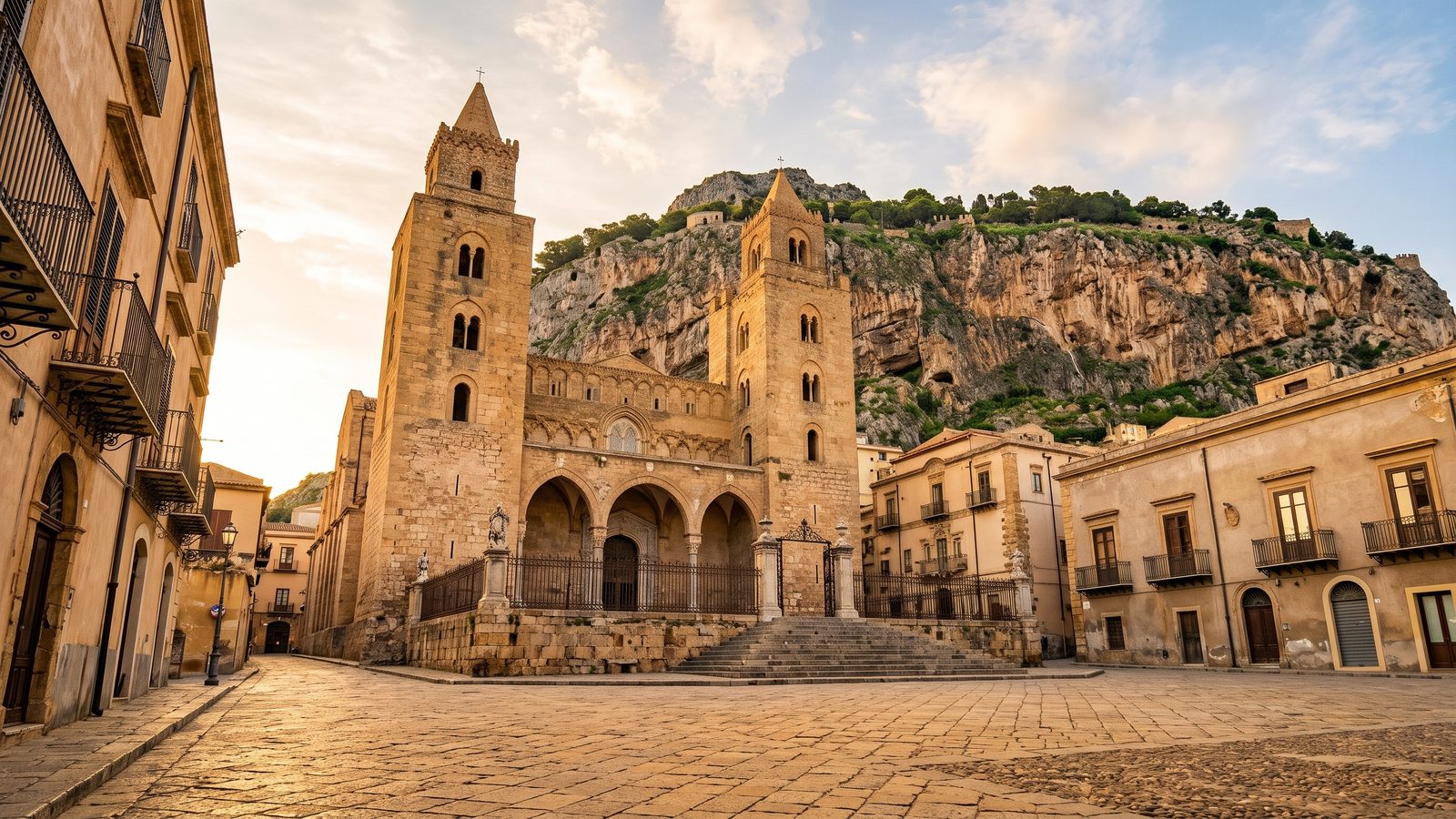
Welcome to Cefalù Cathedral, an extraordinary 12th-century fortress-basilica standing proudly between the Mediterranean Sea and towering cliffs. Founded by the Norman King Roger II in 1131, this UNESCO World Heritage site represents a remarkable fusion of Norman architecture, Byzantine artistry, and Islamic influence. As you explore its sacred space, you will discover breathtaking golden mosaics, ancient Roman columns, and centuries of fascinating Sicilian history.
This self-guided audio tour walks you through the cathedral's dramatic origins, architectural wonders, magnificent artistic masterpieces, and sweeping coastal views. Step inside to feel the enduring spirit of King Roger's royal dream and experience one of the Mediterranean's most impressive treasures at your own peaceful pace.
Listen to a sample
The opening of this tour, exactly as AllTours narrates it on site.
What you'll hear on this tour
Stop 1. Shimmering Mosaics of the Pantocrator
You step into the apse and stand spellbound before the monumental Christ Pantocrator. His piercing blue eyes command your quiet attention while his left hand holds the open Gospel book, inscribed in both Greek and Latin. Notice how thousands of minute gold tesserae line the wall, bending and refracting light into a divine radiance with your every movement. Below Christ, you spot the serene Virgin Hodegetria accompanied by four graceful archangels. As you trace the apostles and saints along the triumphal arch, you see their delicate expressions and lively gestures creating a silent, perpetual liturgy. You are witnessing the absolute pinnacle of Byzantine mosaic craftsmanship.
Stop 2. A King's Shipwreck Vow
You stand on ground commissioned by King Roger II following a perilous storm in 1130. After surviving a harrowing shipwreck near these shores, Roger makes a solemn promise to build a grand cathedral in gratitude to God. You can picture the rapid construction that follows, where skilled Byzantine artisans arrive directly from Constantinople to lay foundations alongside local craftspeople. While Roger envisions this sacred monument as a grand royal burial site to rival Northern Europe, his unexpected death leaves those plans partially unfulfilled. As you walk through the basilica, you feel centuries of shifting history, from Norman strength and Swabian rule to Aragonese modifications.
Stop 3. Columns, Arches, and Roman Spolia
You observe the bold Latin cross plan defining this basilica, showcasing strong Western architectural choices tempered by Norman power. Look closely at the towering monolithic columns lining the central nave; you are looking at Roman spolia, ancient temple columns repurposed across generations. Above your head, an imposing barrel vault spans the central hall while lighter cross vaults define the side aisles. You notice the pointed arches, an early pre-Gothic innovation distributing heavy structural weight with pragmatic ingenuity. Out in the quiet cloister, you admire paired columns topped with intricately carved capitals, each displaying unique miniature relief sculptures of biblical scenes and fantastical mythical beasts.
Stop 4. Panoramic Vistas from the Bell Tower
You ascend the ancient spiral staircase carved directly from rugged local stone, emerging onto the high battlements of the bell tower. Before you stretches a breathtaking panorama of the Tyrrhenian Sea, where local fishing boats still sail the blue water just as they did in Norman times. Turning around, you confront the massive limestone face of La Rocca towering directly behind the town, a formidable natural fortress integrated into King Roger's strategic vision. Looking down, you trace a labyrinth of narrow alleys and terracotta roofs framing lively piazzas. Even the apse windows below were deliberately aligned to catch this shimmering Mediterranean sunlight.
Stop 5. The Living Soul of Cefalù
You feel how this monumental sanctuary functions as the heart of Cefalù's living community. Centuries of Norman, Byzantine, and Arab customs do not clash here; instead, they intertwine in local traditions. In the shadow of these twin sandstone towers, generations of local artisans craft metalwork and textiles carrying a distinct Cefalù style. You are walking through the center of social life, where grand events like the Feast of San Salvatore launch vibrant street processions through the town below. Listen closely to the local Sicilian dialect spoken around you, a rich linguistic mosaic echoing centuries of diverse historical influences under the cathedral's watchful gaze.
Stop 6. A Culinary Melting Pot
You discover that Cefalù's food culture mirrors the multi-layered history of its cathedral. As you explore nearby eateries, you taste Arab culinary influences in sweet-and-sour agrodolce dishes like sarde a beccafico, where fresh sardines are stuffed with pine nuts and raisins. Saffron adds golden color to crunchy arancini rice balls, while cinnamon aromas fill local pastry shops. You also experience the hearty Norman tradition in satisfying pasta dishes tossed with rich tomato sauces and sharp local pecorino cheese. From Tyrrhenian sea catches seasoned with citrus to mountain herbs from the Madonie range, every flavor reveals a legacy of cultural convergence.
Planning your visit
- Best time to go
- Early morning or late afternoon for gentle sunlight through the apse windows and fewer tour groups.
- Approximate duration
- About 1 to 1.5 hours
- Where to start
- Piazza del Duomo, facing the twin sandstone towers at the cathedral's main entrance stairs.
Access and conditions change seasonally — check the official site before you go.
Frequently asked questions
Is Cefalù Cathedral worth visiting?
Yes, Cefalù Cathedral is a UNESCO World Heritage site world-famous for its magnificent 12th-century Byzantine mosaics, Norman fortress towers, and rich multicultural Sicilian history.
How long do you need at Cefalù Cathedral?
Most visitors spend between 45 minutes to 1.5 hours exploring the cathedral nave, admiring the Christ Pantocrator mosaic, visiting the cloister, and climbing the tower for town views.
Why was Cefalù Cathedral built?
King Roger II commissioned Cefalù Cathedral in 1131 following a deeply personal vow after surviving a violent shipwreck off the coast of Cefalù in 1130.
Keep exploring
Header image is an AI-generated illustration of Cefalù Cathedral. AllTours.ai is an AI audio tour guide — point your camera at any landmark and hear its story.