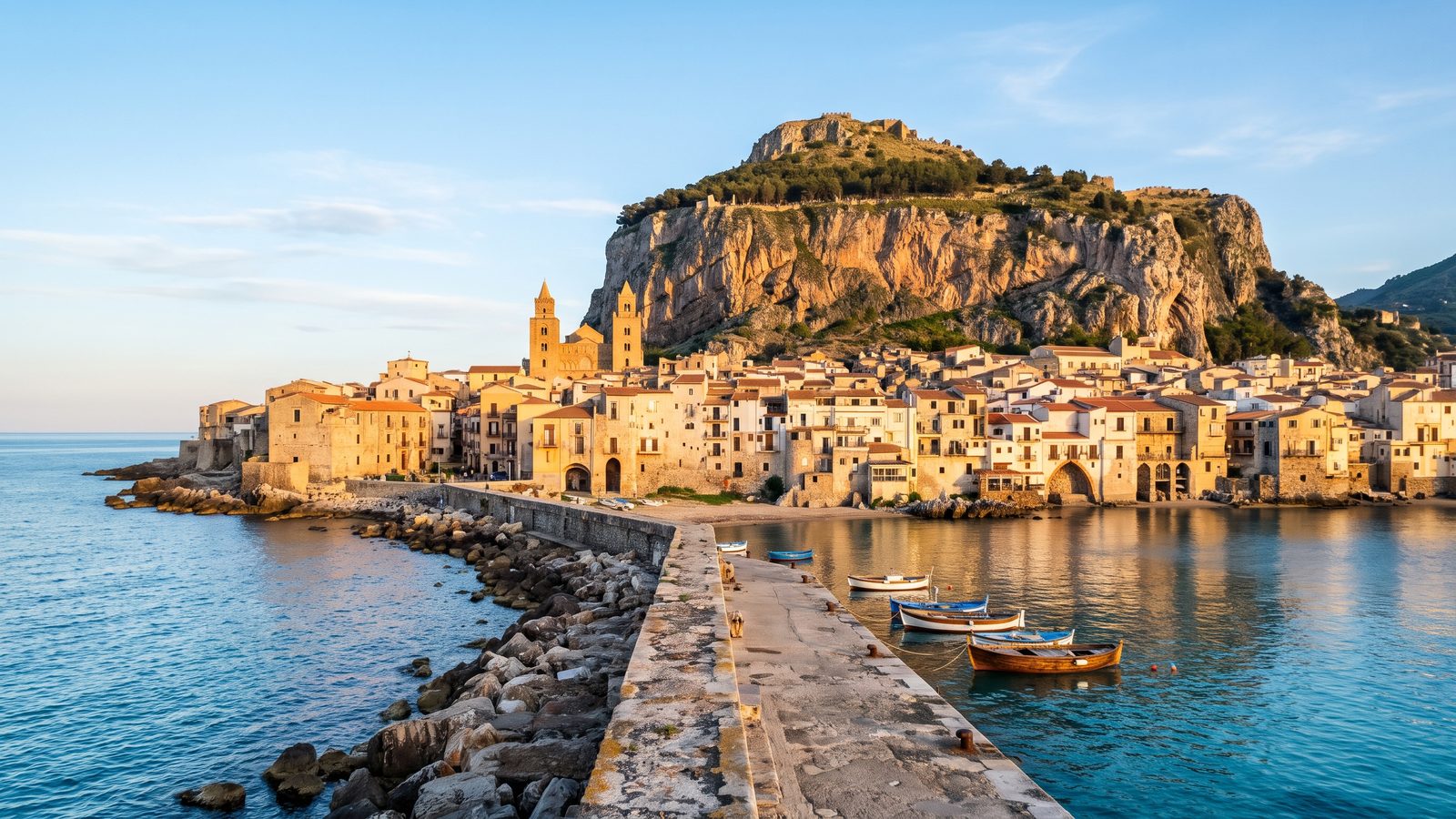
Welcome to Cefalù, a historic Sicilian town nestled dramatically beneath the towering limestone monolith of La Rocca. As you wander medieval streets, the UNESCO World Heritage Duomo di Cefalù dominates the horizon, commissioned in 1131 by King Roger II. Here, ancient roots meet sun-drenched shores, blending centuries of vibrant Mediterranean culture with sparkling turquoise waters. Get ready to experience an authentic coastal haven shaped by ancient civilizations.
From glittering Byzantine mosaics to panoramic summits, this self-guided audio tour leads you through Cefalù's rich history, exquisite architecture, and breathtaking natural scenery. Immerse yourself in local traditions, stroll along golden beaches, and discover why this strategic port has captivated travelers from antiquity to the present day.
Listen to a sample
The opening of this tour, exactly as AllTours narrates it on site.
What you'll hear on this tour
Stop 1. Audacity in Sandstone and Mosaics
Stand before the monumental Duomo di Cefalù and feel the immense power carved into its local sandstone façade. You admire the formidable twin towers, originally built with battlements to serve as both a sacred cathedral and a defensive stronghold. Softening this imposing Romanesque structure, a refined 15th-century three-arched portico welcomes you inside. As you step into the vast nave, look up at the massive columns and early pointed arches. This architectural marvel introduced proto-Gothic innovations to Sicily decades before their widespread adoption. Marvel at how Norman massiveness seamlessly blends with Byzantine structural logic, creating a profound masterpiece at the crossroads of medieval Mediterranean culture.
Stop 2. Echoes of Empires and Vows
You delve into Cefalù's deep past long before the Normans arrived. Ancient Greeks first settled here as Kephaloidion, naming the port after La Rocca's head-like promontory. Romans followed, then Byzantines who built early defensive fortifications on the rock. In the ninth century, Arab rulers renamed it Gafudi, bringing advanced urban planning and agricultural methods that still shape the town today. Norman King Roger I captured the strategic port in 1063. Decades later, Roger II commissioned the grand Duomo—legend says after surviving a violent storm at sea, though it also served as a bold political statement of his expanding kingdom's supreme authority.
Stop 3. Panoramic Majesty atop La Rocca
You complete the rewarding climb up La Rocca as a spectacular 360-degree panorama unfolds beneath you. Standing on this ancient high perch, you gaze across an intricate mosaic of terracotta rooftops cascading toward the sparkling cerulean waters of the Tyrrhenian Sea. The sweeping crescent bay cradles the shoreline, while the hazy silhouettes of the Aeolian Islands shimmer on clear horizons. Turn your gaze inland to admire the rolling green peaks of the Madonie Mountains framing the coast. Imagine ancient Greek mariners or Norman monarchs scanning these exact horizons for incoming fleets, as the shifting Mediterranean sunlight transforms this breathtaking landscape throughout the day.
Stop 4. Living Traditions along Corso Ruggero
Strolling through sunlit vicoli, you feel the vibrant heartbeat of daily life in Cefalù. Listen closely as locals converse in Sicilian dialect, a rich linguistic tapestry blending Greek, Arabic, and Norman inheritances. If you visit in August, imagine the thrilling Festa del Santissimo Salvatore, where daring local youths scramble up a greased wooden pole extending over the sea to grab a flag. You sit at a cozy trattoria to sample authentic pasta con le sarde, tasting Arab-influenced wild fennel, pine nuts, and raisins. Later, join residents for the traditional evening passeggiata along Corso Ruggero, celebrating simple pleasures and warm coastal community.
Stop 5. Wild Monoliths and Seagrass Meadows
Feel the refreshing coastal sea breeze as you discover the wild natural wonders surrounding Cefalù. The massive limestone cliffs of La Rocca, formed from an ancient seabed thrust skyward over millions of years, host delicate wild caper plants sprouting directly from rocky fissures. Look skyward to spot majestic peregrine falcons soaring along thermal currents. Below the cliffs, the crystal-clear Tyrrhenian Sea relies on vast underwater Posidonia oceanica meadows—the vital lungs of the Mediterranean. These pristine seagrass beds oxygenate the coastal waters, providing a safe haven for colorful parrotfish and shimmering schools of anchovies in an extraordinary coastal ecosystem.
Stop 6. Golden Sands of the Tyrrhenian Coast
You walk down to the fine golden shoreline where Cefalù meets the calm harbor waters. Sink your feet into warm sand sculpted by centuries of sea currents flowing around La Rocca. The clear water shifts from shallow turquoise to deep emerald, offering glimpses of the submerged rocky seabed below. This natural aquatic amphitheater once sheltered historic fishing vessels and now provides a tranquil haven for swimmers. As sunset approaches, smell fresh seafood drifting from nearby waterfront trattorias along the Lungomare. You join locals gathering on the shore, watching the evening sky ignite in golden light over the ancient coastal skyline.
Planning your visit
- Best time to go
- Spring (April to June) or early autumn (September to October) for pleasant weather; climb La Rocca early in the morning.
- Approximate duration
- about 2 to 3 hours
- Where to start
- Piazza del Duomo in front of the Cathedral of Cefalù
Access and conditions change seasonally — check the official site before you go.
Frequently asked questions
Is Cefalù worth visiting?
Yes, Cefalù is one of Sicily's most captivating destinations, famed for its UNESCO-listed Norman Cathedral, golden beaches, medieval alleys, and the dramatic backdrop of La Rocca.
How long do you need at Cefalù?
A half-day to a full day is ideal to explore the historic center, visit the Duomo, hike La Rocca for panoramic views, and relax along the seaside promenade.
Who built the Duomo di Cefalù and why?
King Roger II commissioned the cathedral in 1131, fulfilling a solemn vow made during a dangerous storm at sea and asserting his kingdom's power with a monumental royal mausoleum.
Keep exploring
Header image is an AI-generated illustration of Cefalù. AllTours.ai is an AI audio tour guide — point your camera at any landmark and hear its story.