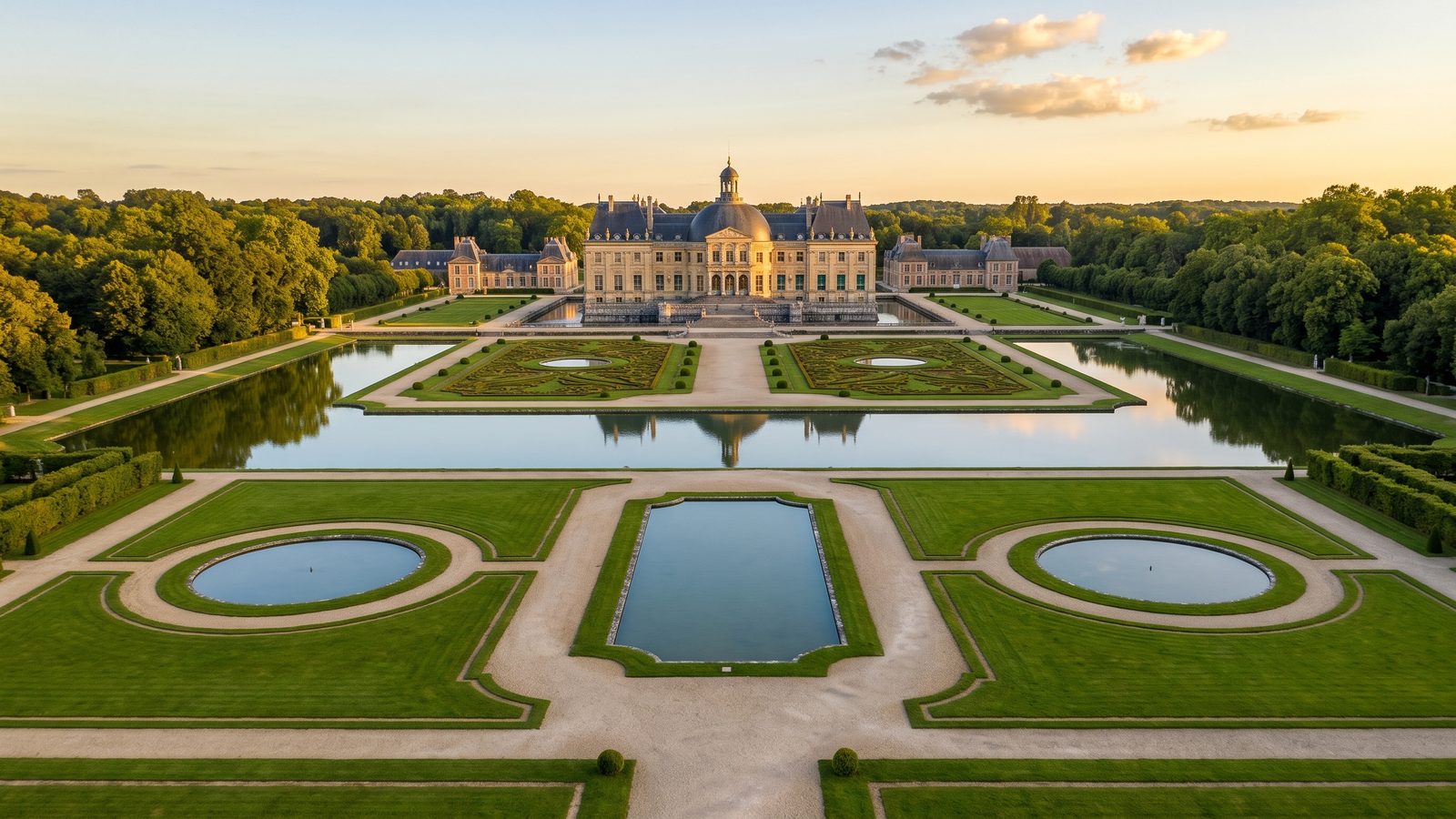
Step into the mid-17th-century masterpiece that ignited a king's envy and sparked the creation of Versailles. Conceived by Nicolas Fouquet, Louis XIV's Superintendent of Finances, Château de Vaux-le-Vicomte represents the collaborative genius of architect Louis Le Vau, painter Charles Le Brun, and landscape architect André Le Nôtre. As you explore this estate, you discover a golden age of ambition, audacious architecture, and revolutionary garden design.
This self-guided audio tour walks you through opulent interior chambers and theatrical formal gardens. Learn how a single lavish party sealed Nicolas Fouquet’s tragic fate, leaving behind a groundbreaking architectural blueprint that directly inspired the Palace of Versailles.
Listen to a sample
The opening of this tour, exactly as AllTours narrates it on site.
What you'll hear on this tour
Stop 1. The Party That Doomed a Minister
You stand at the center of a dramatic saga linked to Nicolas Fouquet, Louis XIV's Superintendent of Finances. Between 1656 and 1661, Fouquet pours his vast fortune into assembling the era's greatest talents: Louis Le Vau, Charles Le Brun, and André Le Nôtre. Their shared vision culminates in a lavish fête on August 17, 1661, intended to honor King Louis XIV. However, witnessing such unprecedented grandeur ignites profound jealousy within the young monarch. Just three weeks later, Fouquet is arrested for embezzlement, while his craftsmen are redirected to construct Versailles. Though Fouquet spends his remaining days imprisoned, his estate remains a supreme testament to his ill-fated genius.
Stop 2. Revolutionary Early French Baroque Design
Gaze up at the striking façade to admire Louis Le Vau’s mastery of early French Baroque design. You immediately notice the deliberate symmetry and the innovative double-pile plan, a layout where rooms are arranged two deep to fill the interior with natural light. Look higher to see the audacious oval dome crowning the Grand Salon, an unheard-of feature for a private 17th-century French residence. The harmonious blend of local stone and dark slate roofing creates a sophisticated visual rhythm across the structure. Every window and pilaster demonstrates precise proportions, establishing this palace as the definitive prototype that directly inspires the construction of Versailles.
Stop 3. The Art of Optical Illusion
Step outside onto the terrace where André Le Nôtre’s landscape genius unfolds across a grand stage. You are looking at the foundational blueprint of the classic French formal garden, where nature is completely sculpted to showcase human power. Notice how the long central axis uses anamorphosis abscondita, an optical illusion that cleverly alters your perspective. Distance bends before your eyes, making the far-off grotto appear remarkably close and the broad canal surprisingly short. Below you, intricate embroidered parterres resemble delicate lace. To achieve this breathtaking harmony, thousands of workers spent years leveling hills and rerouting local streams under Fouquet's unyielding direction.
Stop 4. Gilded Salons and Royal Ambition
Walk inside the palace to experience the luxurious heart of Fouquet’s ambitious estate. You enter the unique oval Grand Salon, where a soaring dome creates a dramatic sense of limitless space. All around you, painter Charles Le Brun leaves his artistic mark through intricate stucco work and vibrant ceiling frescoes that celebrate Fouquet's virtues. You pass through the very rooms where the fateful 1661 celebration took place, including the magnificent King’s Apartment. Though Louis XIV never actually sleeps here, this dazzling display of taste and opulence deeply infuriates the young monarch, providing the direct inspiration for the golden halls of Versailles.
Stop 5. Hydraulic Wonders of the Grand Canal
As you wander toward the water features, you behold an aquatic ballet that predates the famous fountains of Versailles. To power these shimmering jets, cascades, and reflection pools, engineers perform a monumental feat by diverting the nearby River Anqueil into a massive reservoir system. Notice how the vast Grand Canal stretches across the landscape like a giant mirror reflecting the open sky. Secret grottoes along the paths once concealed hidden water jets designed to surprise visitors with whimsical water displays. These historic Grandes Eaux demonstrate absolute control over nature, serving as a powerful display of artistic genius and engineering mastery.
Stop 6. 33 Hectares of Sculpted Grandeur
You are walking through André Le Nôtre’s very first monumental masterpiece, a sprawling 33-hectare landscape extending over three kilometers along a rigid central axis. As you move away from the main building, notice how the intricate boxwood parterres gradually reveal subtle terrain shifts that appear entirely flat when viewed from the castle. Le Nôtre expertly manipulates your gaze, enticing you to walk further down the pathways toward the distant statue of Hercules. The vast canals and hidden stone grottoes recall the extravagant courtly celebrations that once took place here, marking this location as the true birthplace of European landscape design.
Planning your visit
- Best time to go
- Spring through early autumn for blooming parterres and active fountain displays.
- Approximate duration
- About 2 to 3 hours
- Where to start
- In front of the main entrance gates facing the northern château façade.
Access and conditions change seasonally — check the official site before you go.
Frequently asked questions
Is Château de Vaux-le-Vicomte worth visiting?
Yes, Château de Vaux-le-Vicomte is widely considered a masterpiece of 17th-century French architecture and garden design, serving as the direct inspiration for Versailles.
How long do you need at Château de Vaux-le-Vicomte?
Plan to spend around 2 to 3 hours to explore the palace interiors, walk through the 33-hectare formal gardens, and admire the grand fountains.
Why was Nicolas Fouquet imprisoned after building Vaux-le-Vicomte?
After hosting a lavish party on August 17, 1661, Superintendent of Finances Nicolas Fouquet provoked intense envy from King Louis XIV, leading to his arrest three weeks later.
Keep exploring
Header image is an AI-generated illustration of Château de Vaux-le-Vicomte. AllTours.ai is an AI audio tour guide — point your camera at any landmark and hear its story.