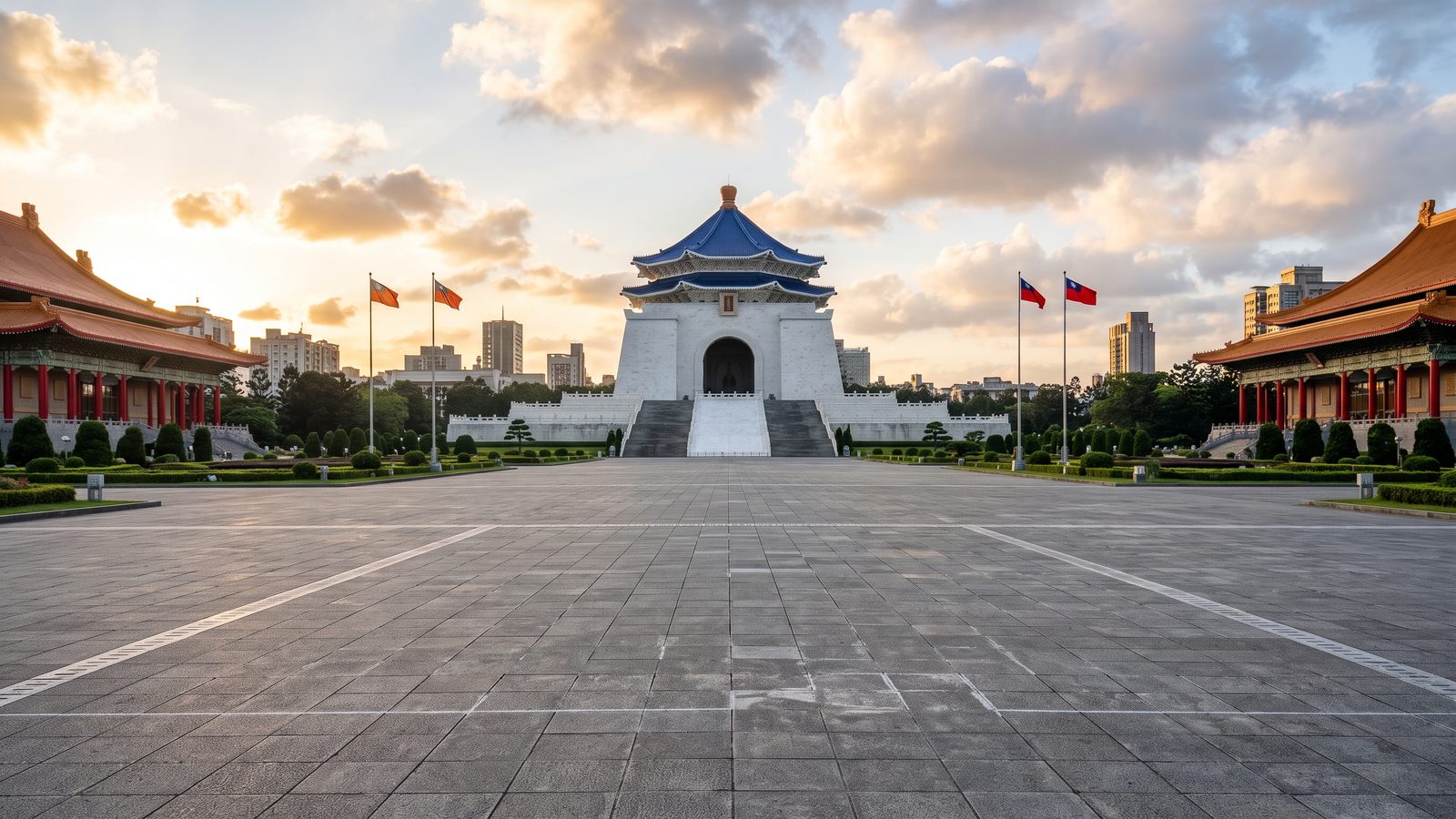
Welcome to Liberty Square, home to the Chiang Kai-shek Memorial Hall. Built following the passing of Generalissimo Chiang Kai-shek in 1975, this magnificent Taipei landmark features dazzling white walls and a brilliant blue-tiled octagonal roof. As you explore this grand plaza, you will discover a profound tribute to Taiwan's former leader, impressive architectural symbolism, classical gardens, and a vibrant center for Taiwanese culture and performing arts.
Experience the precision of the honor guard, admire architecture reflecting national colors, and wander through peaceful Chinese gardens. This self-guided audio tour walks you through the history, philosophy, and living spirit that make this monumental hall an essential heart of Taipei.
Listen to a sample
The opening of this tour, exactly as AllTours narrates it on site.
What you'll hear on this tour
Stop 1. Ascending the Grand Staircase
As you look up at the Memorial Hall, notice how its white walls and octagonal blue-tiled roof echo the colors of the national flag, symbolizing purity, liberty, and the Republic of China emblem. You begin your ascent up the 89 steps, each step deliberately representing a year of Chiang Kai-shek's lifespan. Once you step inside the massive main hall, the sense of scale is awe-inspiring. You stand before a giant seated bronze statue of Chiang Kai-shek, flanked by two motionless honor guards who perform synchronized hourly movements. High above, the inscribed Chinese characters for Ethics, Democracy, and Science remind you of the guiding principles that shaped his vision for the nation.
Stop 2. Symbols Cast in Marble and Tile
Standing before the Memorial Hall, you see a modern masterpiece of traditional Chinese palace architecture. Look closely at the octagonal blue roof, which represents Heaven and the eight trigrams from the I Ching, inviting wisdom and good fortune. Beneath this canopy, pristine white walls stand for purity and equality, contrasting with red railings that complete the colors of the national flag. Notice the four symmetrical sides representing traditional virtues, as well as the exactly 89 steps beneath your feet. Every architectural choice, from glazed roof tiles to massive marble walls, communicates reverence and deep national symbolism as you take in the impressive scale of this monumental design.
Stop 3. Tranquility in the Classical Gardens
You step away from the open plaza into the peaceful greenery of the classical Chinese gardens surrounding the main hall. Winding paths guide your steps, designed deliberately to encourage thoughtful contemplation rather than linear haste. As you walk toward Yunhan Pond, also known as the Cloud-reaching Pond, you see quiet pavilions like the Resting Heart Pavilion reflected on the water's surface. Carefully placed rockeries mimic mountain ranges, while graceful bamboo and plum blossoms offer deep cultural symbols of resilience and integrity. Watch the colorful koi glint beneath the curved bridges, enjoying a serene sanctuary where ancient feng shui principles bring harmony to your surroundings amidst the city's bustle.
Stop 4. The Living Canvas of Liberty Square
Looking across the expansive plaza, you notice how the memorial grounds serve as a dynamic center for Taiwan's living culture. Flanking the square stand the majestic National Theater and National Concert Hall, where traditional Peking Opera and Taiwanese puppetry share stages with international symphony orchestras. You can watch the impressive changing of the guard ceremony, an intricate display of military precision and reverence that draws captivated crowds. All around you, the plaza functions as a vibrant communal space where local residents practice tai chi, students rehearse dances, and families stroll together, creating a lively bridge between historical reverence and modern Taiwanese public life.
Stop 5. Artifacts of a Transforming Era
Descending into the lower levels, you enter a curated exhibition detailing the life and leadership of Generalissimo Chiang Kai-shek. Here, you walk past significant historical artifacts, including his official presidential Cadillac gleaming under gallery lights. You observe his personal military uniforms, handwritten calligraphy, and an authentic re-creation of his presidential office complete with his desk and personal books. Detailed displays trace major 20th-century events, from early military campaigns to the retreat to Taiwan in 1949. As you explore these galleries, intimate family photographs and official documents reveal the complex history and personal story behind one of modern East Asia's most prominent leaders.
Stop 6. Echoes of a Nation's Destiny
As you stand on these historic grounds, you reflect on the turbulent narrative that brought this monumental complex into existence. Built following Chiang Kai-shek's death in 1975 and completed in 1980, the memorial honors a leader who unified China during the Northern Expedition and led the nation through the Second Sino-Japanese War. After the Chinese Civil War prompted his government's relocation to Taiwan in 1949, Chiang established the Republic of China's base here, permanently altering the island's geopolitical future. You consider how this space captures an era defined by global conflict, nation-building, and the profound political shifts that shaped contemporary Taiwan.
Planning your visit
- Best time to go
- Early morning or late afternoon to avoid peak midday heat and witness the daily grounds activities.
- Approximate duration
- about 1.5 to 2 hours
- Where to start
- At the main Liberty Square Archway facing Zhongshan South Road.
Access and conditions change seasonally — check the official site before you go.
Frequently asked questions
Is Chiang Kai-shek Memorial Hall worth visiting?
Yes, it is one of Taipei's most iconic historic and cultural landmarks, offering visitors impressive traditional Chinese architecture, lush gardens, insightful museum exhibits, and a lively public plaza.
How long do you need at Chiang Kai-shek Memorial Hall?
Most visitors spend between 1 and 2 hours to walk through the main hall, see the honor guard ceremony, stroll through the classical gardens, and explore the museum exhibits.
Why was the Chiang Kai-shek Memorial Hall built?
The complex was commissioned following the death of Generalissimo Chiang Kai-shek in 1975 to honor his life, military campaigns, and political leadership as President of the Republic of China.
Keep exploring
Header image is an AI-generated illustration of Chiang Kai-shek Memorial Hall. AllTours.ai is an AI audio tour guide — point your camera at any landmark and hear its story.