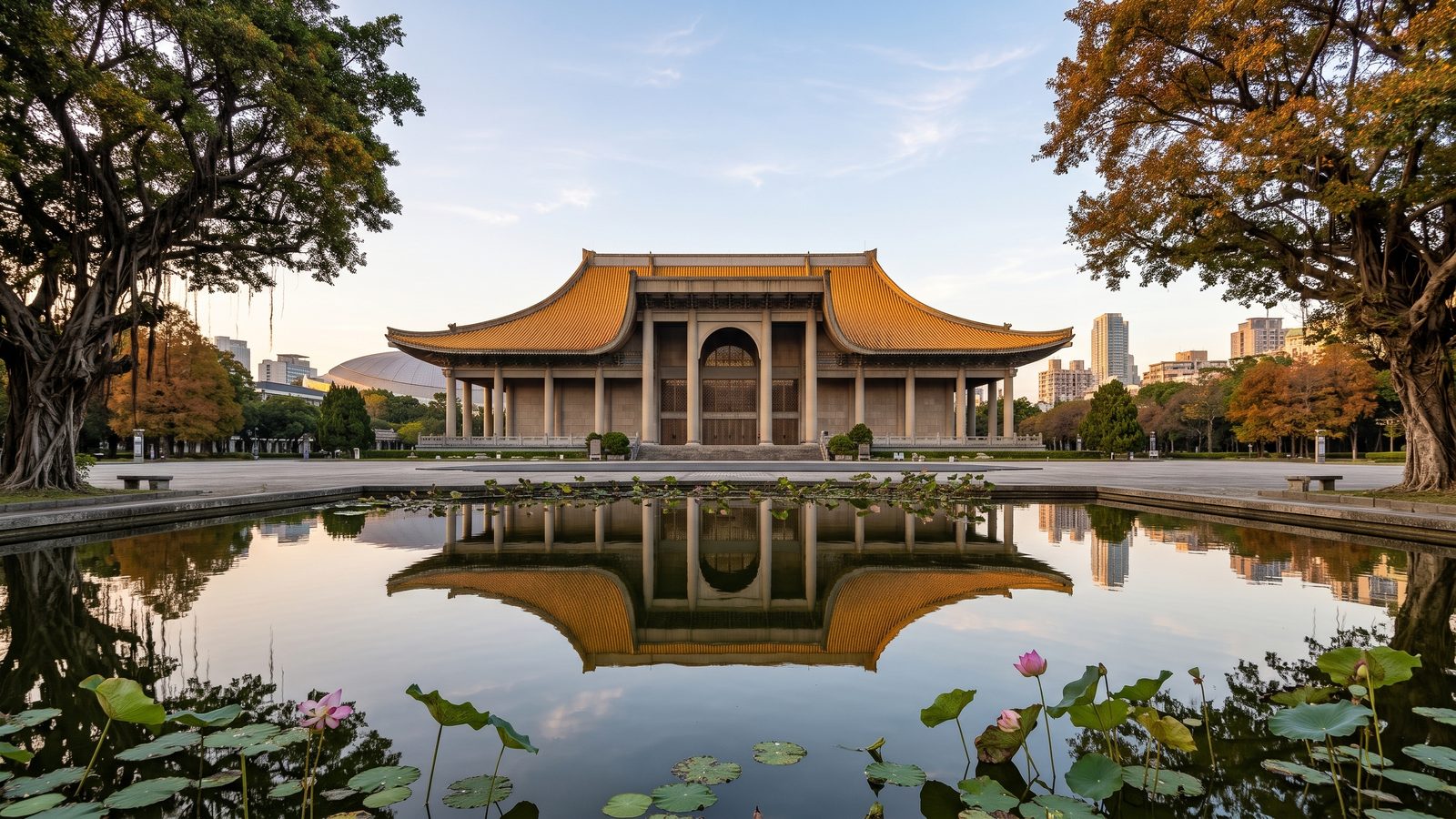
Step into the majestic grounds of the National Sun Yat-sen Memorial Hall, a grand tribute to the founding father of modern China. Completed in 1972, this iconic Taipei landmark seamlessly weaves traditional Chinese palace architecture with 20th-century modernist design. As you walk through its vast halls and tranquil gardens, you uncover the profound political history, cultural performances, and enduring legacy that continue to define Taiwan's vibrant national identity today.
This self-guided audio tour leads you through the hall's striking architectural features, reflective lotus ponds, historical exhibitions, and ceremonial spaces. Experience the precision of the guard changing ritual while gaining insight into Dr. Sun Yat-sen's revolutionary vision and lasting impact on modern Asia.
Listen to a sample
The opening of this tour, exactly as AllTours narrates it on site.
What you'll hear on this tour
Stop 1. Modern Precision Meets Ancient Palace Design
You stand before a masterwork by architect Wang Da-hong, where ancient aesthetics meet 20th-century functionalism. Gazing upward, you notice the magnificent golden glazed tile roof with its iconic upturned swallowtail eaves. These engineered curves lift your eyes skyward, giving lightness to a massive structure spanning 100 meters. As you admire the sweeping silhouette, observe the colossal concrete columns supporting the frame. These unadorned concrete pillars echo classical timber supports, presenting a bold, sleek finish. By employing contemporary engineering to craft traditional curves, the building creates a seamless architectural dialogue between Taiwan's rich heritage and a forward-looking modern identity.
Stop 2. A Grand Tribute to Modern Ideals
You enter the main hall where a colossal bronze statue of Dr. Sun Yat-sen commands the space. Every element around you orchestrates a solemn atmosphere of gratitude and national remembrance. You witness the world-famous Changing of the Guard ceremony, a ritualized homage executed with striking military precision. This daily display is more than formal military pageantry; it serves as a living tribute to the revolutionary leader who championed democracy and freedom. Standing in this expansive civic space, you feel the weight of history and observe how a nation actively preserves foundational principles etched into the building's very fabric.
Stop 3. Serene Landscapes and Reflective Ponds
You step outside into an expansive classical Chinese landscape designed as a peaceful urban oasis. Winding pathways invite you to stroll past sculpted rock formations and ancient banyan trees whose dangling aerial roots symbolize resilience and longevity. Approaching the central lotus pond, you see a striking visual mirror capturing the Hall's golden eaves flickering across the water's surface. Passing through elegant moon gates that frame picturesque garden views, you discover seasonal blooms like orchids and azaleas. This carefully planned sanctuary embodies Dr. Sun's vision of natural harmony, offering a tranquil space for quiet contemplation amidst Taipei's bustling metropolis.
Stop 4. Artifacts of the Revolutionary Spirit
You wander through the exhibition galleries to explore the personal history of Dr. Sun Yat-sen. Authentic documents, strategic campaign maps, and intimate personal letters trace his journey from medical student to revolutionary leader. You examine original proclamations outlining his foundational Three Principles of the People, alongside political tools revealing the grassroots efforts that transformed a nation. Poignant photographs and personal effects illustrate the hardships of exile and the sacrifices made by his comrades. Interactive displays help you understand why these historical moments remain essential to modern Taiwanese identity, bringing his vision of democracy and national renewal vividly back to life.
Stop 5. Where Tradition Meets Community Life
You step inside one of Taipei's premier performing arts venues, located right within the memorial's main auditorium. Here, traditional Taiwanese opera and classical Chinese music alternate with contemporary dance and international orchestral concerts. Outside the auditorium, rotating gallery spaces display fine calligraphy, sculpture, and painting by local artists. Beyond the indoor stages, the surrounding park functions as a vibrant community canvas. You observe local residents practicing tai chi in the soft morning light, youthful dance groups rehearsing routines, and families strolling through the grounds, creating a dynamic space where art, history, and daily community life continuously intertwine.
Stop 6. Building a Monument in Modern Taipei
You trace the historical origins of this site back to 1965, when construction began as a deliberate tribute to immortalize Dr. Sun Yat-sen's legacy. Opening in 1972 in the developing Xinyi District, the seven-year project reflected the Republic of China government's desire to anchor its cultural identity during a period of rapid modernization. Architect Wang Da-hong envisioned more than a static monument; he crafted a central hub intended to serve future generations as an educational and cultural center. Standing here today, you realize how this historic site has witnessed Taiwan's evolution, growing from a forward-looking vision into a essential civic landmark.
Planning your visit
- Best time to go
- Early morning to watch locals practice tai chi in the park, or late afternoon to capture the building bathed in golden sunlight.
- Approximate duration
- About 1 to 1.5 hours
- Where to start
- At the main entrance plaza facing the golden-roofed main hall.
Access and conditions change seasonally — check the official site before you go.
Frequently asked questions
Is National Sun Yat-sen Memorial Hall worth visiting?
Yes, it is one of Taipei's premier cultural and architectural landmarks. Visitors can admire the modern Chinese palace architecture, witness the Changing of the Guard ceremony, explore historical galleries, and relax in classical gardens.
How long do you need at National Sun Yat-sen Memorial Hall?
Most visitors spend between 1 to 2 hours exploring the grand main hall, viewing the bronze statue, watching the guard changing ceremony, and walking around the lotus pond in the gardens.
When was National Sun Yat-sen Memorial Hall built?
Construction began in 1965 and the building officially opened in 1972. It was designed by renowned architect Wang Da-hong to honor Dr. Sun Yat-sen, the Father of the Nation.
Keep exploring
Header image is an AI-generated illustration of National Sun Yat-sen Memorial Hall. AllTours.ai is an AI audio tour guide — point your camera at any landmark and hear its story.