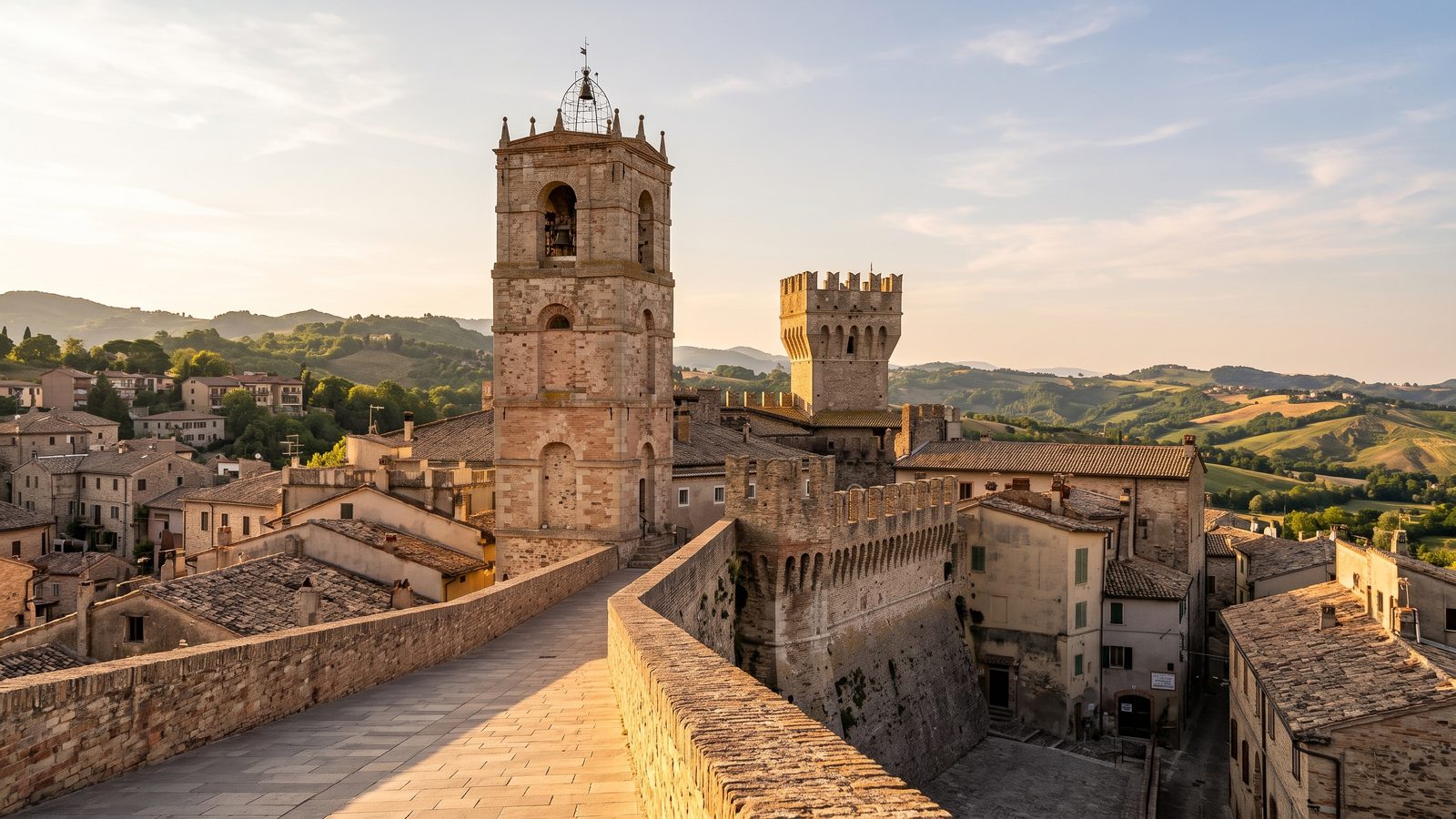
Perched high on a hill in the Marche region, the Civic Tower and Borgia Fortress of Offagna stand as frozen sentinels of medieval military power. Commissioned in the 15th century by the Republic of Ancona and later captured by Cesare Borgia, this formidable stronghold protected vital trade routes and agricultural lands. Today, its imposing stone walls and soaring keep offer an immersive journey into central Italy's dramatic past.
On this self-guided audio tour, you will discover impressive defensive engineering, explore sweeping regional vistas stretching to the sea, and learn how historic traditions live on. Step inside these ancient battlements and experience the stories carved into every stone of this medieval bastion.
Listen to a sample
The opening of this tour, exactly as AllTours narrates it on site.
What you'll hear on this tour
Stop 1. Panoramic Vistas Over Marche and Adriatic
As you ascend to the top of the Civic Tower, a breathtaking panorama unfolds before you. You gaze across the undulating emerald hills of the Marche region, where vineyards and olive groves form a vibrant quilt stretching toward the distant horizon. On a clear day, you can see the shimmering azure ribbon of the Adriatic Sea to the east, reminding you of Offagna's strategic coastal location. Look north, and faint outlines of medieval hilltop villages appear amidst the landscape. Directly below you, the terracotta rooftops of Offagna village cluster around the fortress, revealing ancient street layouts. Standing here in the warm sunlight, you share the perspective of ancient sentinels scanning land and sea for approaching threats.
Stop 2. Genius of 15th-Century Military Engineering
You stand before cyclopean stone walls showcasing late medieval defensive engineering. Notice the swallowtail Ghibelline merlons crowning the battlements, serving as both practical protection and a bold political statement of imperial allegiance. Beneath them, subtle corbels once supported temporary wooden galleries for vertical defense. As you look at the Civic Tower, you observe Romanesque stonework at its base contrasting sharply with the refined brickwork of upper levels, marking different building eras. Pay attention to the deeply splayed arrow slits around you; their internal widening allows archers a broad field of fire while keeping exposure minimal. Even the static arch marking the former drawbridge highlights how impenetrable this entry point was designed to be.
Stop 3. Bulwark of the Anconitan Republic
You are exploring a fortress commissioned in 1456 by the Republic of Ancona to protect inland territories against rival ambitions from Jesi and Osimo. Though it carries the Borgia name following Cesare Borgia's brief 1502 conquest of the Marches, its core legacy rests on Anconitan resilience. Imagine this stronghold during the War of Ancona in 1464, when its thick walls successfully repelled repeated enemy assaults. As you look up at the Civic Tower, you see how Offagna transitioned from a military outpost into a self-governing community. Its civic bell once governed daily life, sounding to signal market openings, curfews, and assembly gatherings throughout the centuries.
Stop 4. Living Traditions of the Medieval Festival
You feel the living pulse of Offagna's cultural heritage as you walk through these ancient courtyards. During the annual Feste Medievali, these stone walls transform into a stage for historic reenactments. You hear medieval music echo through the air alongside the rhythmic clanging of blacksmiths demonstrating traditional crafts. Local families passionately preserve their history across generations, wearing detailed period costumes, preparing authentic Marche cuisine, and competing in spirited jousting tournaments. Flag-wavers bring vibrant energy to the fortress grounds, turning historical memory into an active community ritual. As you soak in the festive atmosphere, you become part of a living tradition that seamlessly connects Offagna's past with its present.
Stop 5. Impenetrable Heart of the Stronghold
You are now looking at the central castle, a quintessential example of medieval military architecture designed to command the entire Esino valley. As you inspect the sheer thickness of these reinforced 15th-century walls, you appreciate how this stronghold earned its reputation as an impregnable bastion. Imagine the heavy clatter of armor filling the internal courtyard while guards vigilantly scan the horizon from crenellated tower battlements. This fortress served as a powerful symbol of authority, solidifying control over the Marches for rulers like Cesare Borgia. Every ancient stone around you whispers tales of ambition, siege defense, and the daily struggles of those who guarded these formidable gates.
Stop 6. Deadly Innovations of Late Medieval Defense
As you stand within this 15th-century stronghold, you experience the unyielding power of late medieval military design. The meticulously laid brick walls project authority across the Marches, revealing distinct layers of masonry from decades of conflict. The towering Civic Tower served as a critical watchtower, allowing its garrison to spot distant threats across rolling hills. Every arrow slit and protruding machicolation you see represents a deadly defensive innovation, engineered to rain projectiles down onto attackers during a siege. Imagine the constant tension, the clang of weapons, and the calculated defenses needed to survive inside these ramparts, where this living fortress served as a crucial stronghold in central Italy's power struggles.
Planning your visit
- Best time to go
- Late afternoon for clear views over the Marche countryside and warm golden light on the fortress walls.
- Approximate duration
- about 1 hour
- Where to start
- At the main entrance gate of the Borgia Fortress in Offagna village.
Access and conditions change seasonally — check the official site before you go.
Frequently asked questions
Is Civic Tower and Borgia Fortress worth visiting?
Yes, it is one of the finest examples of 15th-century military architecture in the Marche region, offering rich medieval history and stunning panoramic views of the countryside and Adriatic Sea.
How long do you need at Civic Tower and Borgia Fortress?
A typical self-guided visit takes about 45 to 60 minutes to explore the ramparts, climb the Civic Tower, and enjoy the historical site.
Why is it called the Borgia Fortress?
Although commissioned in 1456 by the Republic of Ancona, it bears the Borgia name due to Cesare Borgia's brief conquest of the Marches in 1502.
Keep exploring
Header image is an AI-generated illustration of Civic Tower and Borgia Fortress. AllTours.ai is an AI audio tour guide — point your camera at any landmark and hear its story.