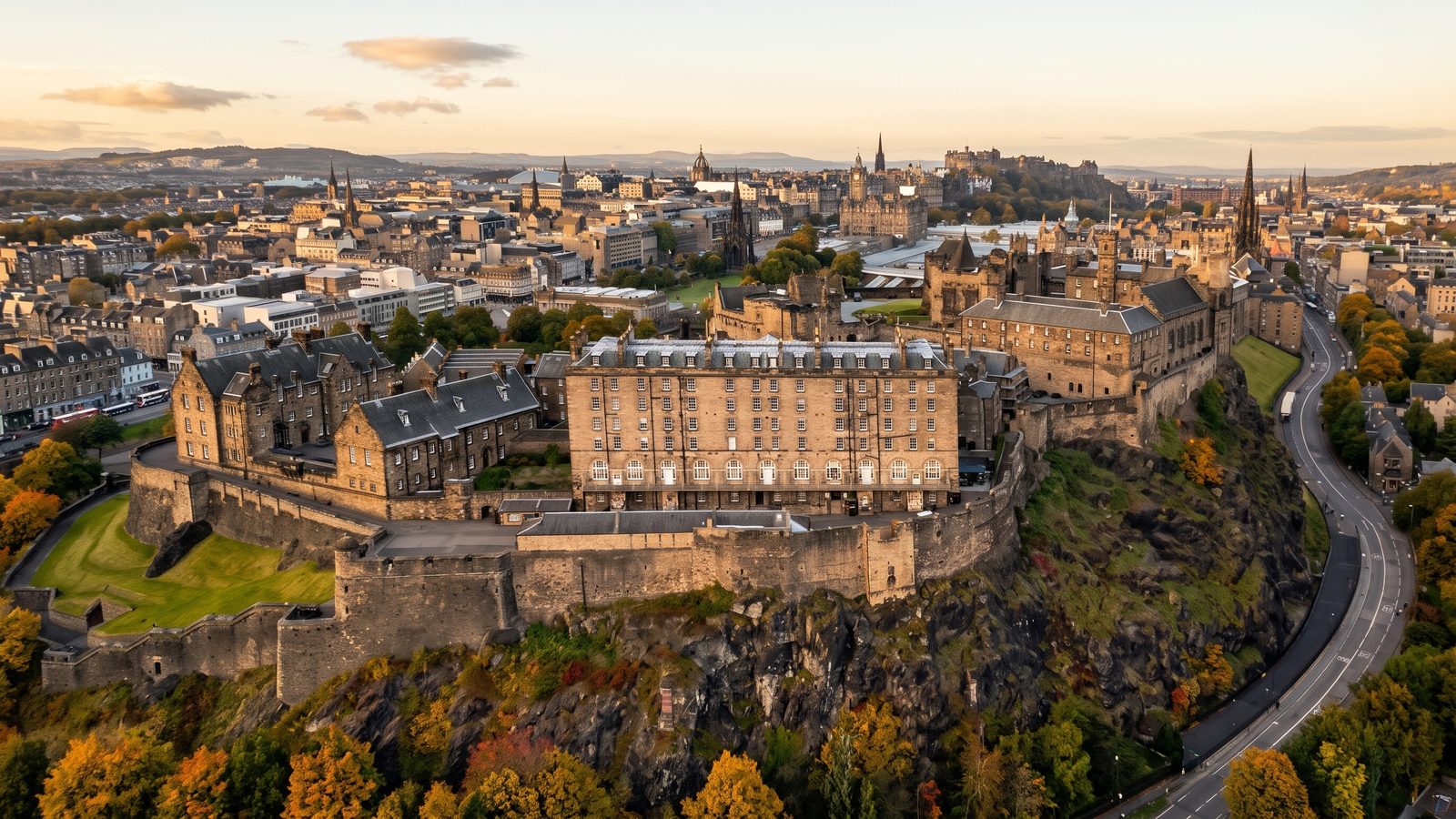
Stand atop Castle Rock, an ancient volcanic plug where Scotland's history was forged across millennia of siege, royal courtly life, and fierce battles. From Iron Age fortifications to royal birthplaces and desperate independence wars, Edinburgh Castle reigns as the defiant heart of a nation. As you walk these cobbled pathways, you will encounter medieval artillery, towering defensive walls, and centuries of royal heritage etched forever into stone.
Discover the intimate chambers of the Royal Palace, marvel at Britain's oldest crown jewels, and look out over breathtaking panoramas stretching from the Royal Mile to the Firth of Forth. Let this self-guided audio tour illuminate the rich architecture, legends, and enduring spirit of Scotland’s most iconic fortress.
Listen to a sample
The opening of this tour, exactly as AllTours narrates it on site.
What you'll hear on this tour
Stop 1. Royal Secrets and Britain's Oldest Crown Jewels
Step inside the Royal Palace where Mary Queen of Scots gives birth to James VI in 1566, a pivotal event that ultimately unites the crowns of Scotland and England. In the neighboring vault, you encounter the Honours of Scotland: the Crown, Sceptre, and Sword of State, which form the oldest crown jewels in Britain. After the Act of Union, caretakers lock these treasures inside a chest for over a century until Sir Walter Scott dramatically rediscover them in 1818. Right beside them rests the ancient Stone of Destiny, the legendary seat of Scottish monarchs. Stand in awe before these sacred symbols of lineage and sovereign power.
Stop 2. The Unyielding Defense of Castle Rock
Look down at the sheer, vertical rock face beneath your feet, a natural deterrent that makes three sides of this volcanic crag virtually impregnable. You stand within a formidable military machine crafted over centuries to withstand relentless sieges. Dominating the eastern approach, the massive Half Moon Battery rises above you, constructed after the devastating Lang Siege of 1573 specifically to counter heavy cannon fire. Pass under the Portcullis Gate beneath the Argyle Tower, where defenders can drop an iron grate to trap invaders in a deadly killing zone. Every narrow passage, curving wall, and gun emplacement projects absolute military power across the Scottish landscape.
Stop 3. Millennia of Defiance on Volcanic Stone
You stand on an ancient volcanic plug fortified since the Iron Age, long before stone ramparts crown the peak. In the 12th century, King David I establishes a royal stronghold here, leaving behind St. Margaret's Chapel, the oldest surviving building on site. As you explore, recall the brutal Wars of Scottish Independence, when the castle constantly shifts between Scottish and English control. In 1314, Robert the Bruce's forces execute a daring night raid, scaling these precipitous cliffs to reclaim Scottish sovereignty. From medieval royal births to bloody sieges, every weathered stone around you whispers tales of betrayal, victory, and an unyielding national spirit.
Stop 4. A Tapestry of Medieval and Renaissance Design
As you walk through the grounds, you observe an architectural palimpsest shaped by shifting centuries and changing threats. Examine the Romanesque simplicity of St. Margaret's Chapel, featuring thick Norman walls and rounded arches. Contrast this early simplicity with the 16th-century Half Moon Battery, engineered with curved stonework to deflect heavy artillery shot. Notice how the castle layout organically hugs the volcanic crag rather than following a geometric plan. At the Royal Palace, early Scottish Renaissance stonework hints at royal comfort, while the Great Hall showcases an impressive Victorian Gothic revival hammerbeam roof. Every doorway and window reflects changing defensive needs and royal tastes.
Stop 5. Commanding Panoramas Over Land and Sea
Step onto the high ramparts to take in a breathtaking panorama that reveals the castle's strategic dominance. Looking north, your gaze sweeps over the Georgian terraces of the New Town across the Firth of Forth to the distant hills of Fife, where sentinels once watched for approaching war fleets. To the east, the dramatic volcanic silhouette of Arthur's Seat towers above Holyrood Palace, highlighting the contrast between fortress control and peaceful royal living. Southward, the city unfolds toward the Pentland Hills, while modern Edinburgh stretches out to the west, framed by distant highland glens that remind you of Scotland's untamed heart.
Stop 6. The Living Heart of Scottish Identity
Listen closely as the daily ritual of the One O'Clock Gun echoes across the city, a maritime tradition that binds Edinburgh's past to its present beat. Beyond military history, you stand in the cultural crucible of a nation. Each August, the broad esplanade transforms into a world stage for the Royal Edinburgh Military Tattoo, filling the night air with precision marching and the fiery skirl of bagpipes. This iconic outline on Castle Rock has long inspired poets, storytellers, and artists across generations. Here, ancient military heritage and living traditions unite, creating a enduring symbol of Scottish pride and defiance.
Planning your visit
- Best time to go
- Early morning at opening to avoid peak crowds, or early afternoon to hear the One O'Clock Gun.
- Approximate duration
- About 2 to 2.5 hours
- Where to start
- The Esplanade, outside the castle's main entrance gates.
Access and conditions change seasonally — check the official site before you go.
Frequently asked questions
Is Edinburgh Castle worth visiting?
Yes, Edinburgh Castle is widely considered one of Scotland's most significant attractions. It houses essential historic treasures like the Honours of Scotland (the crown jewels) and the Stone of Destiny, while providing unmatched views across the city.
How long do you need at Edinburgh Castle?
Most visitors spend about 2 to 3 hours exploring the fortress complex, including the Royal Palace, St. Margaret's Chapel, the Great Hall, defensive ramparts, and museum exhibits.
Who built Edinburgh Castle and how old is it?
Castle Rock has been fortified since the Iron Age. King David I established a royal castle here in the 12th century, constructing St. Margaret's Chapel around 1130, making the oldest standing structures over 900 years old.
Keep exploring
Header image is an AI-generated illustration of Edinburgh Castle. AllTours.ai is an AI audio tour guide — point your camera at any landmark and hear its story.