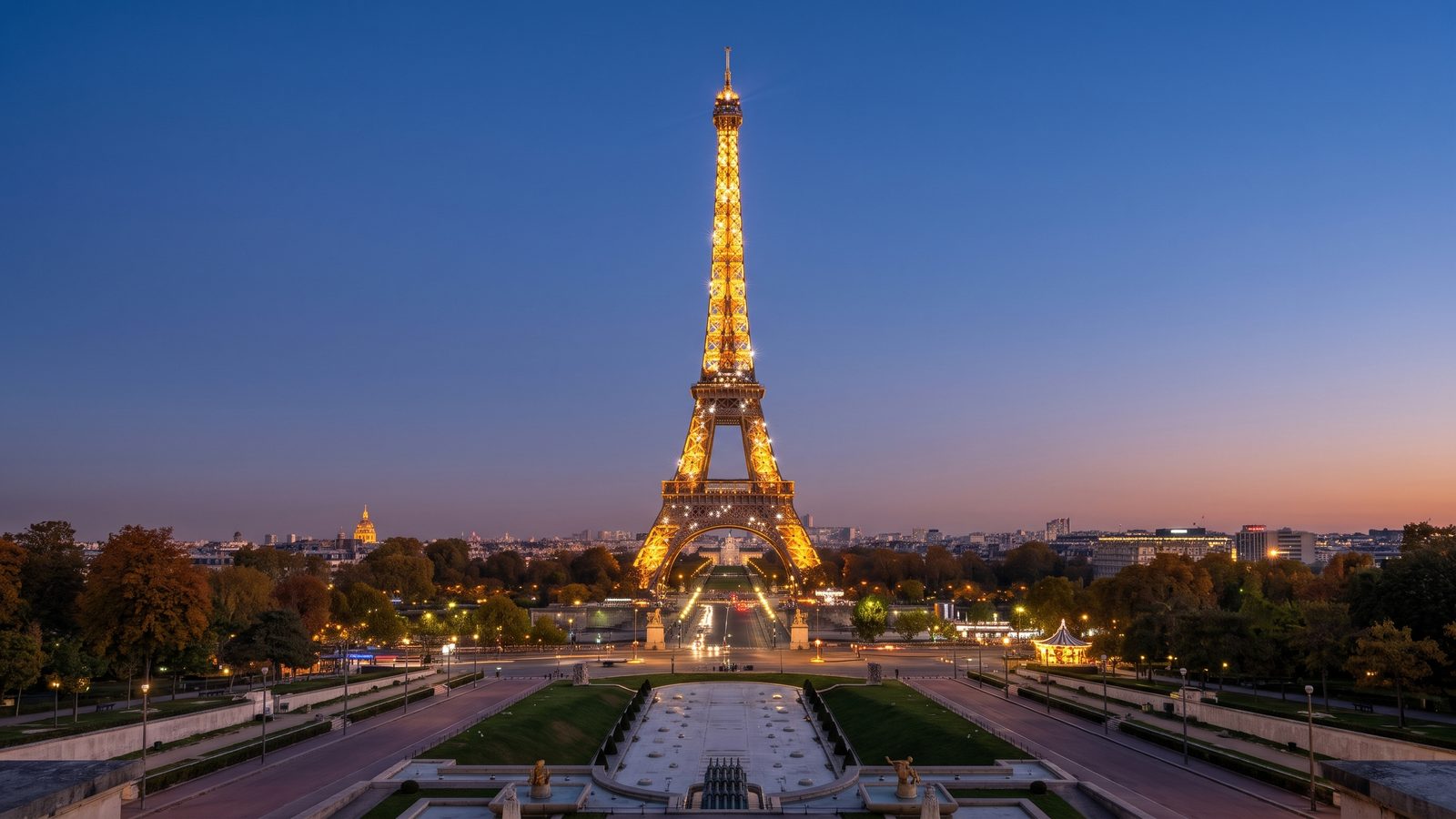
Welcome to Paris's most famous landmark, an engineering marvel designed by Gustave Eiffel for the 1889 World's Fair. Standing 330 meters tall, this intricate wrought-iron masterpiece was once condemned by prominent critics but quickly became the ultimate symbol of French ingenuity. As you explore its majestic tiers, this self-guided audio tour reveals the dramatic rivalries, wartime defiance, and architectural genius behind its enduring global legacy.
Experience breathtaking panoramic views across the Seine, discover world-class dining suspended in the clouds, and learn how early radio science saved the structure from demolition. Follow along to unlock the history, beauty, and hidden details of this iconic monument.
Listen to a sample
The opening of this tour, exactly as AllTours narrates it on site.
What you'll hear on this tour
Stop 1. The Protest Against Eiffel's Iron Giant
Stand beneath the towering iron lattice and picture Paris back in the late nineteenth century. You are looking at a structure that once sparked a fierce cultural war. Leading intellectuals like Guy de Maupassant decried it as a monstrous black smokestack threatening to dishonor Paris. Conceived as a temporary monument for the 1889 World's Fair, it was slated for dismantling after twenty years in 1909. However, Gustave Eiffel cleverly saved his creation by conducting meteorology and radio transmission experiments from the summit. You stand today beside a tower whose strategic radio communications eventually helped change the course of battles during World War I.
Stop 2. Wartime Defiance and High-Stakes History
Feel the weight of history surrounding you as you look up at the soaring arches. During the World War II occupation in 1940, French resistance workers severed the elevator cables just before Adolf Hitler's visit, denying him a triumphant ride to the top and forcing a choice between climbing thousands of steps or walking away. Nearby, imagine the tragic 1912 leap of Franz Reichelt, the 'Flying Tailor,' who tested his homemade parachute suit from the first platform. From the birthplace of French television broadcasts in 1935 to magnificent fireworks celebrating the millennium, this tower serves as a dramatic stage for human history and audacious ambition.
Stop 3. Panoramic Vistas Across Paris Heights
As you ascend the platforms, watch the city of Paris transform beneath your feet. From the first floor, you get an intimate view of the green Champ de Mars and the grand École Militaire. Move up to the second deck, and you unlock the quintessential postcard visual: the glinting Seine, the Arc de Triomphe commanding its star-shaped avenue, and the shimmering dome of Les Invalides. Finally, at the very summit, you take in the perspective Gustave Eiffel enjoyed from his private apartment. You see Haussmannian rooftops stretching endlessly toward Montmartre and Sacré-Cœur, revealing Paris as an intricate, living map.
Stop 4. Culinary Excellence Suspended in Sky
Look around the tower's upper levels and discover a legendary tradition of high-altitude French gastronomy. On the second floor, Michelin-starred Le Jules Verne offers exquisite haute cuisine framed by sparkling cityscapes. Down on the first floor, Madame Brasserie serves vibrant contemporary French dishes designed with modern flair. Dining high above Paris is not a new concept; during the 1889 World's Fair, four distinct restaurants welcomed global visitors right here. Whether you admire these famous venues from afar or sit at a reserved table among the clouds, you are participating in a culinary journey where world-class cooking meets one of the world's greatest urban views.
Stop 5. Capturing the Iconic Golden Light
Frame your camera lens against the intricate wrought-iron pattern surrounding you. As you snap photographs, you join a visual conversation spanning over a century. While daylight photography is completely open, the spectacular nocturnal illumination is protected by legal copyright, requiring permission for commercial use. For your personal photos, seek out wide angles from Trocadéro or layered cinema-style shots at Pont de Bir-Hakeim. Catch the warm glow during golden hour or wait for the blue hour right before the hourly sparkle begins. Frame the iron lattice through Parisian windows or capture its reflection in rain-kissed streets to tell your own visual story.
Stop 6. Masterpiece of Wrought Iron Engineering
Pause to examine the massive metal columns standing before you. Built by Gustave Eiffel for the 1889 World's Fair, this 330-meter-tall landmark briefly reigned as the world's tallest man-made structure. Its breathtaking lattice assembly consists of 18,038 individual pieces of wrought iron held together by 2.5 million precision rivets. What makes this feat even more remarkable is the speed of its construction: workers completed the entire structure in just two years, two months, and five days. Today, you experience an enduring testament to industrial ingenuity that illuminates the Parisian skyline nightly, captivating millions of visitors from across the globe.
Planning your visit
- Best time to go
- Early morning at opening or late afternoon near golden hour for shorter lines and ideal lighting.
- Approximate duration
- About 2 to 3 hours
- Where to start
- Champ de Mars gardens, near the base of the tower's southern pillar.
Access and conditions change seasonally — check the official site before you go.
Frequently asked questions
Is the Eiffel Tower worth visiting?
Yes, visiting the Eiffel Tower provides breathtaking panoramic views of Paris, rich historical context, world-class dining options, and access to one of history's greatest engineering achievements.
How long do you need at the Eiffel Tower?
Most visitors spend between 2 and 3 hours exploring the three main levels, taking in the panoramic views, taking photos, and visiting the summit.
Why was the Eiffel Tower originally built?
It was constructed by engineer Gustave Eiffel as the centerpiece entrance arch for the 1889 World's Fair in Paris, marking the 100th anniversary of the French Revolution.
Keep exploring
Header image is an AI-generated illustration of Eiffel Tower. AllTours.ai is an AI audio tour guide — point your camera at any landmark and hear its story.