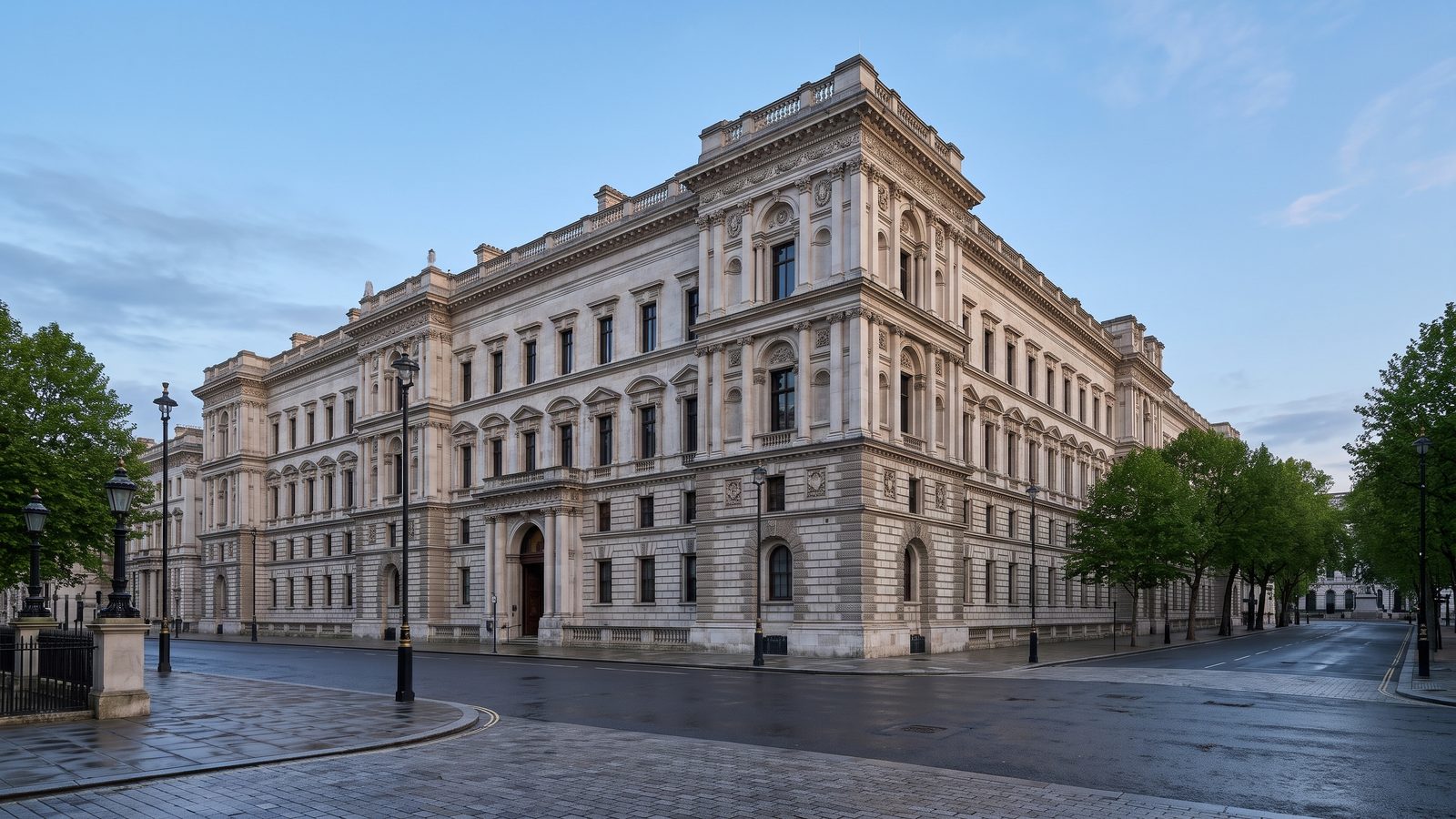
You stand before the Foreign, Commonwealth & Development Office, the historic nerve center of British foreign policy and imperial administration in central London. Commissioned in 1861 to house both the Foreign Office and India Office, this monumental Victorian building has witnessed over a century of critical global statecraft. From grand treaty signings to intense crisis negotiations, these walls embody Britain's evolving international role while blending political power with extraordinary architectural artistry.
As you explore its magnificent spaces, you discover a rich tapestry of history, art, and high diplomacy. From Scott's Italianate stone façade to the vibrant Indo-Saracenic splendor of the Durbar Court, every detail reflects an era of imperial confidence and the enduring craft of international relations.
What you'll hear on this tour
Stop 1. The Crucible of Global Diplomacy
You stand in the quiet command center where Britain's foreign relationships take shape. As you walk through these historic corridors, you feel the weight of centuries of statecraft. Here, diplomats and Foreign Secretaries navigate critical international crises, from the Suez Crisis to Brexit, turning complex disagreements into lasting treaties. You imagine the hushed, intense negotiations where soft power, strategic words, and subtle gestures avert conflicts and build global alliances. Every hall hums with the memory of bilateral agreements and multilateral summits that continuously redefine international relations. In this building, soft power becomes a living force, proving how quiet persistence and calculated diplomacy shape the modern geopolitical landscape.
Stop 2. Clash of Victorian Architectural Styles
You gaze upon a monumental masterpiece of Victorian Italianate design, built after a dramatic battle of architectural wills. Prime Minister Lord Palmerston rejected architect Sir George Gilbert Scott's original Gothic Revival vision, demanding a classical Italianate style to project imperial power. You observe the imposing Portland stone exterior with its heavy lower rustication, pedimented windows, and symmetrical grace. Step inside to discover the breathtaking Durbar Court, where Scott incorporates vivid Indo-Saracenic influences with colorful tilework, towering columns, and intricate arches. From its grand staircases to delicate decorative plasterwork, the building showcases Scott's remarkable versatility in harmonizing diverse styles into a grand architectural narrative.
Stop 3. Allegories of Imperial Power and Artistry
Look closely at the artistic marvels transforming this government building into a breathtaking gallery. In the majestic Durbar Court, your gaze rises to Sir William Richmond’s vibrant murals, where classical allegorical figures represent distant continents and signal Britain's historic global reach. Beneath your feet, intricate geometric mosaic floors showcase extraordinary precision, while delicate carvings frame every doorway. As you ascend the grand staircase, notice how polished marble and ornate ironwork turn structural features into sculptural art. Outside, allegorical statues of Justice and Truth adorn the exterior walls, quietly reminding every visiting dignitary of the fundamental values and cultural sophistication meant to guide British diplomatic work.
Stop 4. A Battle of Ambition and Empire
You stand before a building born from intense political rivalry and global ambition. Commissioned in 1861 to house both the Foreign Office and the India Office, construction finished in 1868 under the direction of Sir George Gilbert Scott. Over the past century and a half, these rooms have adapted to Britain’s changing place in the world. You trace its transformation from the height of the British Empire through the complex era of decolonization. As the India Office evolved into the Commonwealth Office and finally merged into today's Foreign, Commonwealth & Development Office, this iconic site remained the central engine room for British international strategy.
Stop 5. Dining as a Tool of Statecraft
As you explore these stately chambers, consider how food functions as a silent language of statecraft. In these quiet dining rooms and grand halls, skilled chefs prepare everything from simple working lunches to elaborate banquets in the Durbar Court. You picture diplomats breaking bread over seasonal British produce crafted with international flair, easing tensions where formal discussions stall. From formal diplomatic dinners serving roasted lamb to delicate canapés at evening receptions, every menu is engineered to build bridges and foster camaraderie. Even simple cups of tea served during marathon negotiation sessions offer essential moments of respite, showing how culinary traditions serve high-stakes international diplomacy.
Stop 6. Framing Decades of International Statecraft
You step into a living visual archive where crucial moments of international history have been captured on camera. Imagine early photographers hauling bulky equipment through these halls to photograph intricate mosaic floors and soaring plaster ceilings. Around you, every major treaty signing, royal reception, and ministerial press conference has been immortalized. You can almost hear the steady click of press shutters outside as foreign ministers arrive for urgent summits. From official portraits of Foreign Secretaries in quiet, stately rooms to fast-paced press briefings in the Durbar Court, photography transforms fleeting diplomatic handshakes into permanent, powerful historical records of British statecraft.
Planning your visit
- Best time to go
- During the annual London Open City / Open House Festival weekend in September, or weekday mornings for exterior views.
- Approximate duration
- about 1 hour
- Where to start
- Outside the main exterior façade on King Charles Street, Whitehall, London.
Access and conditions change seasonally — check the official site before you go.
Frequently asked questions
Is Foreign, Commonwealth & Development Office worth visiting?
Yes, it features spectacular Victorian Italianate architecture, Sir William Richmond's allegorical murals, and the famous Indo-Saracenic Durbar Court.
How long do you need at Foreign, Commonwealth & Development Office?
A self-guided tour of the building's history, architecture, and exterior design details typically takes 45 to 60 minutes.
Why was the Foreign, Commonwealth & Development Office built in an Italianate style?
Architect Sir George Gilbert Scott originally designed a Gothic Revival building, but Prime Minister Lord Palmerston rejected it, insisting on a classical Italianate style to reflect imperial power.
Keep exploring
Header image is an AI-generated illustration of Foreign, Commonwealth & Development Office. AllTours.ai is an AI audio tour guide — point your camera at any landmark and hear its story.