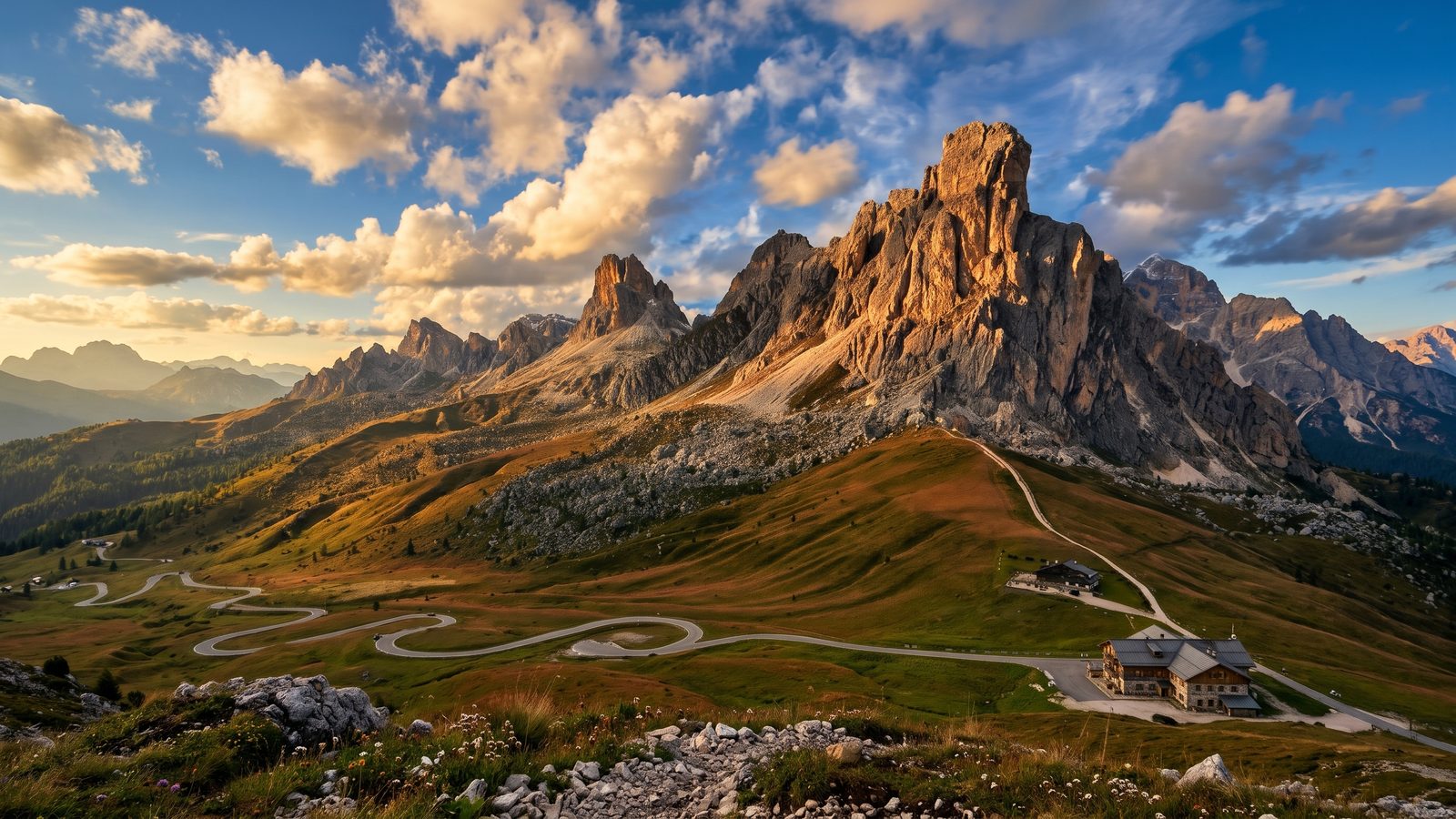
Welcome to Passo Giau, a breathtaking alpine pass standing at 2,236 meters above sea level in the Italian Dolomites. Famous for its starring role in the Giro d'Italia cycling race since 1973, this high-mountain haven offers dramatic views of the towering Ra Gusela peak and the UNESCO-listed Dolomite rock faces. As you step out onto this living canvas, you stand on land shaped by ancient trade, rich Ladin culture, and military frontlines.
This self-guided audio tour walks you through the pass's dramatic heritage, stunning geological amphitheaters, local culinary delights, and world-class photography spots. Whether you are chasing the fiery glow of sunset or exploring centuries of alpine history, prepare to experience one of the most iconic landscapes in the Italian Alps.
Listen to a sample
The opening of this tour, exactly as AllTours narrates it on site.
What you'll hear on this tour
Stop 1. Capturing the Legendary Alpine Light
You step into an open-air studio where dramatic alpine light transforms every mountain ridge. As the afternoon wanes, you position your camera to catch the sun's fiery alpenglow painting the rugged face of Ra Gusela in glowing orange and deep purple tones. Below you, the curving hairpin turns of the pass create striking natural leading lines that guide your gaze straight toward the distant Tofane group. You look across to the Croda da Lago massif, where early morning mists cling to craggy ramparts, offering ethereal compositions. Frame the solitary hikers with a telephoto lens to emphasize nature's vast scale, or set your tripod after dark to record star trails swirling above these ancient giants.
Stop 2. Echoes of the High Mountain Front
You trace a path carved by centuries of alpine travel, far beyond modern cycling legends. Before paved roads existed, shepherd tracks connected neighboring valleys here, later serving as an elevation route between the Venetian Republic and Tyrol. The true historical drama unfolds around you from the Great War, when this serene pass became part of the fierce Dolomite Front. You walk ground where soldiers endured extreme conditions, carving tunnels and temporary supply roads into sheer cliff faces to move artillery high above the clouds. Though nature reclaims these battle scars, the enduring spirit and engineering feats of those troops remain permanently etched into the surrounding crags and mountain memory.
Stop 3. The Needle and Alpine Meadows
You gaze upon a visual masterpiece sculpted by elemental forces over millions of years. Directly ahead, the sharp form of Ra Gusela thrusts upward like a massive stone needle, dominating your view with its striking, symmetrical profile. Beyond it, the serrated crests of the Croda da Lago group frame the horizon like ancient battlements above undulating green slopes. You watch the pale Dolomite rock shift from soft gray to luminous white as sunlight moves across the cliff faces. Below these giant crags, lush alpine meadows cascade down the pass, dotted with larch trees that turn into brilliant gold come autumn, creating a vivid contrast against the towering stone.
Stop 4. Flavors of the Dolomite High Country
You warm yourself with the hearty mountain flavors of Dolomitic cuisine, crafted for life at high altitude. You taste Casunziei all'ampezzana, delicate beet-filled half-moon pasta tossed in melted butter, smoked ricotta, and poppy seeds. Earthy wild mushrooms, gathered from nearby forests, simmer into rich ragùs served over steaming creamy polenta. You sample savory speck, a juniper-smoked cured ham that pairs perfectly with aged local cheeses. To finish your meal, you enjoy a slice of warm Apfelstrudel, its spiced apples and crisp pastry reflecting the region's historical crossroad of cultures. Every bite honors local resourcefulness and long-standing alpine culinary traditions.
Stop 5. Living Traditions of the Ladin Valleys
You stand at an ancient cultural crossroads where deep-rooted Ladin traditions flourish. You listen closely to hear the melodic Rhaeto-Romance language, an ancient linguistic treasure preserved for millennia across these isolated valleys. Looking down the slopes, you spot traditional shepherd huts known as malghe, where artisans continue to produce traditional mountain cheeses using centuries-old methods. Local folklore fills the air with tales of enchanted peaks and the mythical Fanes kingdom. Around the nearby valley towns, you admire intricate wood carvings and vibrant textiles, representing generations of skilled craftsmanship. This resilient heritage connects the mountain communities deeply to their land and ancestral past.
Stop 6. A Colossal Amphitheater of Peaks
You stand in the center of a monumental mountain theater stretching out in every direction. Looking north, the rugged Tofane group rises into the sky, its peaks frequently draped in drifting mists. To the east, the craggy ramparts of the Croda da Lago massif hold guard over hidden alpine lakes nestled within the rock. Turning southwest, your eyes find the slender rock spire of Gusela del Nuvolau standing beside the expansive Nuvolau massif. As clouds shift across the sun, moving shadows continually retexture every cliff face and deep crevice, offering you a dynamic landscape that changes with every passing minute on this elevated mountain perch.
Planning your visit
- Best time to go
- Late spring through autumn for open road access; late afternoon is ideal for capturing sunset alpenglow.
- Approximate duration
- about 1 to 2 hours
- Where to start
- Passo Giau summit parking area near Rifugio Passo Giau.
Access and conditions change seasonally — check the official site before you go.
Frequently asked questions
Is Giau Pass worth visiting?
Yes, Passo Giau is widely considered one of the most stunning mountain passes in the Italian Dolomites, offering dramatic 360-degree views of peaks like Ra Gusela, UNESCO World Heritage scenery, WWI history, and famous cycling routes.
How long do you need at Giau Pass?
Plan to spend between 1 and 2 hours at the pass to enjoy the self-guided audio tour, take photos, and walk around the alpine meadows.
What role did Passo Giau play in World War I?
During World War I, Passo Giau served as part of the Dolomite Front between Austrian and Italian forces, where soldiers engineered mountain roads, tunnels, and fortifications directly into the high alpine terrain.
Keep exploring
Header image is an AI-generated illustration of Giau Pass. AllTours.ai is an AI audio tour guide — point your camera at any landmark and hear its story.