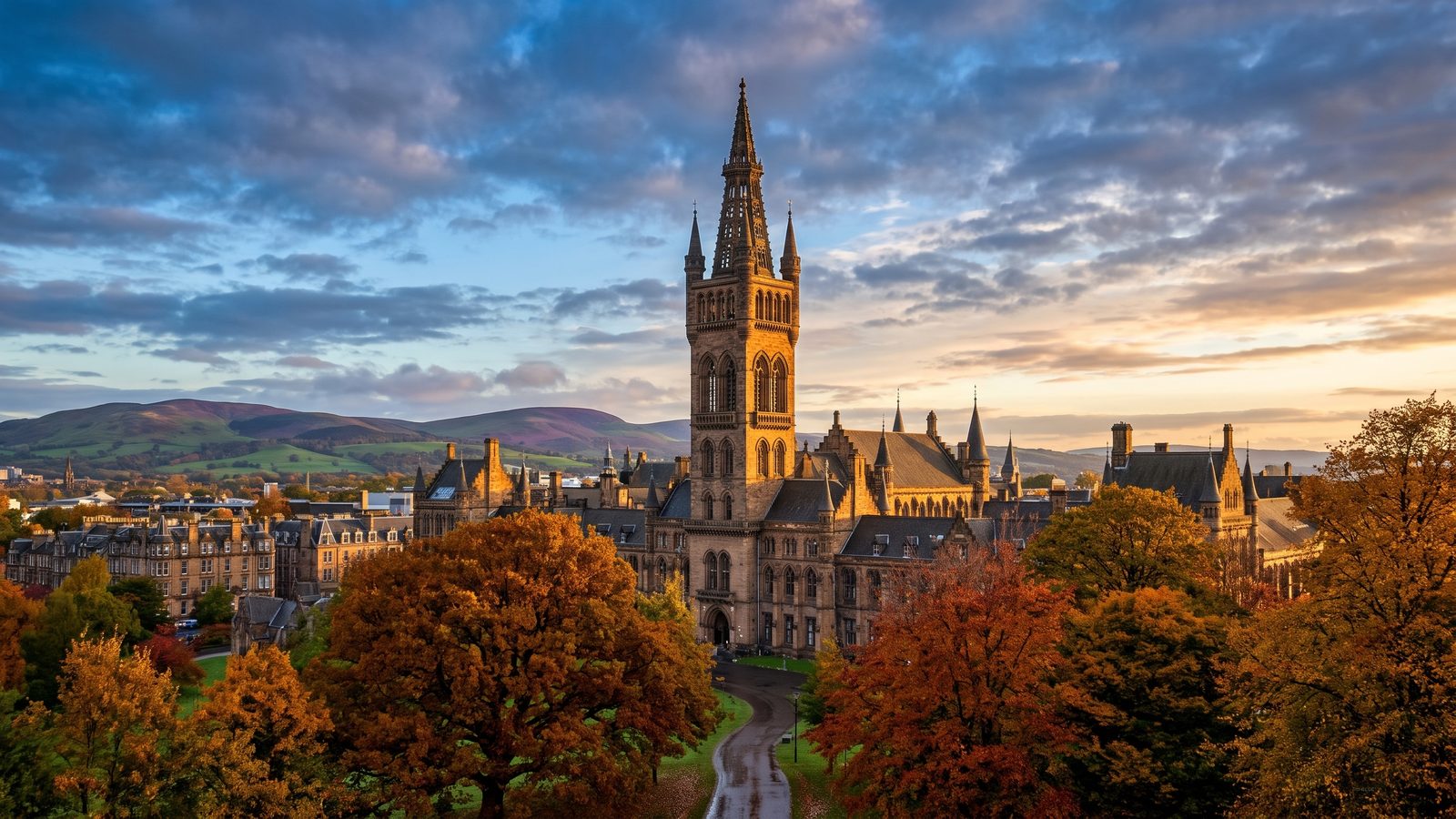
Welcome to the Gilbert Scott Building, an architectural masterpiece sitting high on Gilmorehill in Glasgow's vibrant West End. Designed by renowned Victorian architect Sir George Gilbert Scott, this magnificent complex serves as the iconic heart of the University of Glasgow. As you walk through its vaulted cloisters and under its soaring spires, you walk in the footsteps of centuries of world-changing scholars and bold thinkers who transformed global knowledge.
This self-guided audio tour leads you past intricate sandstone tracery, dramatic stone arches, and sweeping views across the Glasgow skyline. Discover how a monumental 19th-century decision to move from High Street created one of the world's most impressive Gothic Revival educational landmarks, blending academic rigor with stunning baronial architectural features.
What you'll hear on this tour
Stop 1. A Gothic Shield Above Gilmorehill
You stand before a profound architectural statement created by Sir George Gilbert Scott. Look up at how the design harmoniously blends Victorian Gothic Revival with distinct Scottish baronial features, including charming turrets and rugged corbelling. As your eyes wander across the exterior, you spot detailed gargoyles and heraldic shields carved directly into the stone. Each detail narrates a rich chapter of academic history and civic patronage. You are looking at a structure built not merely for functional university life, but designed to stand as an enduring beacon of learning and intellectual progress high above Glasgow.
Stop 2. Crucible of the Scottish Enlightenment
As you step inside these hallowed halls, you immerse yourself in the crucible of Scottish Enlightenment thought. You feel the tangible intellectual legacy of pioneering minds who walked these spaces, such as Adam Smith, whose groundbreaking economic theories were forged here, and Lord Kelvin, whose revolutionary scientific discoveries transformed human understanding. Today, you witness these very same corridors and lecture halls vibrant with active academic energy. Modern scholars continue rigorous research and study across diverse departments, ensuring that the legacy of innovation born within these walls continues to shape global knowledge into the future.
Stop 3. Mastery of Victorian Gothic Revival
Gaze upon the intricate stonework to grasp Sir George Gilbert Scott's mastery of the Victorian Gothic Revival style. You notice delicate sandstone tracery adorning the pointed arches and intricate crockets climbing up soaring pinnacles. Every element is meticulously carved from local stone to evoke the solemn grandeur of medieval cathedrals. This intentional aesthetic elevates your experience of the academic environment, connecting you directly to the weight of centuries of scholarly tradition. As you walk beneath the cloisters, the dramatic play of light and shadow highlights the craft that defines this magnificent educational sanctuary.
Stop 4. Panoramic Skyline of the West End
From this elevated vantage point, you appreciate how the Gilbert Scott Building commands the entire Glasgow skyline. You watch as its majestic silhouette forms an unmistakable landmark across the city. Your eyes follow the soaring spires as they pierce the Scottish sky, highlighting the craftsmanship required to raise such high towers. Below you, the imposing scale of the complex frames the surrounding West End in a breathtaking tableau. Notice how the shifting light across the stone constantly changes the view, creating a picturesque scene that has inspired generations of students, locals, and travelers alike.
Stop 5. Relocating to Gilmorehill
You trace the origins of this grand campus back to a monumental decision in the 1860s to relocate the entire university from its cramped High Street site to Gilmorehill. Construction begins in 1870 as Sir George Gilbert Scott's ambitious Victorian Gothic Revival design takes shape. You discover that this massive building project is funded by an extraordinary public subscription, reflecting Glasgow's deep commitment to education. As you wander around the expansive grounds today, you see how this historic decision created a lasting monument to civic pride, academic vision, and architectural ambition.
Stop 6. Soaring Heights and Intricate Tracery
Take a moment to fully immerse yourself in the magnificent Victorian Gothic detailing surrounding you. You observe a dramatic verticality, a defining characteristic of Gothic architecture designed to elevate your mind toward higher knowledge. Look closely at the delicate stone tracery lining the windows, demonstrating the extraordinary skill of 19th-century stonemasons. You see delicate crockets accenting the pinnacles, reinterpreting medieval cathedral motifs to suit a modern academic setting. This distinct style is far more than a decorative choice; it serves as a powerful statement of enduring intellectual legacy and timeless architectural beauty.
Planning your visit
- Best time to go
- Morning or early afternoon on a clear day for optimal lighting on the sandstone and views across the West End.
- Approximate duration
- about 1 hour
- Where to start
- The main courtyard entrance of the Gilbert Scott Building on Gilmorehill, University of Glasgow.
Access and conditions change seasonally — check the official site before you go.
Frequently asked questions
Is the Gilbert Scott Building worth visiting?
Yes, the Gilbert Scott Building is one of Glasgow's most famous landmarks, renowned for its breathtaking Victorian Gothic Revival architecture, historic cloisters, and sweeping views over the city.
How long do you need at Gilbert Scott Building?
Most visitors spend about 45 minutes to an hour exploring the grand quadrangles, cloisters, exterior stonework, and surrounding Gilmorehill campus views.
When was the Gilbert Scott Building constructed?
Construction on Gilmorehill began in 1870 after the decision was made in the 1860s to relocate the University of Glasgow from its original High Street site.
Keep exploring
Header image is an AI-generated illustration of Gilbert Scott Building. AllTours.ai is an AI audio tour guide — point your camera at any landmark and hear its story.