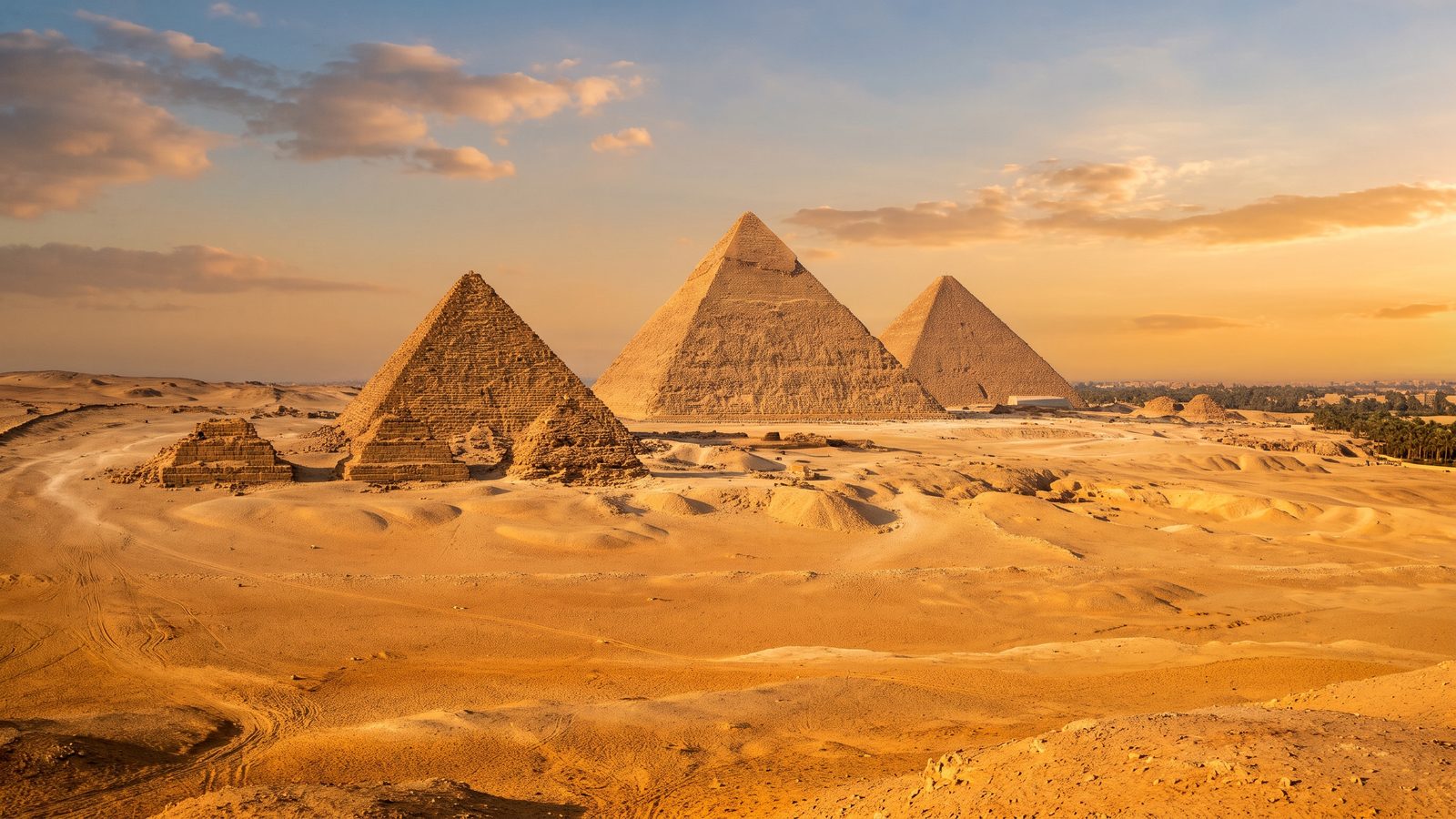
You stand at the edge of the Sahara desert before the Giza Pyramids, humanity's ultimate statement of ambition built over 4,500 years ago during Egypt's Old Kingdom. Constructed for Pharaoh Khufu and his successors, these colossal stone peaks have captivated travelers, conquerors, and scholars for millennia. As you look across the sweeping plateau, you feel the staggering scale of a civilization that mastered geometry, astronomy, and quarrying to challenge time itself.
This self-guided audio tour reveals the extraordinary stories locked within these ancient stones. Step back in time as you discover how thousands of skilled workers, complex funerary rituals, and precise astronomical alignments converged on this desert horizon to create the last surviving wonder of the ancient world.
Listen to a sample
The opening of this tour, exactly as AllTours narrates it on site.
What you'll hear on this tour
Stop 1. Engineering the Impossible
You look up at the massive limestone blocks rising high into the desert sky. Ancient builders quarry, transport, and stack multi-ton stones—some weighing up to 80 tons—with tolerances measured in mere millimeters. You see a staggering feat of applied physics and geometry that challenges modern engineering capabilities. The builders align the massive base to true north using precise astronomical observations and land surveying techniques. To elevate these massive stones, workers maneuver along intricate ramp systems, perhaps spiraling around the inner core, orchestrated by an extraordinary logistical network. Every block you examine represents an unprecedented mastery of mechanical force, organizational planning, and ancient ingenuity.
Stop 2. A Cosmic Dance in Stone
You observe the astonishing precision of these meticulously engineered structures, where stone blocks fit together so tightly that time cannot separate them. As you gaze along the subtle outward slope of the casing stones, you see a deliberate design intended to deflect harsh desert winds and drifting sand for millennia. Inside, intricate passageways slope upward toward the Grand Gallery, where a soaring corbelled ceiling guides you toward the quiet depths of the King’s Chamber. Notice how the monument aligns not only to the cardinal directions, but also to key constellations, creating a profound astronomical map locked inside an eternal stone fortress.
Stop 3. Pathway to the Stars
You stand before a monument designed not merely as a tomb, but as a celestial engine connecting earth to the cosmos. In ancient Egyptian cosmology, the pyramid's angular shape mimics the primordial Benben mound, the original point of creation. You imagine this structure functioning as a grand cosmic ramp, allowing Pharaoh Khufu's soul, his ba, to ascend directly into the night sky toward the circumpolar stars—the imperishable ones that never set. Inside these stone corridors, symbolic pathways navigate the perilous dangers of the Duat underworld, guiding the divine ruler toward eternal rebirth and ensuring cosmic harmony for his people on earth.
Stop 4. Legacy of the Old Kingdom
You feel the immense weight of four millennia as you stand on the dusty Giza plateau. Built around 2580–2560 BC during the Old Kingdom’s golden age, the Great Pyramid represents over two decades of intense human effort overseen by architects like Hemiunu. Tens of thousands of skilled artisans and specialized workers labor under exceptional organization, quarrying millions of blocks across the Nile and moving them up monumental ramps. As you trace the footprint of Pharaoh Khufu’s ultimate masterpiece, you realize this massive undertaking reflects a society operating at its absolute peak, dedicating its vast resources and scientific intellect to securing the pharaoh's immortal realm.
Stop 5. Devotion Written in Stone
You step into the world of a civilization obsessed with eternity, where building these pyramids serves as a monumental act of civic duty and faith. Thousands of skilled artisans, laborers, and priests unite under a shared spiritual vision, working in harmony for their divine pharaoh. Rather than forced labor, this massive project represents an expression of cosmic balance and deep religious devotion, securing the ruler's role as a vital intermediary between humanity and the gods. Through complex funerary rituals and meticulous preparations for the afterlife, you see how these enduring stones reflect a culture that viewed death not as an end, but as a glorious transition.
Stop 6. Unveiling the Ancient Secrets
You trace the long, unfolding history of how the world slowly rediscovered these ancient giants after centuries buried beneath desert sands. Early visitors like the Greek historian Herodotus recorded vivid accounts filled with wonder, while medieval Arab scholars documented the vast exterior and attempted to solve its mysteries. By the 19th century, systematic scientific exploration replaced legend, unsealing hidden chambers and quiet interior passageways that had remained undisturbed for thousands of years. As you walk beside these historic blocks today, you follow in the footsteps of generations of explorers who gradually unlocked the secrets of this majestic lost era.
Planning your visit
- Best time to go
- Early morning right at opening or late afternoon offers cooler desert temperatures and clear light for photography.
- Approximate duration
- about 2-3 hours
- Where to start
- Begin at the main plateau entrance near the Great Pyramid of Khufu.
Access and conditions change seasonally — check the official site before you go.
Frequently asked questions
Is Giza Pyramids worth visiting?
Yes, visiting the Giza Pyramids is an unforgettable experience. As the last surviving wonder of the ancient world, the sheer scale, ancient history, and engineering precision of Khufu's monument make it an essential journey.
How long do you need at Giza Pyramids?
Most visitors spend between 2 and 4 hours exploring the plateau, which allows ample time to view the Great Pyramid, visit panoramic vantage points, and see the Sphinx.
When were the Giza Pyramids built?
The Giza Pyramids were constructed during Egypt's Old Kingdom, approximately between 2580 and 2560 BC, during the reign of Pharaoh Khufu and his successors.
Keep exploring
Header image is an AI-generated illustration of Giza Pyramids. AllTours.ai is an AI audio tour guide — point your camera at any landmark and hear its story.