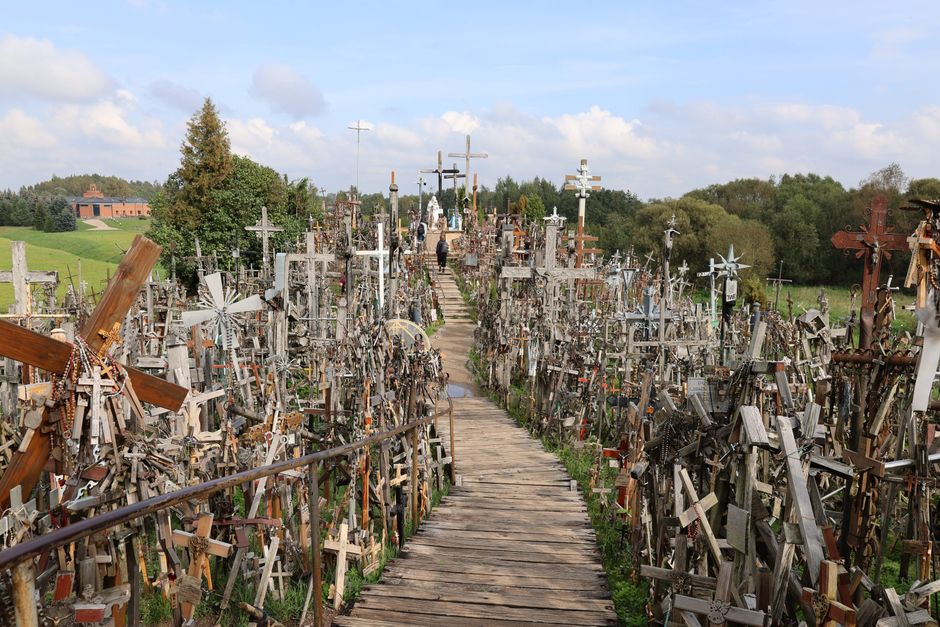
Welcome to the Hill of Crosses, a truly unique and deeply moving pilgrimage site near Šiauliai, Lithuania. This low mound, adorned with hundreds of thousands of crosses, is more than just a religious monument; it's a testament to unwavering faith and indomitable national spirit. Prepare to walk among a forest of symbols, each telling a silent story of hope and remembrance.
With AllTours.ai, your camera becomes your personal guide, narrating the profound history and legends embedded in this extraordinary landscape. We'll delve into its origins, its dramatic role during the Soviet occupation, and the powerful acts of resistance that ensured its survival. Get ready to experience a site where every step reveals layers of devotion, defiance, and cultural identity.
What you'll hear on this tour
Stop 1. The Sea of Crosses Begins
As you approach the Hill of Crosses, the sheer magnitude of this sacred site instantly commands attention. What begins as a scattering of wooden and metal crosses quickly transforms into an overwhelming forest of devotion. Imagine the countless hands that have placed these symbols here over nearly two centuries, each one a prayer, a memory, or a vow. This initial view offers a powerful introduction to a place where faith and history intertwine, inviting you to step into a landscape unlike any other.
Stop 2. Echoes of Ancient Origins
While its modern fame stems from Soviet resistance, the tradition of placing crosses here dates back to the 19th century, following the 1831 November Uprising. Legend says the first crosses were placed by families mourning lost rebels, unable to find their bodies. Over time, it grew into a pilgrimage site, a place where prayers for healing and remembrance were offered. Stand here and consider the generations who have sought solace and expressed their deepest beliefs on this very spot, long before it became a symbol of national defiance.
Stop 3. The Scars of Resistance
During the Soviet occupation, the Hill of Crosses became an undeniable symbol of Lithuanian Catholic identity and resistance. Soviet authorities repeatedly bulldozed the site in the 1960s and 70s, attempting to erase this powerful expression of faith. Yet, as soon as the bulldozers left, locals would creep back under cover of darkness, rebuilding it cross by cross. This area particularly tells the story of that relentless struggle, showcasing the incredible courage and unwavering spirit that refused to be extinguished.
Stop 4. Pope John Paul II's Visit
In 1993, the newly independent Lithuania welcomed Pope John Paul II, who visited the Hill of Crosses and declared it a place of hope, peace, and sacrifice. His presence here elevated the site's global significance, cementing its status as a powerful symbol of faith and freedom. Look for the large crucifix he personally gifted, a beacon among the countless smaller ones. His visit not only honored the past struggles but also inspired future generations to continue the tradition of placing crosses, ensuring its enduring legacy.
Stop 5. A Living, Growing Testimony
The Hill of Crosses is not a static monument; it is a living, breathing testament to ongoing faith. Pilgrims from around the world continue to add their own crosses, rosaries, and religious artifacts, each contributing to its ever-changing landscape. Take a moment to observe the incredible diversity of crosses – from tiny, intricate metalwork to towering wooden structures. This final stop encourages you to reflect on the personal stories woven into this collective act of devotion and perhaps even consider leaving your own small symbol of hope and remembrance.
Planning your visit
- Best time to go
- Early morning or late afternoon for fewer crowds and best light, especially during spring or early autumn.
- Approximate duration
- About 45-60 minutes to explore the main areas.
- Where to start
- The main entrance pathway, clearly marked by a large parking area and visitor center. You'll see the first clusters of crosses emerging from the landscape.
Access and conditions change seasonally — check the official site before you go.
Frequently asked questions
Can I leave my own cross at the Hill of Crosses?
Yes, absolutely! Visitors are encouraged to bring and leave their own crosses or rosaries as a personal act of devotion or remembrance. You'll find many small spaces to place your contribution among the existing thousands.
Is there an entrance fee to visit the Hill of Crosses?
There is no official entrance fee to the Hill of Crosses itself, as it is an open-air pilgrimage site. However, there might be a small charge for parking if you arrive by car. Always check local signage or the official visitor information for the latest details.
How do I get to the Hill of Crosses from Šiauliai?
The Hill of Crosses is located about 12 kilometers (7.5 miles) north of Šiauliai. You can reach it by car, taxi, or a local bus service that runs from Šiauliai bus station. Look for buses heading towards Joniškis or take a tour organized from the city.
Keep exploring
Photography via Pexels. AllTours.ai is an AI audio tour guide — point your camera at any landmark and hear its story.