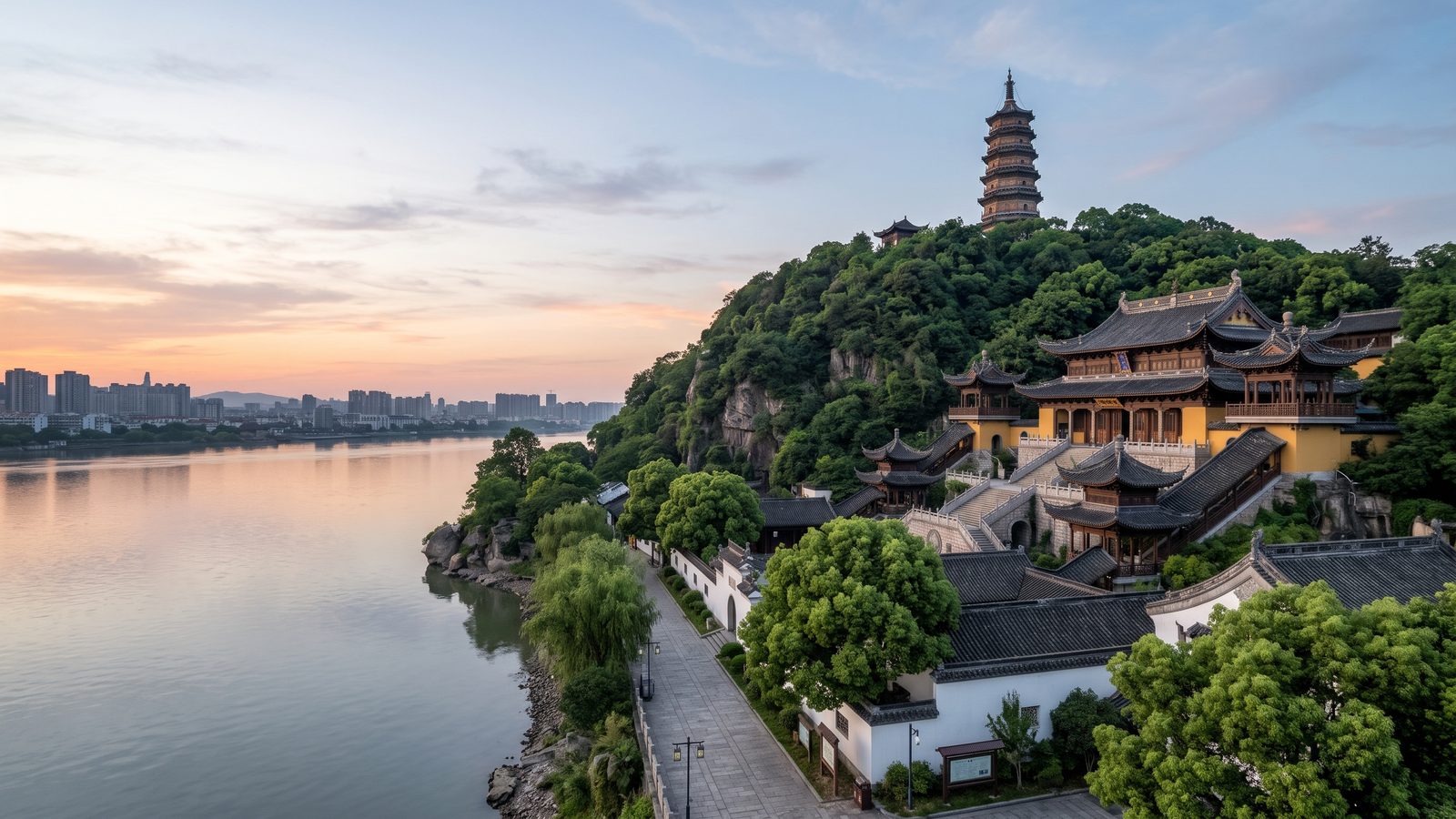
Welcome to Jinshan Temple, a majestic Buddhist sanctuary rising dramatically above Zhenjiang in Jiangsu Province. Dating back nearly 1,700 years to the Eastern Jin Dynasty, this sprawling temple complex weaves together deep spiritual devotion, imperial patronage, and enduring Chinese folklore. As you walk among its mountain-side halls and soaring pagodas, you step directly into a living landscape where ancient history meets timeless cultural mythology.
This self-guided audio tour leads you through sacred courtyards, ancient timber pavilions, and historic monastic spaces. You will encounter revered statues, learn about Chan Buddhist meditation practices, and explore the iconic sites tied to the famous Legend of the White Snake as you ascend Jinshan Hill.
Listen to a sample
The opening of this tour, exactly as AllTours narrates it on site.
What you'll hear on this tour
Stop 1. From River Island to Imperial Sanctuary
You stand on ground steeped in nearly seventeen centuries of history, beginning in the 4th century during the Eastern Jin Dynasty as Zeshou Temple. As you look around, imagine this sanctuary in its original state as a solitary island rising directly from the waters of the Yangtze River. Over time, natural river flow and land reclamation gradually connect the island to the mainland. By the Tang Dynasty, the complex earns its revered name, Jinshan Temple, becoming a vital center for Chan Buddhism. You trace the footsteps of Qing Dynasty Emperor Kangxi, whose personal imperial inscription still graces these halls, marking centuries of royal patronage through floods and dynastic shifts.
Stop 2. Soaring Pagodas and Masterful Timber Framework
You gaze up at Cishou Pagoda, a magnificent seven-story octagonal structure that dominates the skyline. Rebuilt during the Qing Dynasty, it preserves Song Dynasty timber-frame techniques, visible in the intricate dougong bracket sets supporting each upturned eave. As you explore the complex, you notice how the temple adapts to the natural slope of Jinshan Hill rather than following a flat layout. You ascend through interconnected courtyards and grand halls like the Dabei Pavilion, where massive timber columns and roof trusses demonstrate incredible structural resilience. Roofs gleaming with vibrant glazed tiles and sculpted mythical beasts serve as protective symbols, harmonizing the architecture with its mountain setting.
Stop 3. The Epic Legend of the White Snake
You enter a living cultural landscape deeply tied to the famous Legend of the White Snake. This dramatic tale, celebrated across Chinese opera, folklore, and literature, unfolds directly on these temple grounds. You stand near the cave of the monk Fahai, where the legendary struggle between love, duty, and spiritual discipline takes place. As you walk through these sacred spaces, you feel the lingering tension of Fahai's legendary battle against the White Snake spirit. This narrative explores the intricate boundary between human emotions and the supernatural world, establishing Jinshan Temple as an enduring inspiration for generations of artists and storytellers throughout China.
Stop 4. The Miraculous Camphorwood Guanyin of Compassion
You turn your gaze toward the revered statue of Guanyin, the Bodhisattva of Compassion. Carved from a single camphorwood log during the Song Dynasty, this statue radiates serene tranquility with her gentle expression and empathetic gaze. You observe her right hand holding a willow branch for healing, while her left hand cradles a vase of divine nectar offering spiritual solace. Notice the flowing, naturalistic folds of her wooden robes. According to local lore, this miraculous image survived a devastating temple fire during the Ming Dynasty completely unharmed, reinforcing its sacred power and drawing centuries of devoted prayers to this enduring symbol of mercy.
Stop 5. The Monastic Crucible of Chan Meditation
You walk through halls that served for centuries as a renowned monastic academy for Chan, or Zen, Buddhism. Here, dedicated monks focus entirely on the pursuit of enlightenment through zuochan, intense seated meditation aimed at transcending conventional thought. You feel the solemn heritage of strict adherence to the Vinaya monastic code and the emphasis on direct experiential wisdom rather than simple scripture study. Great spiritual masters teach and transmit the Dharma across generations within these walls. Every courtyard and hall is constructed to support this inner journey, embodying the Three Jewels of Buddhism through sacred art, preserved texts, and a disciplined community of seekers.
Stop 6. Cascading Sacred Halls and Ancient Scriptures
You ascend through cascading levels of Jinshan Temple, where buildings merge seamlessly with the mountain itself. As you enter the Great Buddha Hall, you admire intricate Song Dynasty wood carvings along the eaves depicting celestial beings. Inside, an immense camphorwood statue of Sakyamuni Buddha radiates profound tranquility across the hall. You climb higher to reach the Sutra Depository, which houses delicate, thousand-year-old hand-copied scriptures preserved by the mountain's unique microclimate. Moving along winding stone corridors, you pass the Guanyin Hall, whose blessed foundation stones symbolically protect the complex from floods, creating a deeply immersive journey upwards toward spiritual enlightenment.
Planning your visit
- Best time to go
- Spring and autumn offer comfortable temperatures and clear views for climbing the temple pathways.
- Approximate duration
- about 1.5 to 2 hours
- Where to start
- The main entrance gate at the base of Jinshan Hill.
Access and conditions change seasonally — check the official site before you go.
Frequently asked questions
Is Jinshan Temple worth visiting?
Yes, Jinshan Temple is one of Zhenjiang's premier historical sites, renowned for its hill-integrated architecture, Chan Buddhist heritage, and deep connection to the Legend of the White Snake.
How long do you need at Jinshan Temple?
Most visitors spend about 1.5 to 2 hours visiting the main halls, Cishou Pagoda, Fahai Cave, and scenic stairways.
What is the history behind Jinshan Temple?
Founded during the Eastern Jin Dynasty around the 4th century AD, the temple originally stood as an island in the Yangtze River before land reclamation connected it to mainland Zhenjiang.
Keep exploring
Header image is an AI-generated illustration of Jinshan Temple. AllTours.ai is an AI audio tour guide — point your camera at any landmark and hear its story.