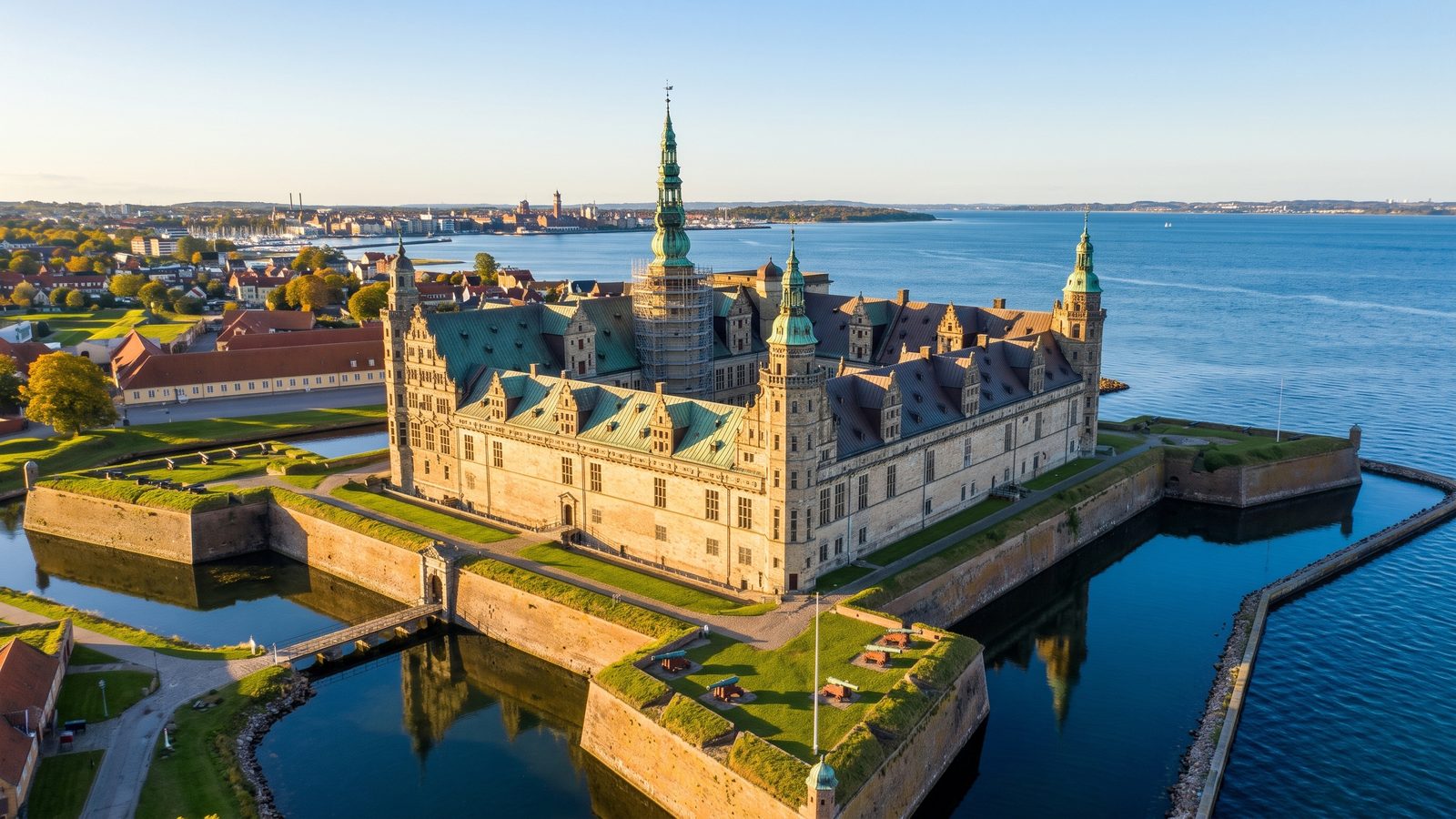
You stand before Kronborg Castle, a UNESCO World Heritage site and magnificent Renaissance fortress guarding the narrow Øresund strait in Helsingør, Denmark. Built by King Frederick II in the 1570s, this formidable stronghold commanded tribute from passing ships for centuries, filling the royal treasury. As you explore its towering copper spires, grand courtyards, and subterranean passages, you walk in the footsteps of kings, soldiers, and literary legends.
This self-guided audio tour leads you through the dramatic story of Denmark's maritime empire. From its strategic origins controlling lucrative Baltic trade routes to its immortalization as the setting for William Shakespeare's Hamlet, Kronborg Castle brings centuries of royal intrigue, engineering feats, and theatrical legacy vividly to life.
Listen to a sample
The opening of this tour, exactly as AllTours narrates it on site.
What you'll hear on this tour
Stop 1. The Dramatic Stage of Elsinore
You step into the literary legend of Elsinore, the dramatic backdrop for William Shakespeare's tragic masterpiece, Hamlet. Although Shakespeare likely never visits Denmark himself, stories of this magnificent fortress reach England through sailors and traveling actors, inspiring his immortal vision. You imagine Prince Hamlet pacing these stone ramparts, haunted by his father's ghost as sea winds blow across the Øresund. The themes of power, betrayal, and revenge fit seamlessly into Kronborg's royal history. Every summer, actors bring the tragedy back to life in the castle courtyards, ensuring that Shakespeare's enduring words continue to echo through these ancient stones.
Stop 2. Unyielding Bastions and Subterranean Casemates
You feel the sheer military might of Kronborg as you stand among its massive bastions. Designed to enforce the Sound Toll across the narrow strait, these thick Swedish granite walls once host thunderous cannon crossfires, securing Denmark's dominant maritime power. Beneath your feet lies a subterranean city—the sprawling, damp casemates capable of sheltering a thousand soldiers with months of provisions during a siege. As you navigate these dark underground passages and look out over the fortified glacis, you appreciate the sophisticated 16th-century engineering that makes Kronborg an almost unassailable naval stronghold designed to guard sovereign territory against fierce Swedish assaults.
Stop 3. Splendor of the Renaissance Court
You step into the lavish world of King Frederik II and Queen Sophie of Mecklenburg-Güstrow, who transform Kronborg into a glittering Renaissance residence. Fueled by vast revenues from the Sound Dues, Frederik crafts a vibrant court that attracts artists and diplomats from across Europe. Queen Sophie manages vast royal estates and co-steers the monarchy's wealth, ensuring uninterrupted opulence. In the Great Hall, you visualize grand banquets where international alliances take shape over lavish feasts. Within these very walls, their son, the future King Christian IV, is born, cementing Kronborg as the ultimate symbol of Danish royal prestige and absolute maritime authority.
Stop 4. From Eric's Tollhouse to Renaissance Jewel
You trace Kronborg's strategic origins to the 1420s, when King Eric of Pomerania builds the original fortress, Krogen, to levy the lucrative Sound Dues on passing ships. In the 1570s, King Frederick II radically transforms the site into a dazzling Renaissance castle, importing master artisans to showcase Denmark's supreme wealth. Your journey takes a tragic turn in 1629, when a devastating fire consumes most of the structure, leaving only the chapel standing. Yet you witness resilience in action as King Christian IV immediately initiates a ambitious reconstruction, restoring Kronborg's majestic presence and defining its silhouette for centuries to come.
Stop 5. Masterwork of Northern European Renaissance
You gaze upon the delicate Dutch Renaissance detailing that defines Kronborg's outer walls and grand central courtyard. Master builders Anton van Opbergen and Hans van Steenwinckel the Elder craft intricate sandstone ornamentation that frames doors and windows against a sturdy red brick base. Looking upward, you admire soaring copper spires that crown the castle, reflecting sunlight across the waters of the Øresund. Four surrounding wings create a striking space designed for both defense and royal display. Even the massive outer bastions blend military functionality with elegant architectural lines, harmonizing martial force with palatial elegance.
Stop 6. Treasures of Trade and Maritime Power
You enter Kronborg's exhibition chambers, where centuries of trade and royal life come into focus. You examine historic ledgers detailing the massive Sound Dues collected from international merchant ships, revealing the financial foundation of Denmark's golden age. Moving through the Royal Chambers, you view period furniture and royal portraits that depict the daily routines and political maneuvering of Danish monarchs. Descending into the chilling casemates, you encounter stark military artifacts and archaeological finds, from weathered cannonballs to gilded goblets. Each object bridges the gap between opulent court life above and the grim defensive reality below.
Planning your visit
- Best time to go
- Morning on weekdays, especially in late spring or summer, for clear sunlight over the strait and fewer crowds.
- Approximate duration
- About 2 to 3 hours
- Where to start
- Begin at the main outer gate facing the harbor in Helsingør.
Access and conditions change seasonally — check the official site before you go.
Frequently asked questions
Is Kronborg Castle worth visiting?
Yes, Kronborg Castle is a UNESCO World Heritage site renowned for its Renaissance architecture, underground casemates, rich naval history, and literary fame as the setting for Shakespeare's Hamlet.
How long do you need at Kronborg Castle?
Most visitors spend 2 to 3 hours exploring the royal apartments, subterranean casemates, castle courtyards, bastions, and maritime museum exhibitions.
Why was Kronborg Castle built?
Kronborg was built to control the narrow Øresund strait and enforce the Sound Dues, a toll levied on passing ships that generated immense wealth for the Danish crown.
Keep exploring
Header image is an AI-generated illustration of Kronborg Castle. AllTours.ai is an AI audio tour guide — point your camera at any landmark and hear its story.