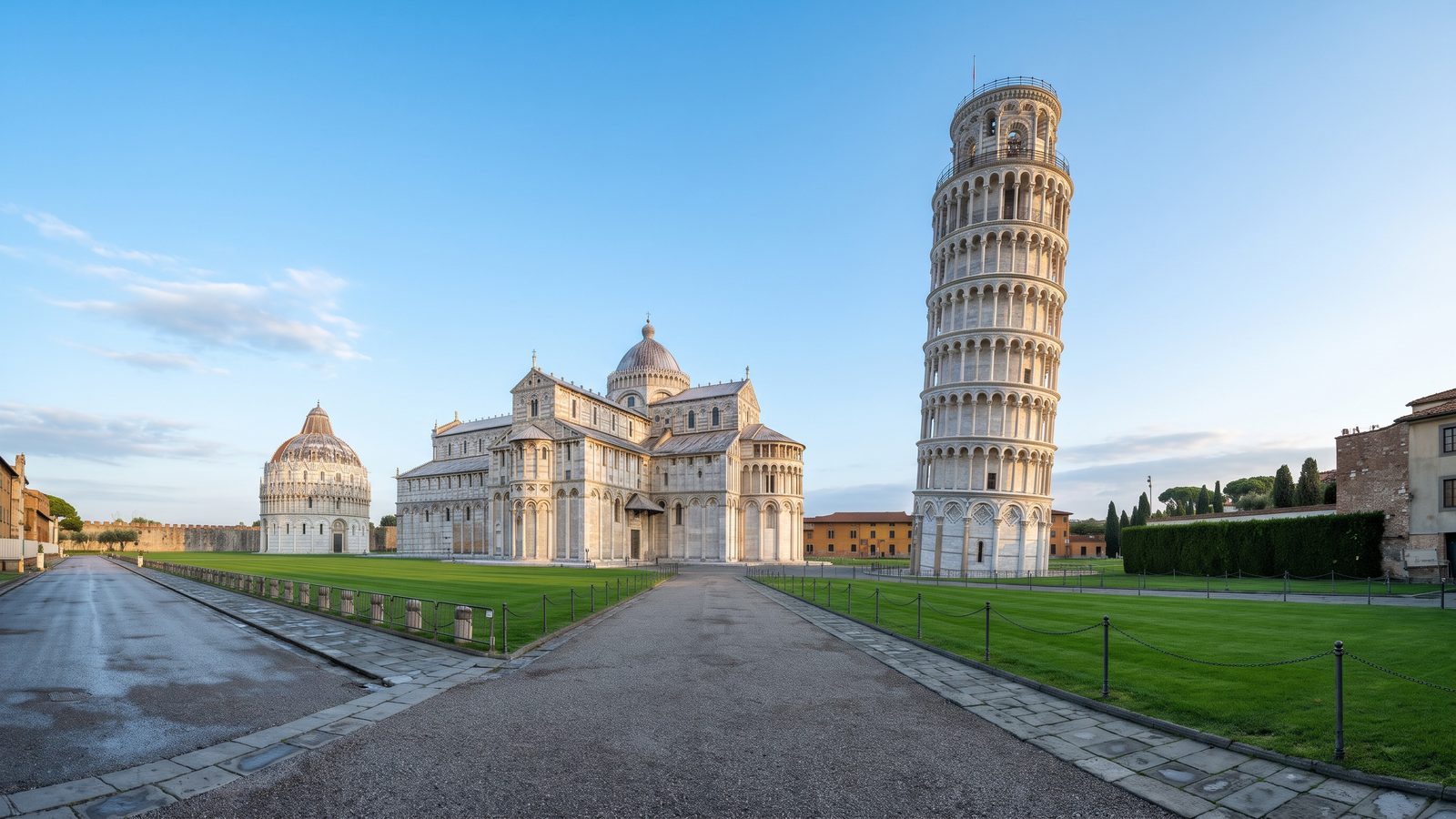
Welcome to Piazza dei Miracoli, the magnificent 'Square of Miracles' in Pisa, Tuscany. As you step onto this UNESCO World Heritage site, your eyes naturally gravitate toward the iconic Leaning Tower of Pisa, a breathtaking marble bell tower famous for its dramatic tilt. Alongside the gleaming white cathedral, this architectural complex stands as a stunning monument to medieval grandeur, human perseverance, and artistic brilliance that continues to captivate millions of visitors.
With this self-guided audio tour, you will explore the rich history, unique Romanesque architecture, and fascinating cultural legacy behind Pisa's most famous monument. Learn how soft subsoil created an unintentional global icon and discover the best perspectives to photograph this world-famous landmark during your visit.
Listen to a sample
The opening of this tour, exactly as AllTours narrates it on site.
What you'll hear on this tour
Stop 1. Centuries of an Unintended Tilt
You trace the remarkable timeline of this legendary bell tower back to 1173, when initial construction begins alongside the main cathedral. By the time builders complete the third story, you notice the dangerous tilt emerging due to the extremely soft subsoil beneath. A century-long pause caused by regional Pisan wars paradoxically saves the structure, allowing the weak ground to settle before heavy additional weight is added. In 1272, Giovanni di Simone resumes the project, attempting to compensate for the noticeable lean by constructing higher floors with a deliberate curve. Finally, Tommaso di Andrea Pisano seals this famous, unintended architectural tilt when finishing the bell chamber in the late fourteenth century.
Stop 2. Engineers Against Nature's Whims
You observe the distinct tilt stretching toward the sky, a direct consequence of the unstable subsoil foundation that begins shifting during the construction of the second floor in the twelfth century. As you examine the marble exterior, you discover how medieval engineers continuously work to counteract the tower's increasing inclination over generations. They even add heavier masonry onto one side in a brave attempt to balance the heavy structure against gravitational pulls. What begins as a standard cathedral bell tower stands today as a world-renowned architectural marvel, reflecting incredible medieval ingenuity and persistent human effort striving bravely against nature's unpredictable whims.
Stop 3. Pisan Romanesque Marble Elegance
You stand before the tower and cathedral to admire the distinct Pisan Romanesque style, a design defined by its dazzling white marble facade. As you look closely at the exterior, you see tiers of blind arcades and rows of delicate, slender columns, each capital intricately carved to form a rhythmic sense of elegance. This exquisite architectural language uses open loggias and repeating geometric patterns across the entire Piazza dei Miracoli. You observe how local builders masterfully combine regionally sourced materials with a profound sense of proportion, creating a unified complex that remains one of Italy's greatest architectural achievements.
Stop 4. A Maritime Power's Golden Age
You immerse yourself in the cultural legacy of Pisa's golden age, when the powerful maritime republic builds this spectacular piazza to showcase immense wealth and spiritual devotion. As you look across the white structures, you perceive how Pisan Romanesque design uniquely blends Lombard, Byzantine, and Islamic artistic influences. This rich stylistic synthesis directly reflects Pisa's vast Mediterranean trade networks and international reach. You discover an architectural language that proudly proclaims the city's distinct civic identity and religious fervor, establishing Pisa as an influential cultural beacon across Europe for centuries.
Stop 5. Capturing the Playful Perspective
You join fellow visitors in facing the unique visual challenge and exciting creative opportunity the Leaning Tower offers to photographers. Looking around the green lawns, you witness countless travelers perfecting the famous forced-perspective pose, playfully pretending to hold up the tilting marble cylinder. You notice how the gentle morning sun illuminates the gleaming white surface, casting soft shadows that reveal rich dimensional details far better than harsh midday light. As you frame your shots, your camera lens does more than record reality; it actively interprets the impossible angle, turning an ancient engineering flaw into your personal visual narrative.
Stop 6. The Shared Ritual of Pilgrimage
Your personal presence here connects you directly to centuries of global travelers who have journeyed to marvel at this famous tilt. You consider how travel to Pisa transforms over time, evolving from arduous medieval religious pilgrimages to today's swift international arrivals. Standing in the central square, you become part of a continuous human stream, all converging for that quintessential moment and playful photo that easily transcends language barriers. As you capture your own memory today, you participate in a shared travel ritual, linking your experience to millions of visitors who have stood in this exact spot.
Planning your visit
- Best time to go
- Early morning near sunset to avoid peak crowds and capture soft lighting on the white marble.
- Approximate duration
- About 1.5 hours
- Where to start
- Piazza dei Miracoli, near the main entrance by the North lawn in front of the Cathedral.
Access and conditions change seasonally — check the official site before you go.
Frequently asked questions
Is Leaning Tower of Pisa worth visiting?
Yes, seeing the Leaning Tower of Pisa in person is a memorable experience. Located in the stunning Piazza dei Miracoli alongside the magnificent cathedral and baptistery, it offers world-unique architecture and rich history.
How long do you need at Leaning Tower of Pisa?
Most visitors spend about 1 to 2 hours exploring Piazza dei Miracoli, admiring the tower and cathedral facade, and taking photos. If climbing the tower or entering all complex monuments, plan for 2 to 3 hours.
Why does the Leaning Tower of Pisa lean?
The tower began leaning during construction in 1173 because it was built on soft subsoil composed of sand, clay, and mud. Subsequent builders attempted to compensate by building curved upper floors and adding extra masonry.
Keep exploring
Header image is an AI-generated illustration of Leaning Tower of Pisa. AllTours.ai is an AI audio tour guide — point your camera at any landmark and hear its story.