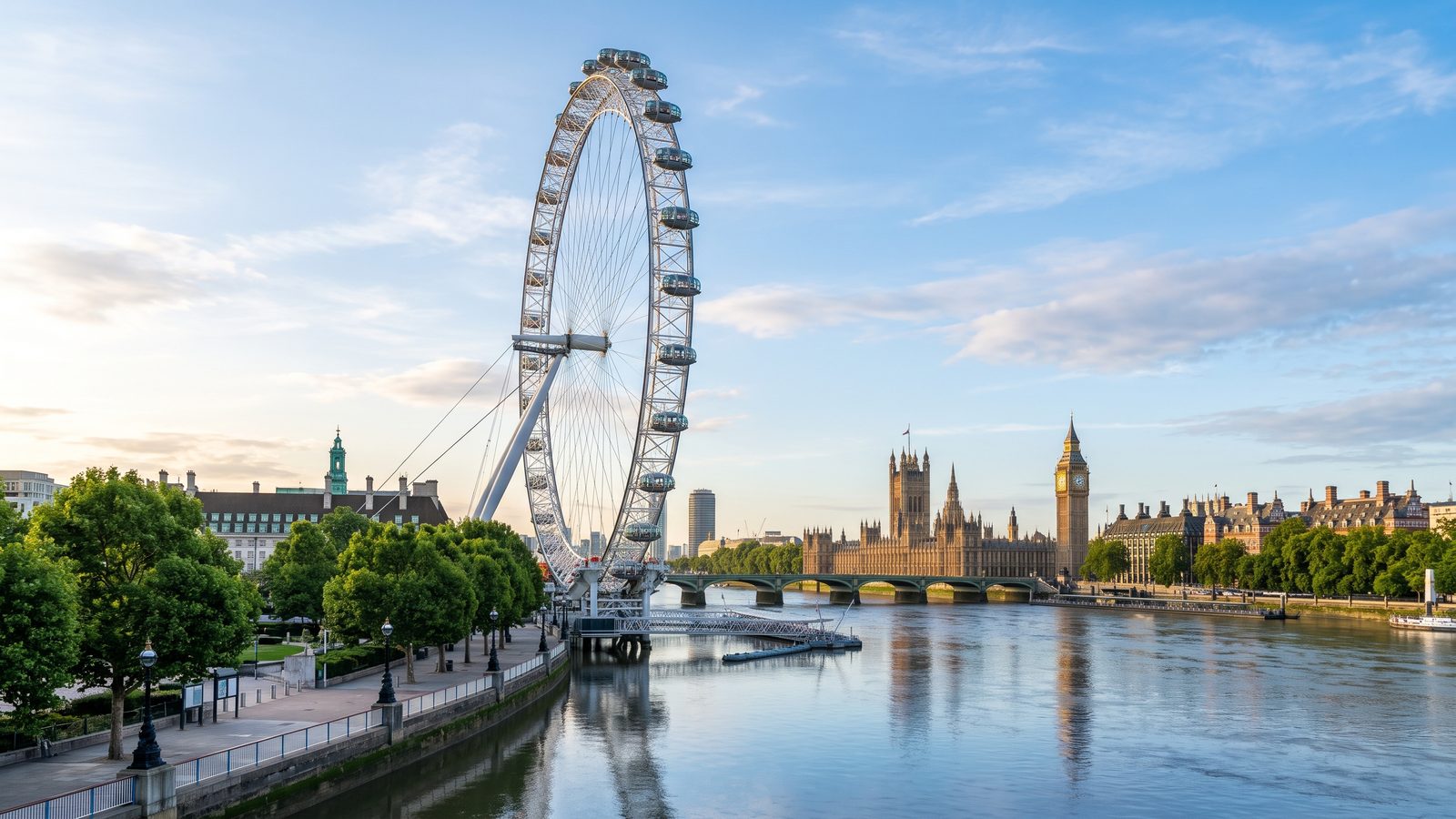
Step aboard the London Eye for an immersive journey above the heart of London's South Bank. As your capsule glides skyward, this self-guided audio tour reveals the history, engineering genius, and breathtaking architectural landmarks that define the British capital. From Roman roots to futuristic skyscrapers, discover how a temporary millennium monument transformed into the UK's most beloved paid attraction and a timeless symbol of modern London.
With engaging stories delivered right to your smartphone, you'll uncover hidden details in the skyline, learn about the radical construction over the River Thames, and experience the panorama at your own pace. Prepare to see Big Ben, St. Paul's Cathedral, and the City of London from an unforgettable perspective.
What you'll hear on this tour
Stop 1. Panoramic Vistas Across the Capital
As your pod gently ascends above the South Bank, the immense scale of London unfolds beneath you. Directly across the Thames, you gaze upon the Houses of Parliament and the Gothic tower of Big Ben. Sweeping your eyes eastward, modern marvels like the Shard, the Gherkin, and the Walkie-Talkie pierce the horizon. On a clear day, your view extends up to 25 miles along the winding ribbon of the river. You notice how St. Paul’s Cathedral aligns seamlessly with the Millennium Bridge below. From this elevated perspective, London lays out like a living map, connecting centuries of history and modern architecture into one grand landscape.
Stop 2. An Engineering Feat on the River
You stand before a landmark born from a visionary competition to mark the new millennium. Husband-and-wife architects Julia Barfield and David Marks designed this radical wheel, overcoming staggering engineering hurdles. Crews assembled the vast structure horizontally over the River Thames, floating components down the river on barges. In 1999, powerful strand jacks slowly lifted the giant frame upright over several days. Though its first rotation carried passengers on New Year’s Eve 1999, the wheel officially opened to the public in March 2000. Intended as a temporary five-year attraction, popular demand transformed it into a permanent fixture on London’s modern silhouette.
Stop 3. Reinventing the Classic Observation Wheel
As you board, you witness the ultimate evolution of the Ferris wheel, originally invented by George Washington Gale Ferris Jr. in 1893. Unlike classic fairground wheels with open gondolas, you step inside a fully enclosed, climate-controlled capsule. Notice how each pod mounts entirely outside the main rim, offering an unobstructed 360-degree panorama. Supported by a giant cantilevered A-frame on just one side, the structure turns at a slow, gentle pace. Completing a full rotation in roughly thirty minutes, the wheel transforms a fairground ride into an elegant, continuous journey through London’s sky.
Stop 4. Gazing Upon the Ancient Square Mile
Looking eastward, you spot the dense cluster of skyscrapers marking the City of London, also known as the Square Mile. You are gazing at the original birthplace of London, continuously inhabited since the Romans founded Londinium nearly two thousand years ago. This tiny borough still maintains its own governance and elects its own Lord Mayor annually. After the catastrophic Great Fire of 1666 destroyed medieval streets, visionaries like Sir Christopher Wren rebuilt the area. Today, modern giants like the Gherkin stand side by side with Wren’s masterpiece, the iconic dome of St. Paul’s Cathedral.
Stop 5. Milestones and Proposals in the Sky
As you ride, remember that you are part of a massive global procession. Over 85 million people have stepped inside these pods, making this the UK’s most visited paid attraction. Within these glass capsules, more than 5,000 marriage proposals have taken place against the backdrop of London’s skyline. Royal visitors, celebrities, and families from every corner of the Earth share this exact view. From the visionary architects Julia Barfield and David Marks to the hundreds of engineers who assembled the frame, countless human stories combine to make this wheel an enduring symbol of connection.
Stop 6. Audacious Design and Floating Components
Consider the sheer scale and ingenuity behind this modern marvel, originally conceived as the Millennium Wheel. Each of the 32 fully enclosed glass capsules weighs ten tonnes and comfortably holds up to 25 passengers. At full capacity, over 800 people ride the wheel simultaneously during a single revolution. Transported up the Thames on barges and raised piece by piece, the wheel proved human audacity can redefine a city's identity. What started as a temporary celebration of the year 2000 now stands as an indispensable icon, showcasing forward-thinking design and structural bravado right on the riverbank.
Planning your visit
- Best time to go
- Clear mornings or sunset for optimal 25-mile visibility and stunning light over the Thames.
- Approximate duration
- About 30 to 45 minutes
- Where to start
- South Bank of the River Thames, directly opposite the Houses of Parliament.
Access and conditions change seasonally — check the official site before you go.
Frequently asked questions
Is London Eye worth visiting?
Yes, as the UK's most visited paid attraction, it offers an unprecedented 360-degree perspective of London, allowing you to see up to 25 miles on clear days and view key landmarks like Parliament and St. Paul's Cathedral.
How long do you need at London Eye?
A full revolution takes approximately 30 minutes, but plan for around 45 to 60 minutes in total to allow time for boarding and enjoying the experience.
Who designed the London Eye and when did it open?
It was designed by husband-and-wife architects Julia Barfield and David Marks. The wheel made its first rotation for passengers on New Year's Eve 1999 and officially opened to the public in March 2000.
Keep exploring
Header image is an AI-generated illustration of London Eye. AllTours.ai is an AI audio tour guide — point your camera at any landmark and hear its story.