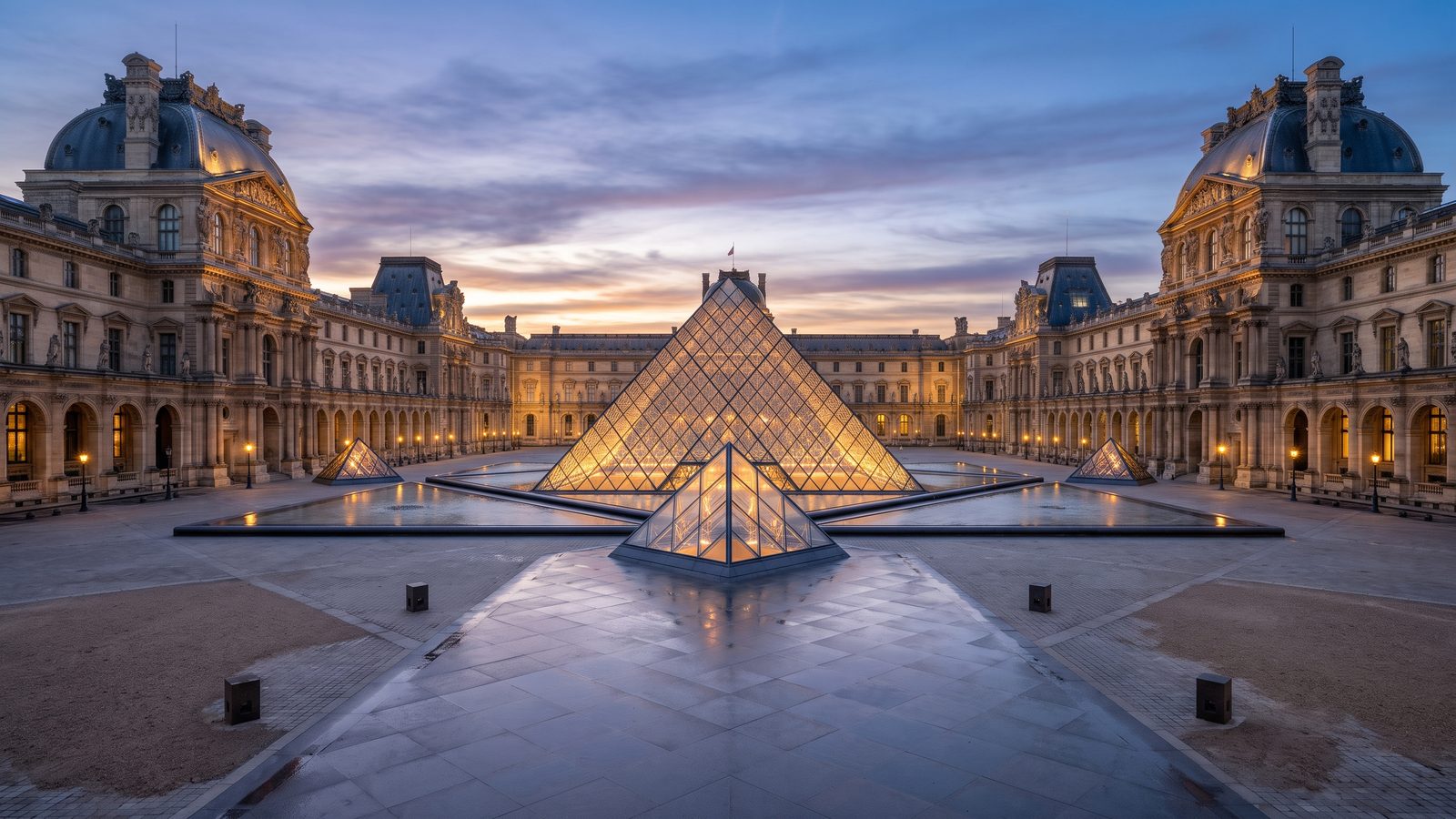
Step into the world's largest art museum, where centuries of French royalty, architectural evolution, and global artistic triumphs collide. Once a medieval fortress guarding Paris, the Louvre transformed into a magnificent royal palace before becoming a sanctuary for humanity's greatest cultural treasures. With its striking glass pyramid welcoming you into endless galleries, this audio tour invites you to journey through millennia of human creativity and monumental history.
As you walk these grand halls, you will encounter legendary sculptures, sweeping history paintings, and breathtaking royal decor. Experience the deep connections between ancient civilizations and modern artistic expression as you discover the stories behind the museum's iconic collection at your own pace.
Listen to a sample
The opening of this tour, exactly as AllTours narrates it on site.
What you'll hear on this tour
Stop 1. From Medieval Fortress to National Treasury
You stand on ground originally fortified by King Philip Augustus in 1190 to defend Paris from invaders, where deep medieval foundations still remain visible today. You trace its transformation in the 14th century under Charles V into a cozy royal residence, followed by Francis I's Renaissance vision that demolishes the original medieval keep. You observe Catherine de' Medici expanding the grounds with the Tuileries Palace and Henry IV connecting them via the grand sprawling wings. After Louis XIV moves the royal court to Versailles in 1682, the palace evolves into an art repository. Finally, the French Revolution democratizes this royal collection, opening it to the public in 1793.
Stop 2. Centuries of Evolving Royal Grandeur
You walk amidst an extraordinary architectural timeline spanning medieval strongholds to modern marvels. Beneath your feet lie the 12th-century defensive foundations, contrasting sharply with the classical symmetry of the Renaissance Cour Carrée designed under Francis I. You examine intricate facades carved by Pierre Lescot and Jean Goujon before following the vision of Henry IV along the revolutionary Grande Galerie. This mile-long corridor established a pioneering standard for displaying public art under soaring ceilings. Outside, I.M. Pei's bold glass pyramid forms a brilliant geometric entrance. Its transparent glass reflects historic facades while inviting light down into subterranean halls, creating a seamless dialogue between ancient roots and modern design.
Stop 3. Masterpieces Across the Millennia
You step into a living timeline of human visual expression, where every brushstroke tells a compelling story. You journey from the serene balance of ancient Greek forms to the emotional depth of Renaissance masters. You observe how Leonardo da Vinci layers fine glazes using his famous sfumato technique to give the Mona Lisa her ethereal glow and unsettlingly lifelike gaze. As you explore further galleries, you encounter delicate patterns from Islamic traditions alongside dramatic Baroque masterworks that capture intense human emotion. Every gallery reveals how artistic innovation bridges diverse cultures across time, inviting you to connect with the universal language of human beauty and creative passion.
Stop 4. Monuments Carved in Stone
You ascend the grand Daru staircase where the Winged Victory of Samothrace greets you, her marble drapery billowing as if landing on a ship's prow to mark a 2nd-century BCE naval triumph. Continuing onward, you encounter the serene Venus de Milo, whose classical contrapposto posture and missing arms invite endless wonder. Nearby, Michelangelo's unfinished Dying Slave displays raw human struggle captured in stone for a papal tomb. You also behold Antonio Canova's Neoclassical masterpiece, Psyche Revived by Cupid's Kiss, where polished marble mimics soft flesh in a gentle embrace. These timeless sculptures challenge you to feel the deep emotion carved by master hands.
Stop 5. Navigating Curated Eras of Human History
You navigate monumental galleries carefully curated to transport you through distinct historic epochs. In the Denon Wing, dramatic French Romantic paintings like Delacroix's Liberty Leading the People share space with Italian Renaissance masterpieces. You descend into the Sully Wing to encounter Egyptian antiquities, meeting the steady gaze of the 4,500-year-old Seated Scribe amidst ancient sarcophagi and sacred artifacts. Ascending toward the Richelieu Wing, you explore the dazzling Galerie d'Apollon, an ornate precursor to Versailles featuring the French Crown Jewels. Each wing functions as an unfolding chapter, meticulously designed to connect you with the power, spirituality, and artistic mastery of bygone eras.
Stop 6. A Global Rosetta Stone of Civilization
You engage in a profound cultural dialogue that spans millennia, tracing shared human creative evolution from ancient Mesopotamia to the Enlightenment. The Louvre acts as a global Rosetta Stone, continually defining what constitutes a masterpiece while setting international benchmarks for artistic excellence and education. By presenting diverse cultural narratives within its halls, the museum challenges your perspective on world heritage and deepens cross-cultural understanding. You realize this historic palace is not merely a venue for displaying artifacts, but a sacred pilgrimage site where collective human memory is actively preserved, celebrated, and embedded into the vibrant spirit of Paris.
Planning your visit
- Best time to go
- Wednesday or Friday evenings for smaller crowds, or early morning right at opening.
- Approximate duration
- About 2 to 3 hours
- Where to start
- In front of the main Glass Pyramid in the Cour Napoléon.
Access and conditions change seasonally — check the official site before you go.
Frequently asked questions
Is the Louvre Museum worth visiting?
Yes, as the world's largest art museum housing legendary works like the Mona Lisa and Winged Victory of Samothrace, it offers an unmissable cultural experience.
How long do you need at Louvre Museum?
While you could spend days exploring its entire collection, a typical visit using an audio tour takes about 2 to 3 hours to cover key highlights and major galleries.
What was the Louvre before it became a museum?
Originally built as a medieval fortress in the late 12th century, the Louvre was converted into a royal palace before opening as a public museum during the French Revolution in 1793.
Keep exploring
Header image is an AI-generated illustration of Louvre Museum. AllTours.ai is an AI audio tour guide — point your camera at any landmark and hear its story.