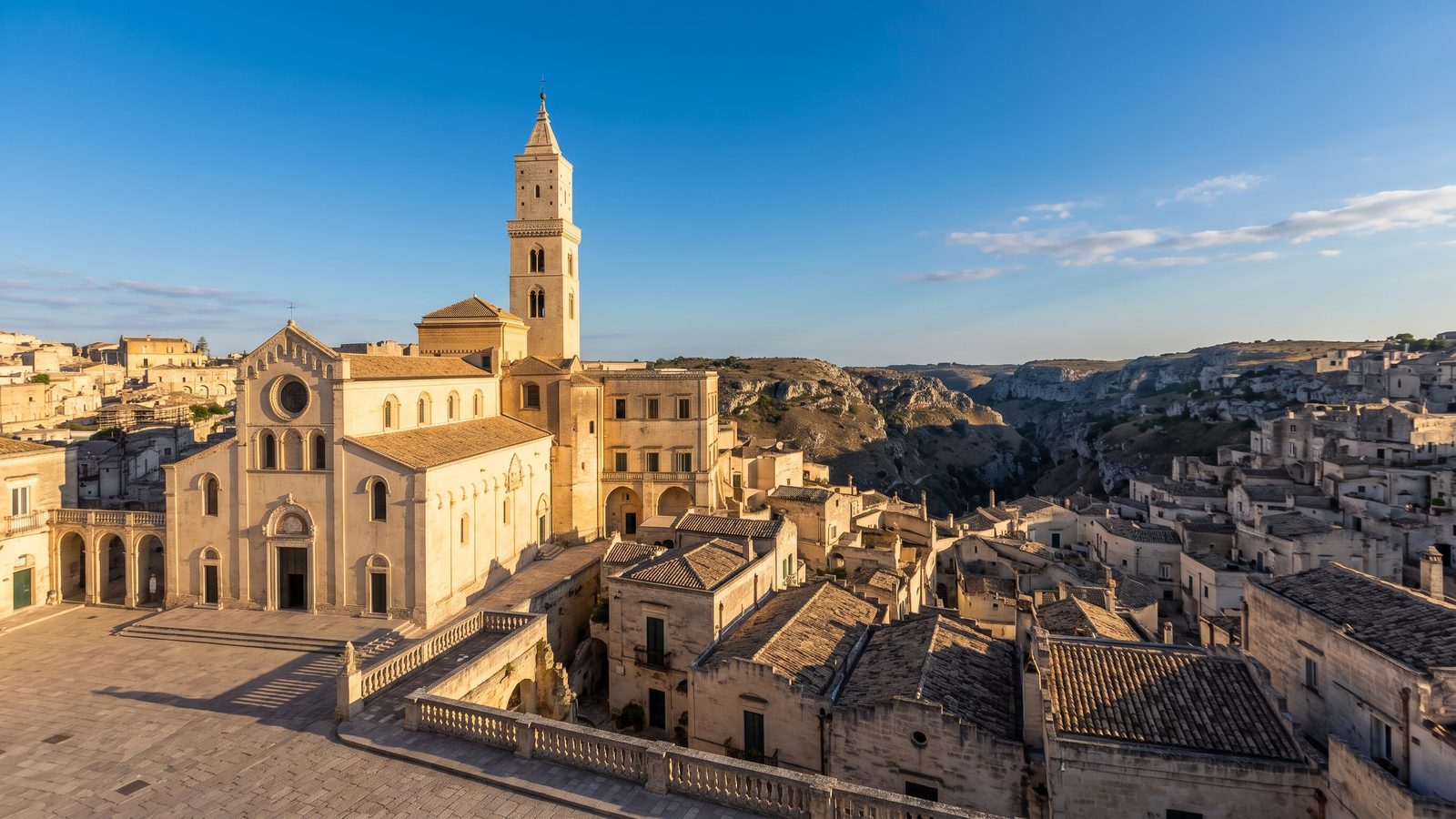
Standing proud at the highest point of Matera between the Sasso Barisano and Sasso Caveoso, Matera Cathedral is a majestic symbol of faith, history, and human resilience. Built in the 13th century from local pale tufa stone, this Apulian Romanesque masterpiece crowns a city renowned for its ancient cave dwellings. Step inside to explore centuries of dramatic architectural evolution and artistic treasures.
This self-guided audio tour walks you through the cathedral's rich history, from its medieval origins and stunning rose window to opulent Baroque transformations and sweeping panoramic vistas over the Gravina ravine. Discover how this sacred monument remains the beating heart of Matera's living heritage.
Listen to a sample
The opening of this tour, exactly as AllTours narrates it on site.
What you'll hear on this tour
Stop 1. Panoramic Vistas Over the Ancient Sassi
You stand at the cathedral's elevated vantage point, gazing out across an extraordinary living diorama of human history. Below you, the intricate maze of Sasso Barisano weaves built stone directly into natural rock, while the cavernous expanse of Sasso Caveoso reveals Matera's ancient troglodytic soul. Beyond the city roofs, the dramatic chasm of the Gravina ravine cuts through the landscape, leading your eyes toward the vast, untamed Murgia Materana plateau. As sunlight shifts across the Paleolithic caves and rupestrian churches, the pale tuff stone glows with dynamic textures. You are looking at an unbroken map of continuous human settlement stretching across millennia.
Stop 2. From Medieval Stone to Baroque Grandeur
You examine the cathedral's luminous exterior, constructed entirely from local pale tuff stone that seamlessly blends into the surrounding Sassi landscape. Your eyes trace the powerful main portal, the Porta Maggiore, with its sculptured beasts and biblical scenes, before rising to the exquisite twelve-rayed rose window that acts as the building's spiritual eye. Step inside, and you experience a striking architectural transformation. The once-austere Romanesque interior now shines with 18th-century Baroque grandeur. Elaborate stucco work and vibrant frescoes adorn the soaring Latin cross nave and barrel vaults, demonstrating how Matera boldly adapted its sacred spaces across centuries while retaining its medieval core.
Stop 3. Sacred Polyptychs and Intricate Carvings
You step toward the main altar, where a grand 16th-century polyptych captures your attention with its vibrant Venetian-style lighting, depicting the enthroned Madonna della Bruna alongside celestial saints. In the apse, you admire the 15th-century walnut choir stalls, featuring delicate intarsia carvings that bring biblical narratives to life. As you explore the side chapels, you discover rare 14th-century Byzantine fresco fragments showing scenes of the Last Judgment, offering a glimpse into the cathedral's early Eastern influences. Before leaving the interior chapels, seek out the poignant 16th-century stone Nativity scene carved by Altobello Persio, which captures the sacred story with profound realism and emotional warmth.
Stop 4. Eight Centuries at the Civic Heart
You stand before a monument whose roots reach back to 1203, when Pope Innocent III raised Matera to an archdiocese and prompted the construction of a landmark cathedral. Rising on the site of a former Benedictine monastery dedicated to Saint Eustachius, the structure took nearly three decades to build before its consecration in the 13th century. For over eight hundred years, this colossal edifice has anchored Matera's spiritual identity and civic life. Although Baroque additions reshaped the interior during the 17th and 18th centuries, careful modern restorations have revealed the original Romanesque strength, allowing you to walk through layers of fascinating regional history.
Stop 5. The Crown Jewel of UNESCO Heritage
You reflect on how this grand cathedral serves as the crown jewel of Matera's UNESCO World Heritage status, symbolizing the remarkable endurance of human community. Beyond its physical stone and art, the cathedral anchors the city's living culture, preserving collective memories through generations of triumphs and hardships. Every year, it becomes the vibrant focus of the traditional Festa della Madonna della Bruna, bridging ancient traditions with present-day devotion. By connecting the humble cave dwellings below with majestic sacred architecture above, the cathedral stands as an irreplaceable link between nature, history, and the enduring identity of Matera's people.
Stop 6. Unveiling Ancient Layers Through Modern Science
You observe the fruits of extensive conservation efforts carried out between 2003 and 2006, which carefully stripped away centuries of grime to reveal hidden medieval artistry. Restoration experts utilized laser cleaning and micro-blasting techniques on the main altar, safely removing paint layers without damaging the delicate 13th-century stone beneath. Specialists painstakingly consolidated fragmented polychrome frescoes, reviving the gentle gaze of the Madonna della Bruna after decades of obscurity. Balancing the preservation of simple Romanesque structures with extravagant Baroque stuccoes presented a complex challenge. Today, you witness how modern conservation science reinforced settling foundations while restoring vibrant historical details for future visitors.
Planning your visit
- Best time to go
- Late afternoon for warm sunlight illuminating the pale tufa facade and sweeping views over the Sassi.
- Approximate duration
- About 45 to 60 minutes
- Where to start
- Piazza Duomo, directly in front of the cathedral's main entrance on the highest ridge of Matera.
Access and conditions change seasonally — check the official site before you go.
Frequently asked questions
Is Matera Cathedral worth visiting?
Yes, Matera Cathedral is worth visiting for its striking Apulian Romanesque exterior, rich Baroque interior artwork, beautiful Madonna della Bruna frescoes, and sweeping panoramic views over the ancient Sassi districts.
How long do you need at Matera Cathedral?
Most visitors spend between 45 minutes and one hour exploring the cathedral interior, admiring the artwork, and taking photos from Piazza Duomo.
When was Matera Cathedral built?
Construction began in 1203 following Pope Innocent III's decision to elevate Matera to an archdiocese, with consecration taking place later in the 13th century.
Keep exploring
Header image is an AI-generated illustration of Matera Cathedral. AllTours.ai is an AI audio tour guide — point your camera at any landmark and hear its story.