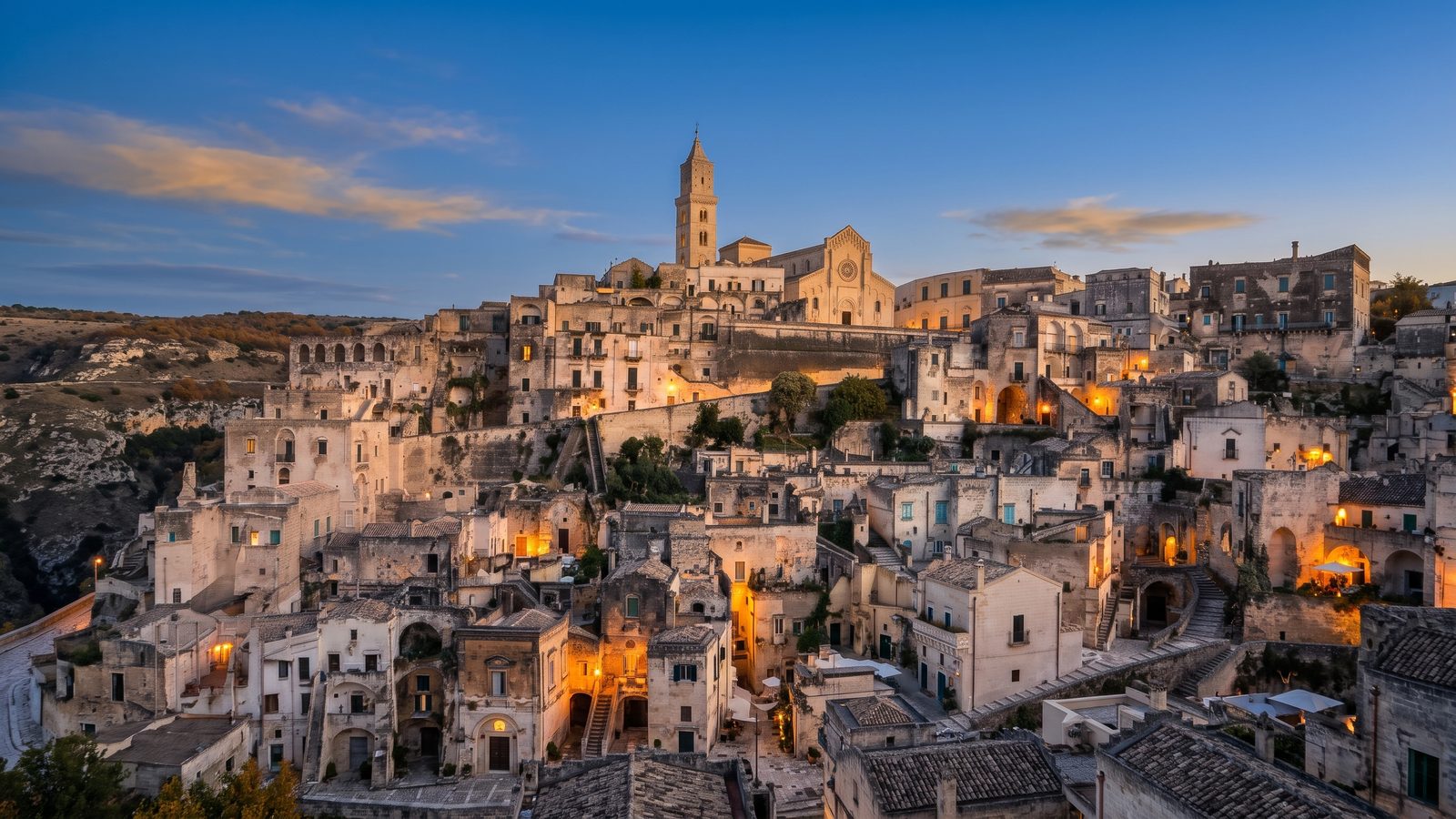
Welcome to Matera, where human history is carved directly into ancient calcarenite stone. Occupied for over 9,000 years, this UNESCO World Heritage site stands as one of the world's oldest continuously inhabited settlements. As you wander through the labyrinthine Sassi districts, you will discover subterranean cave-houses, hidden rock churches adorned with Byzantine frescoes, and a living testament to thousands of years of human endurance and adaptive design.
Step across roof-streets, gaze over the dramatic Gravina Canyon, and admire the majestic cathedral crowning Civita hill. From its mid-century evacuation to its modern revival, Matera offers an unforgettable journey through subterranean history, architecture, and resilient spirit carved entirely out of living rock.
Listen to a sample
The opening of this tour, exactly as AllTours narrates it on site.
What you'll hear on this tour
Stop 1. Carved from Nine Millennia of History
You stand in one of the world's oldest human settlements, occupied continuously for over 9,000 years. As you trace these calcarenite walls, imagine Paleolithic communities carving out basic shelters before evolving into Bronze Age farmers. Over centuries, these Sassi offer refuge from Byzantine, Lombard, and Norman conflicts, leaving historical layers etched directly into the stone. Yet by the mid-20th century, extreme poverty leads to the Sassi being labeled 'the shame of Italy.' Families share cramped spaces with livestock, triggering government evacuations in the 1950s. Today, you witness a miraculous transformation, where forgotten squalor gives way to a celebrated UNESCO World Heritage site showcasing unbroken human continuity.
Stop 2. Masterpieces of Architectural Subtraction
Look closely at the soft tufa bedrock beneath your feet. In Matera, architecture relies on subtraction rather than construction. You observe subterranean case grotta and deep palombari cisterns excavated directly into the earth. As you walk along these roof-streets, notice that your path is actually the domed ceiling of a dwelling below. This terraced layout creates a passive microclimate, maintaining comfortable interior temperatures year-round. Beneath the surface, an intricate hydrological network collects precious rainwater, directing it through channels into vast underground chambers. Every stone façade and excavated room reveals an ingenious design honed over millennia to thrive within a challenging Mediterranean environment.
Stop 3. Sacred Frescoes Hidden in Stone
Step into the shadowy depths of Matera’s subterranean churches, where ancient art comes alive on tufa walls. You discover vibrant Byzantine-inspired frescoes painted centuries ago by anonymous hermits using earthy pigments from local minerals. Observe detailed biblical scenes, saintly iconography, and majestic Pantocrator figures preserved in these sacred caverns. In sites like the Crypt of the Original Sin, known as the 'Sistine Chapel of Matera,' the enigmatic 9th-century Flower Painter depicted creation stories long before the Italian Renaissance began. These subterranean galleries served as visual bibles for local worshippers. Today, you can admire how these delicate colors and spiritual narratives endure inside the rock.
Stop 4. Panoramas of a Living Nativity Scene
Gaze across the breathtaking panorama of the Sassi as ancient stone dwellings cascade down the ravine. You watch soft sunlight paint the calcarenite rock, highlighting every aged fissure and terraced façade. From this vantage point, you appreciate the extraordinary density of Matera’s urban fabric, where rooftops serve as streets and winding staircases link centuries of human life. As twilight falls, the entire valley transforms into a glowing, magical presepe, or living nativity scene. Instead of bright modern lighting, warm scattered glows illuminate the ancient dwellings, offering you an unforgettable sight etched in stone, shadow, and warm Mediterranean light.
Stop 5. The Crown of Civita Hill
You stand before Matera Cathedral, constructed between 1230 and 1270 at the highest point of the Civita hill. As you examine the Apulian Romanesque façade, notice the delicate 13th-century rose window and the towering bell tower dominating the skyline. Step inside to experience a striking contrast: a lavish 17th-century Baroque interior covered in radiant gold leaf and intricate stucco work. Seek out the revered Byzantine fresco of the Madonna della Bruna, Matera’s patron saint, alongside rare 15th-century wooden choir stalls in the apse. This magnificent monument seamlessly blends medieval strength with ornate Baroque artistry above the Sassi.
Stop 6. The Untamed Beauty of Gravina Canyon
Look beyond the Sassi to the dramatic Gravina Canyon, carved over eons by the Gravina stream. You feel the warm Mediterranean breeze carrying wild thyme and rosemary scents across the arid Murgia plateau. Notice how hardy scrubland clings to sun-baked limestone cliffs, creating a stark natural contrast to the human architecture opposite the gorge. Above the canyon walls, you might spot kestrels or peregrine falcons gliding along thermals. The pale calcarenite rock beneath your feet bears witness to ancient geological forces, shaping the untamed landscape that dictated human survival for thousands of years in this rugged Italian countryside.
Planning your visit
- Best time to go
- Late afternoon in spring or autumn to enjoy pleasant walking temperatures and sunset illumination across the Sassi.
- Approximate duration
- About 2 to 2.5 hours
- Where to start
- Civita hill near the Matera Cathedral or Piazza Vittorio Veneto.
Access and conditions change seasonally — check the official site before you go.
Frequently asked questions
Is Matera worth visiting?
Yes, Matera is one of the world's oldest continuously inhabited cities and a UNESCO World Heritage site famous for its cave-house architecture, ancient rock churches, and unique historical story.
How long do you need at Matera?
A typical self-guided audio tour covering the Sassi districts and cathedral takes 2 to 2.5 hours, though spending a full day allows you to explore subterranean churches and view the evening lights.
Why was Matera called 'the shame of Italy'?
In the mid-20th century, extreme poverty forced families in the Sassi to live in unhygienic cave dwellings alongside livestock, leading to government-mandated evacuations in the 1950s before its modern restoration.
Keep exploring
Header image is an AI-generated illustration of Matera. AllTours.ai is an AI audio tour guide — point your camera at any landmark and hear its story.