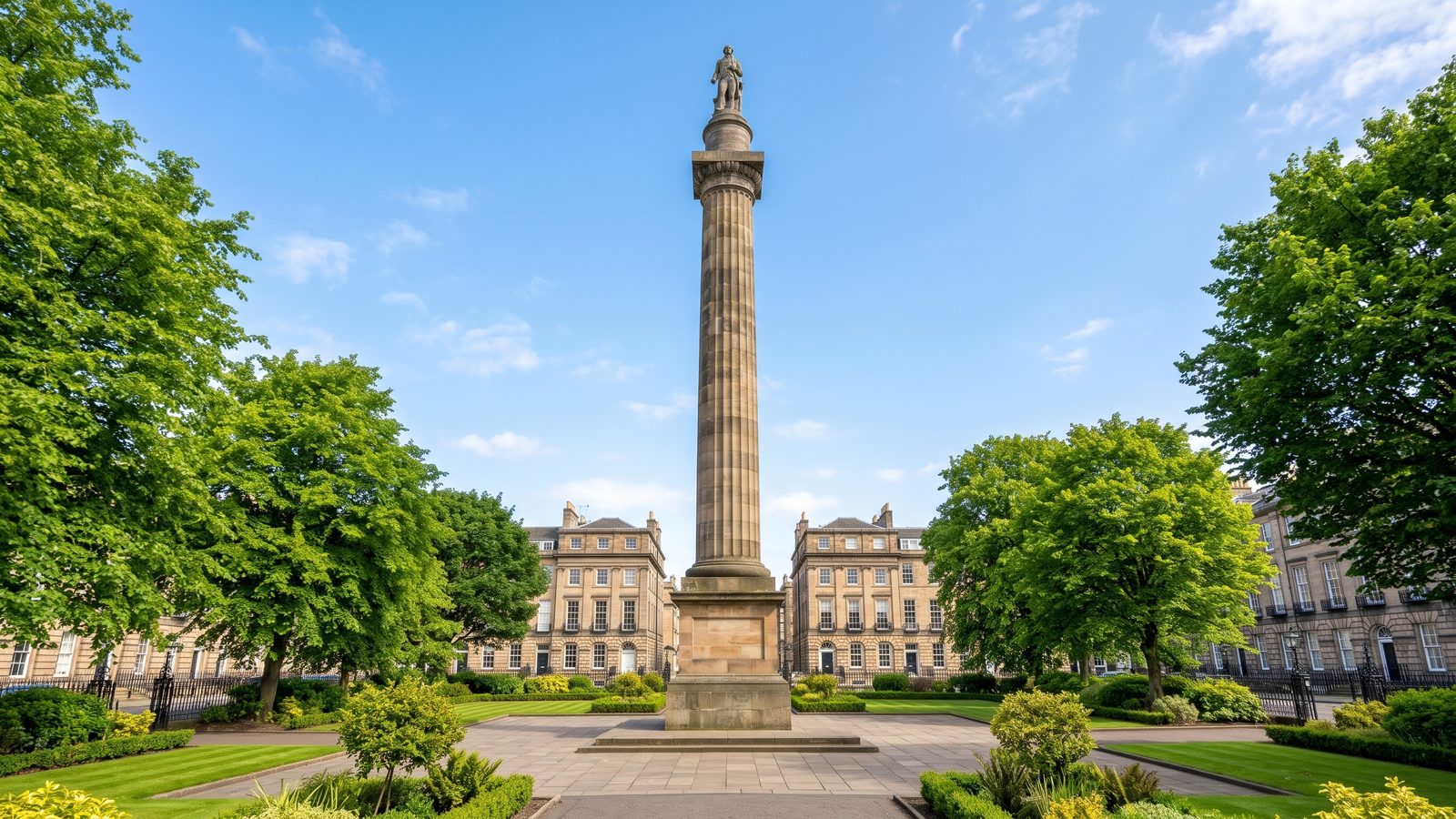
Welcome to St Andrew Square, home to the striking Melville Monument dominating Edinburgh's New Town skyline. Rising 150 feet above the vibrant public gardens, this imposing column commemorates Henry Dundas, 1st Viscount Melville, one of the most powerful political figures in late 18th-century Britain. As you explore this historical landmark, you will uncover the monument's grand Roman inspiration, its complex legacy, and its central role in shaping Edinburgh's urban landscape.
This self-guided audio tour walks you through the history, architecture, and political intrigue surrounding the monument. From his impeachment trial to his controversial role in imperial history, you will experience St Andrew Square through engaging stories of ambition, craftsmanship, and debate.
Listen to a sample
The opening of this tour, exactly as AllTours narrates it on site.
What you'll hear on this tour
Stop 1. A Controversial New Town Anchor
You stand in the shadow of this towering 150-foot column, taking in an architectural echo of Rome's famous Trajan's Column. Looking up toward the sky, you see the statue of Henry Dundas crowning the summit, completed by sculptor Robert Forrest in 1823. As you admire the sheer scale of the structure within St Andrew Square, you confront its complex and deeply contentious legacy. Dundas wielded vast political power during his lifetime, famously using his influence to delay the abolition of the slave trade. Today, standing here allows you to reflect on how this impressive physical landmark carries a complicated history that continues to spark debate.
Stop 2. Political Might and Impeachment Trials
You step closer to delve into the historical currents that shaped this imposing monument. During the late 18th century, Henry Dundas accumulated so much political influence across Scottish and imperial affairs that contemporaries nicknamed him 'King Harry the Ninth.' As you contemplate his formidable authority, you learn about his dramatic 1806 impeachment trial. Dundas became a central figure in a high-profile public spectacle when he faced serious charges for misappropriating naval funds. Although the trial ultimately resulted in his acquittal, it permanently marked his career. Here, beneath the column, you encounter a physical embodiment of an era defined by intense political maneuvering and supreme imperial power.
Stop 3. The Roman Toga of an Imperial Statesman
Fix your eyes on the towering top of the column, where Robert Forrest's statue of Henry Dundas, 1st Viscount Melville, commands the sky. You notice that Dundas does not wear contemporary 19th-century clothing; instead, he stands in a striking oratorical pose, draped in a classical Roman toga. This deliberate artistic decision elevates him to the status of an ancient statesman, signaling authority, wisdom, and eternal grandeur. As you observe this larger-than-life depiction from below, you feel how effectively the sculpture conveys the immense influence and formidable authority Dundas wielded throughout his political lifetime.
Stop 4. Classical Proportions and Sandstone Craftsmanship
You observe the magnificent classical design of the 150-foot column, directly inspired by Trajan's Column in ancient Rome. Architect William Burn designed this towering structure, utilizing durable Craigleith sandstone to construct its soaring form. As you examine the monument from its base, you notice the meticulous fluting carved into the shaft, leading your eyes up toward the intricate capital. A robust pedestal anchors the entire column, establishing balanced classical proportions that define its commanding presence in St Andrew Square. The craftsmanship reflects the ambitious architectural standards that helped shape Edinburgh's New Town during the early 19th century.
Stop 5. Edinburgh's First New Town Square
You look around at St Andrew Square, immersing yourself in the very first residential square laid out in Edinburgh's New Town back in 1767. Surrounding you is grand Georgian architecture, built to house the city's wealthiest residents and establishing an enduring blueprint for Scottish urban planning. As you walk through the square today, you experience its historic transition from an exclusive private garden into a lively public green space. While it now serves as a bustling commercial and financial hub, the square still retains its elegant, symmetrical design, anchored seamlessly by the grand monument at its heart.
Stop 6. Ascending Scale and Masterful Detail
Your gaze ascends the colossal 150-foot column that dominates the square. At its summit, you discern Robert Forrest's statue depicting Viscount Melville in his formal robes, facing east across the city. As your eyes trace the shaft downwards, you appreciate the fine detail of the fluted stone, a testament to early 19th-century masonry and design. Built between 1821 and 1828, this monument was deliberately engineered to make a bold architectural statement. Standing here, you recognize how its impressive scale and classical detailing were crafted specifically to command attention across the entirety of Edinburgh's New Town.
Planning your visit
- Best time to go
- Daylight hours, especially bright mornings or afternoons when details on the statue and sandstone column are clearly visible.
- Approximate duration
- About 30 to 45 minutes
- Where to start
- St Andrew Square, central Edinburgh, near the base of the monument column.
Access and conditions change seasonally — check the official site before you go.
Frequently asked questions
Is Melville Monument worth visiting?
Yes, the Melville Monument in St Andrew Square is a key highlight of Edinburgh's New Town, offering impressive classical architecture and insight into Scotland's complex political history.
How long do you need at Melville Monument?
You need about 30 to 45 minutes to appreciate the monument, read the history of Henry Dundas, and explore the surrounding Georgian square.
Who was Henry Dundas and why is the Melville Monument controversial?
Henry Dundas, 1st Viscount Melville, was a powerful late 18th-century Scottish politician. The monument is controversial because Dundas used his political influence to delay the abolition of the slave trade.
Keep exploring
Header image is an AI-generated illustration of Melville Monument. AllTours.ai is an AI audio tour guide — point your camera at any landmark and hear its story.