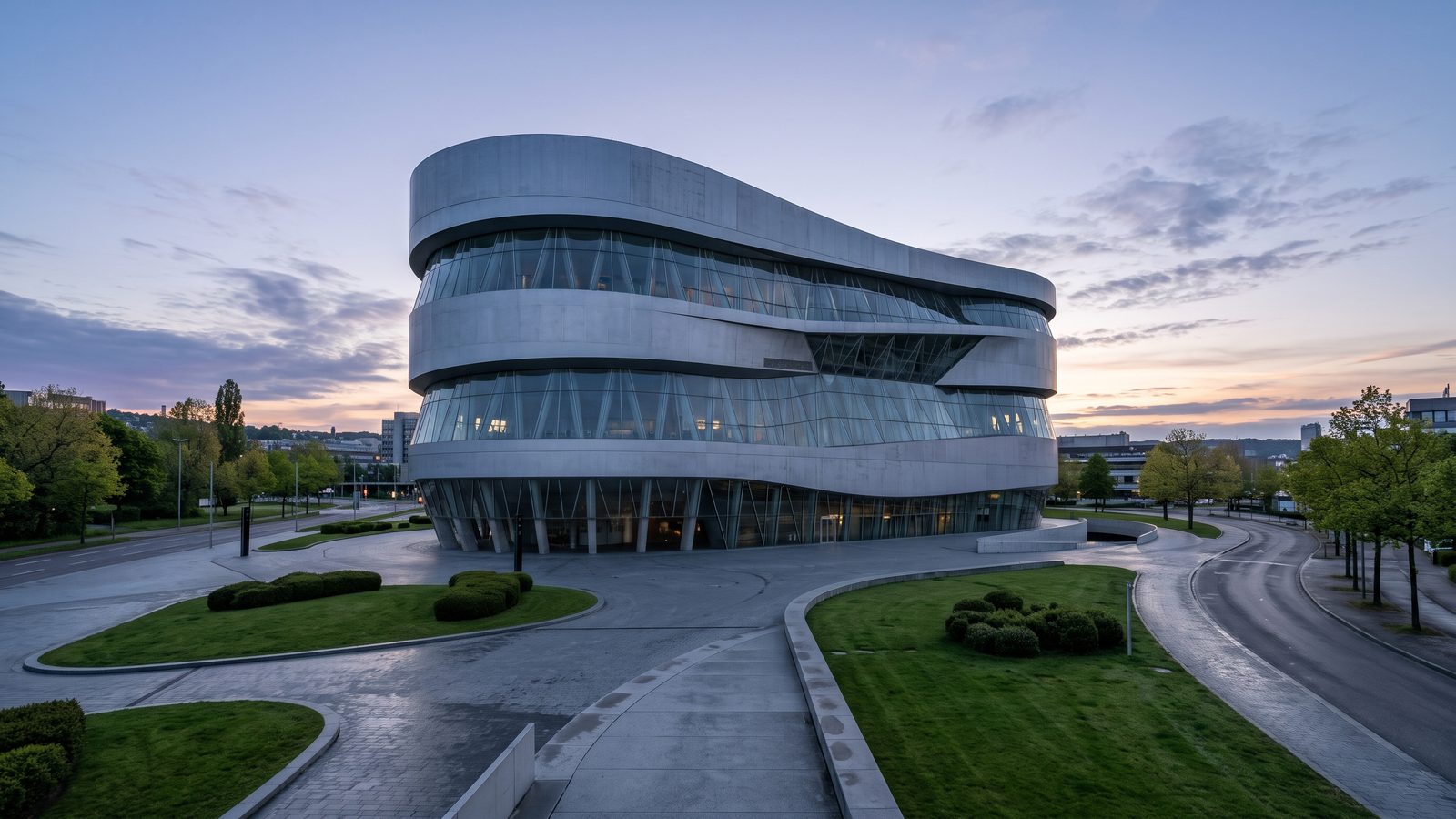
Welcome to the Mercedes-Benz Museum in Stuttgart, a striking architectural marvel defined by a concrete and glass double-helix structure. Inside, you step into 130 years of engineering mastery initiated by pioneers Karl Benz and Gottlieb Daimler in 1886. Housing over 160 iconic vehicles, this self-guided journey leads you through the evolution of mobility, connecting historic breakthroughs with modern design and vision in an unforgettable, immersive setting.
As you navigate the double-helix ramps, your audio guide brings the exhibits to life with rich context and stories. You will experience how radical ideas transformed human travel, from the very first self-propelled motor car to groundbreaking safety innovations and futuristic concept vehicles that continue to shape global transport.
Listen to a sample
The opening of this tour, exactly as AllTours narrates it on site.
What you'll hear on this tour
Stop 1. Architecture of the Double Helix
As you step into the exhibition space, you immediately notice how the futuristic architecture becomes an active partner in your journey. The ingenious double-helix structure presents you with two distinct paths to explore: one winding chronologically through automotive history, and another branching off into specialized Collection Rooms that highlight distinct vehicle types. You travel through immersive displays that place legendary automobiles, artifacts, and historical milestones within their broader technological and cultural contexts. Every turn brings a fresh view of the central atrium, offering a seamless narrative experience where spatial design and historical storytelling merge effortlessly.
Stop 2. Genesis of the Modern Motorcar
You stand at the very beginning of motoring history, tracing personal mobility back to Karl Benz’s revolutionary 1886 patent motor car. Alongside the independent work of Gottlieb Daimler, these pioneering breakthroughs established the foundation for Daimler-Benz AG and altered global transportation forever. As you walk through the chronological displays, you witness how engineering excellence adapted through two world wars, post-war reconstruction, and the economic boom that followed. You see firsthand how early mechanical audacity matured into an industrial giant, continuously reshaping global infrastructure, industrial design, and the way society moves.
Stop 3. Pioneering Safety and Future Concepts
Here, you explore a legacy defined by persistent ingenuity and a commitment to human safety. You discover how Karl Benz's initial Patent-Motorwagen did far more than roll down a street; it ignited an entire global industry. As you examine the exhibits, you trace fundamental safety breakthroughs that revolutionized driving, including the development of the life-saving crumple zone and anti-lock braking systems (ABS). You also observe the continuous search for power efficiency, following the progression from early diesel engines to modern, forward-looking electric concepts that continue to push mechanical and technological boundaries.
Stop 4. Evolution of Aerodynamics and Elegance
In this gallery, you gain a deep appreciation for the Mercedes-Benz design philosophy. You observe how early engineers and craftsmen sculpted vehicle bodies not merely for visual aesthetic appeal, but for optimal aerodynamic efficiency and streamlined elegance. As you move along the display, pay close attention to the evolution of the signature front grille. You watch it subtly adapt across generations while maintaining its bold, unmistakable identity of prestige. Every sweeping line and carefully chosen material reflects a deliberate balance between functional performance, structural innovation, and an enduring pursuit of timeless luxury.
Stop 5. Mechanical Perfection and Engine Mastery
You now stand before displays dedicated to the relentless pursuit of engineering perfection. As you inspect the cutaway models and legendary powertrains, notice how early engines, such as the famous M100, introduced direct fuel injection—a game-changing breakthrough for motor efficiency and power delivery. You observe meticulous chassis development on display, where suspension geometry was endlessly refined to achieve harmony between passenger comfort and dynamic handling. Every precision component and aerodynamic curve reflects decades of rigorous testing, iterative design, and an unwavering commitment to testing what is mechanically possible.
Stop 6. Redefining Human Potential and Distance
As you pause among these early milestone vehicles, you encounter the fundamental birth of personal freedom. You are looking at more than simple mechanical transportation; you are witnessing the radical concept of self-propulsion that shattered physical distances and redefined human potential across the globe. You feel the immense audacity of those early inventors who dared to imagine life beyond animal horsepower. By forging machines capable of crossing continents quickly, they ignited a massive industrial revolution, fundamentally altering global landscapes, connecting isolated communities, and forever changing the rhythm of daily human life.
Planning your visit
- Best time to go
- Weekday mornings right at opening offer the quietest experience along the spiral ramps.
- Approximate duration
- About 2 to 3 hours
- Where to start
- Begin in the main ground-floor atrium and take the futuristic atrium elevator up to the top level to start your chronological descent.
Access and conditions change seasonally — check the official site before you go.
Frequently asked questions
Is Mercedes-Benz Museum worth visiting?
Yes, it is widely considered one of the top automotive museums globally. Its striking double-helix architecture, display of over 160 historic vehicles, and deep dive into 130 years of mobility make it a must-see in Stuttgart.
How long do you need at Mercedes-Benz Museum?
Most visitors spend around 2 to 3 hours walking down the double-helix ramps and exploring the chronological legend rooms and themed collection rooms.
Who invented the first Mercedes-Benz car?
The origins trace back to 1886, when Karl Benz built his Patent-Motorwagen and Gottlieb Daimler independently created a motorized carriage, leading to the establishment of Daimler-Benz AG.
Keep exploring
Header image is an AI-generated illustration of Mercedes-Benz Museum. AllTours.ai is an AI audio tour guide — point your camera at any landmark and hear its story.