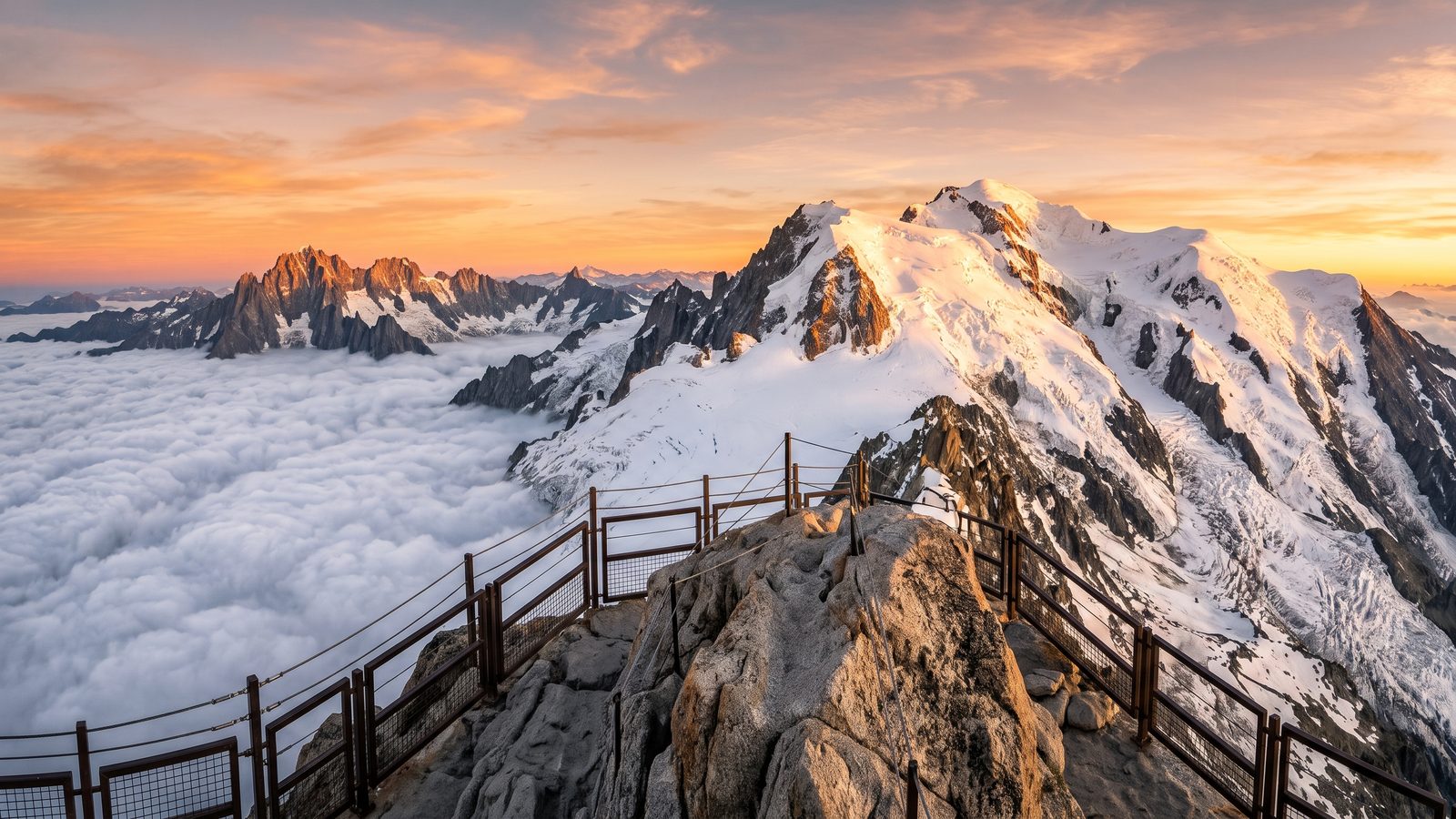
Step into Chamonix and gaze upward at the Mont Blanc Massif, the legendary birthplace of modern mountaineering. Towering over Western Europe, this breathtaking wilderness of granite spires, blue glaciers, and snow-capped peaks has captivated adventurers for centuries. As you follow this self-guided tour, you step into a world carved by ice and tectonic power, where pioneering climbers first tested human endurance and airborne athletes soar across thermals.
Whether you admire the dramatic séracs, track changing clouds, or contemplate the rich history of high-altitude exploration, this immersive experience brings the mountain's untamed spirit directly to life. Prepare to discover the raw geology, soaring vistas, and enduring allure that define Europe’s grandest alpine sanctuary.
Listen to a sample
The opening of this tour, exactly as AllTours narrates it on site.
What you'll hear on this tour
Stop 1. Birthplace of High Alpine Exploration
You stand in the awe-inspiring presence of the Mont Blanc Massif, Western Europe's highest summit and the birthplace of modern mountaineering. You imagine 1786, when Jacques Balmat and Michel-Gabriel Paccard first conquered this giant, igniting global passion for alpine exploration. As you look around, you see ancient glaciers carving deep paths through jagged granite peaks, framing verdant valleys far below. Mont Blanc towers as a gleaming beacon for climbers, its vast kingdom of rock and ice anchoring iconic spots like the Aiguille du Midi. You absorb this raw display of nature's power, feeling an unforgettable invitation to adventure.
Stop 2. Epic Thresholds of Human Resilience
You feel the crisp mountain air crackling with an audacious spirit of exploration at this epicenter of mountaineering. Here, your challenge involves mastering an intricate dance across ice, rock, and extreme altitude. You envision skiing the legendary Vallée Blanche, an off-piste descent stretching over twenty kilometers past crevasses and towering séracs. Across these mountains, ultra-endurance runners tackle the grueling Ultra-Trail du Mont-Blanc, driving their bodies across 170 kilometers of rugged terrain. You listen mentally for ice axes biting into the icy flanks of the Grandes Jorasses and spot sheer granite walls like the Aiguille du Dru, where climbers conquer sheer vertical rock.
Stop 3. Dancing Atmospheric Veils Over Glaciers
You raise your eyes to watch a dramatic atmospheric ballet taking shape around the peaks. Orographic cap clouds cling tightly to the summit as moisture cools against colossal granite walls. You spot smooth, dish-like lenticular clouds floating overhead, signaling powerful air currents and giving rise to ancient tales of celestial visitors. These shifting cloud formations act as crucial weather indicators, warning climbers when clear skies might rapidly collapse into whiteouts. Above low valley mists, you experience the surreal sea of clouds, where high summits emerge like isolated islands from an ocean of white, while sunlight paints the ice below in brilliant hues.
Stop 4. Sculpted Granite and Shimmering Ice
You watch light and shadow sweep across the sharp granite spires of the massif, sculpted by wind and ice over millennia. Below, the pristine ice of the Vallée Blanche glows ethereal blue, demonstrating the immense glacial forces shaping these alpine valleys. On the Bossons Glacier, you observe shifting séracs, dynamic ice architecture that constantly reorganizes itself above the valley floor. Looking lower, vibrant green alpine meadows dotted with resilient edelweiss create a stark, beautiful contrast against frozen ridges. You stand captivated by this wild scenery, a living masterpiece of rock and sky that has long inspired artists and intrepid alpinists.
Stop 5. Soaring Silently Above Ice and Rock
You turn your gaze toward the sky, where paragliders drift gracefully over alpine precipices. Born in the 1980s when mountaineers sought swift mountain descents, paragliding considers this massif its spiritual home. You imagine launching from the grassy slopes of Plan Praz or the cliffs of Le Brévent, stepping out into cool air. You ride warm thermal currents rising from the valley floor, sharing the sky with soaring eagles. High above miniature villages, you experience profound silence, broken only by the rustle of your canopy. Facing giant granite walls and icy expanses, you gain a fresh perspective on this mountain sanctuary.
Stop 6. Perpetual White Gold Sculpting Peaks
You feel the sharp chill in the air, generated by the deep snow that perpetually caps the massif. This white gold acts as a living sculptor, compressing light surface powder into dense firn before transforming over centuries into solid glacial ice. You trace delicate wind-carved cornices and expansive snowfields, recognizing the immense historical record stored within every layer. While this reflective blanket feeds glaciers and alpine ecosystems far below, you remain respectful of its unpredictable power. In an instant, soft powder can shift into unstable slabs, triggering thunderous avalanches across the peaks.
Planning your visit
- Best time to go
- Summer (June to September) for hiking, paragliding, and clear summit views; winter/spring (December to April) for ski mountaineering.
- Approximate duration
- About 3 hours
- Where to start
- Chamonix town center or the Aiguille du Midi cable car lower station
Access and conditions change seasonally — check the official site before you go.
Frequently asked questions
Is Mont Blanc Massif worth visiting?
Yes, the Mont Blanc Massif is one of the most celebrated mountain ranges in the world. It offers world-class alpine scenery, historic glaciers, iconic mountaineering routes, and unmatched panoramas across France, Italy, and Switzerland.
How long do you need at Mont Blanc Massif?
You need at least 1 to 3 days to experience the main highlights, such as taking cable cars to mountain viewpoints, taking a guided glacier walk or ski descent, and exploring the surrounding trails in Chamonix.
Who first climbed Mont Blanc and when?
Jacques Balmat and Michel-Gabriel Paccard made the first successful ascent of Mont Blanc in 1786, an achievement widely regarded as the birth of modern mountaineering.
Keep exploring
Header image is an AI-generated illustration of Mont Blanc Massif. AllTours.ai is an AI audio tour guide — point your camera at any landmark and hear its story.