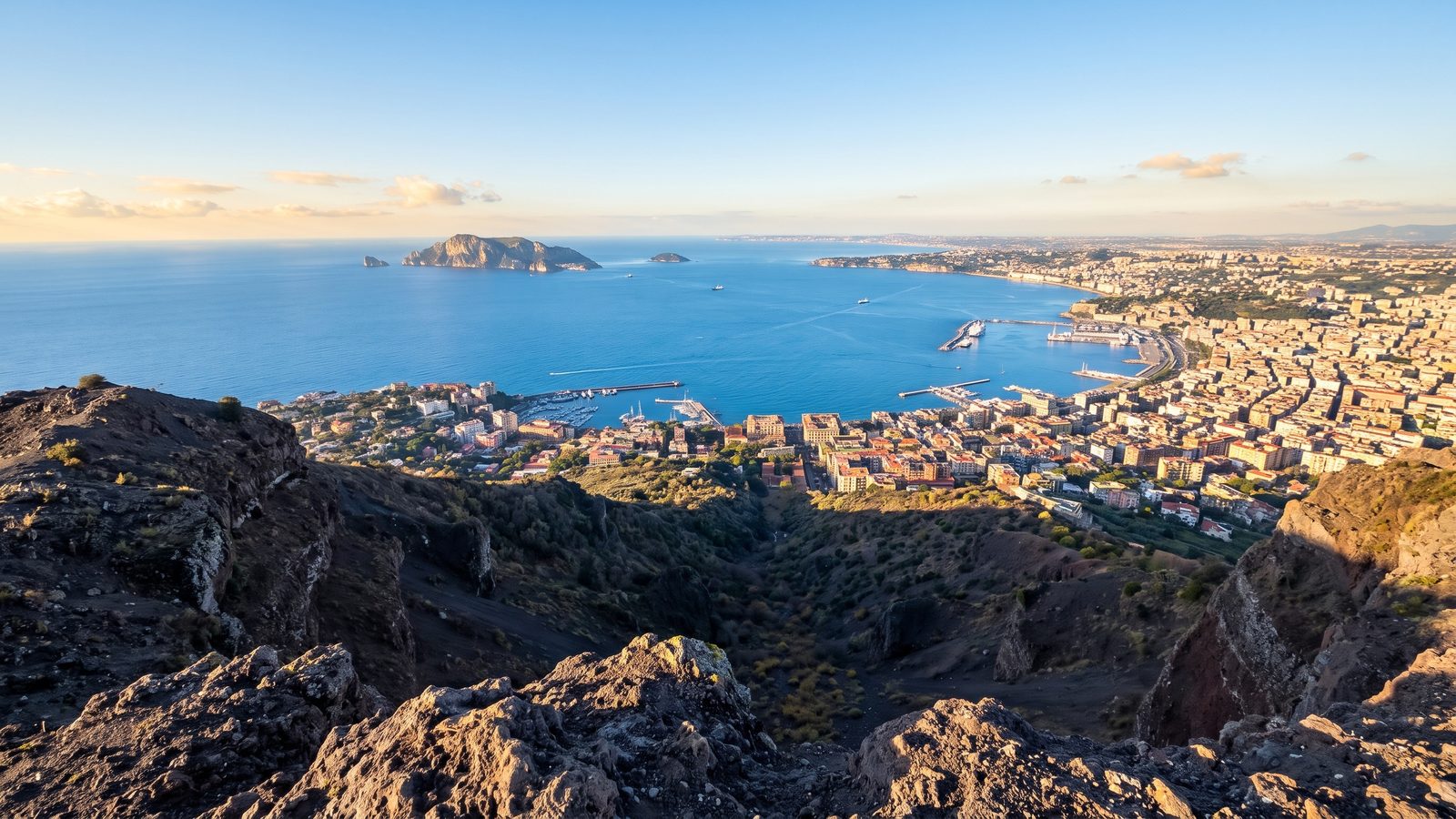
You stand before Mount Vesuvius, an active stratovolcano dominating the Bay of Naples and a living legend of raw geological power. Famed for its catastrophic eruption in 79 AD that instantly entombed Pompeii and Herculaneum, this brooding peak offers an extraordinary window into ancient Roman history. As you ascend, you discover how this legendary giant shaped civilizations, local culture, and dramatic landscapes across millennia.
This self-guided audio tour leads you through the history, myth, and majestic panoramas of Vesuvius. From tales of Vulcan's breath to sweeping views of Naples and shimmering sapphire waters, immerse yourself in a story of devastation, survival, and enduring beauty at your own pace.
Listen to a sample
The opening of this tour, exactly as AllTours narrates it on site.
What you'll hear on this tour
Stop 1. The Cataclysmic 79 AD Eruption
You step onto a mountain defined by sudden, devastating force. Long before the tragic disaster, ancient Romans cultivate these fertile volcanic slopes, largely unaware of the brooding giant beneath their feet. That changes in 79 AD when a violent eruption, vividly documented by Pliny the Younger, instantly entombs the thriving cities of Pompeii and Herculaneum under layers of ash. As you look across the rugged landscape, you trace a destructive legacy that stretches back even further to an immense Bronze Age eruption. Today, you feel the lingering gravity of this history, where nature's unpredictable raw power forever reshaped human destiny across the Campania region.
Stop 2. Breath of Vulcan and Prophecies
You listen to ancient myths echoing across these ash-covered slopes, where Vesuvius lives as a legendary entity. In Roman mythology, you see the mountain personified as a raging giant, its fiery outbursts interpreted as the fierce breath of Vulcan, the god of fire. Lore tells of a once-peaceful peak cursed by the gods, and of the Sibyl of Cumae, a cryptic prophetess who forewarns of its ultimate fury from her nearby cave. Local tradition holds that this formidable peak acts as a protective sentinel over Naples, while the lingering spirits of the ancient fallen watch over the city thriving in its shadow today.
Stop 3. Frozen Cities and Neapolitan Resilience
You examine how volcanic fury preserved ancient design while inspiring modern urban strength. In Pompeii, you envision Roman ingenuity frozen in time, where grid streets reveal elegant homes, bustling shops, and public baths decorated with vibrant frescoes like those inside the Villa of the Mysteries. Nearby in Herculaneum, deep mud layers preserve wooden frames and multi-story houses with delicate atriums. Beyond these ancient ruins, you notice how Vesuvius shapes modern Neapolitan architecture. In Naples, magnificent Baroque and Neoclassical landmarks, including the Royal Palace and the Basilica of San Francesco di Paola, stand as enduring symbols of artistic expression and human resilience beside the peak.
Stop 4. Panoramic Views of the Bay
You turn your gaze outward to take in a breathtaking panorama from high above the coastline. Before you lies the sparkling crescent of the Bay of Naples, a shimmering sapphire body of water embracing the vibrant city below. As your eyes trace the ancient shorelines subtly altered by ancient volcanic eruptions, you spot the distant islands of Capri and Ischia rising from the sea. Right below your rugged vantage point, fertile green plains unfold across the landscape, nourished by nutrient-rich volcanic ash. This striking contrast between dark stone and lush greenery reveals the true, magnificent scale of the surrounding Italian countryside.
Stop 5. Neapolitan Identity and Sacred Wine
You immerse yourself in the rich cultural identity of Campania, deeply bound to the looming volcano. Throughout Neapolitan art, you recognize the dramatic silhouette of Vesuvius as a constant motif that symbolizes both striking beauty and ever-present danger. Your journey also connects to the soil beneath your feet through local gastronomy. On these sun-drenched volcanic slopes, winemakers produce the famous Lacryma Christi, or 'Tears of Christ', a rich and mineral-infused wine nurtured by the fertile ash. As you taste this unique vintage, you experience a delicious cultural legacy born directly from the mountain's natural gifts and enduring spirit.
Stop 6. Naples: A Layered Living Palimpsest
You gaze down at the sprawling, energetic metropolis of Naples, originally founded as Neapolis by the Greeks in the 6th century BC. Looking out from your high vantage point, you observe a dense urban landscape that reflects thousands of years of continuous human habitation and remarkable resilience. You can still trace original Roman street layouts beneath modern neighborhoods and spot imposing medieval fortresses, such as Castel Nuovo, guarding the busy harbor. This panoramic cityscape forms a living palimpsest, where overlapping historical eras tell an unforgettable story of survival, vibrant coastal culture, and enduring community spirit in the volcano's shadow.
Planning your visit
- Best time to go
- Spring or early autumn during morning hours for clear visibility across the bay and comfortable temperatures.
- Approximate duration
- about 2 to 3 hours
- Where to start
- The main visitor entrance and trailhead near the upper parking area on Mount Vesuvius.
Access and conditions change seasonally — check the official site before you go.
Frequently asked questions
Is Mount Vesuvius worth visiting?
Yes, visiting Mount Vesuvius offers a unique combination of dramatic volcanic landscapes, breathtaking views over the Bay of Naples, and deep historical connections to ancient Roman sites like Pompeii.
How long do you need at Mount Vesuvius?
Most visitors spend about 2 to 3 hours exploring the crater trail, taking in the panoramic views, and enjoying the self-guided audio tour.
When did Mount Vesuvius erupt and destroy Pompeii?
Mount Vesuvius famously erupted in 79 AD, entombing the Roman cities of Pompeii and Herculaneum under layers of volcanic ash and pumice.
Keep exploring
Header image is an AI-generated illustration of Mount Vesuvius. AllTours.ai is an AI audio tour guide — point your camera at any landmark and hear its story.