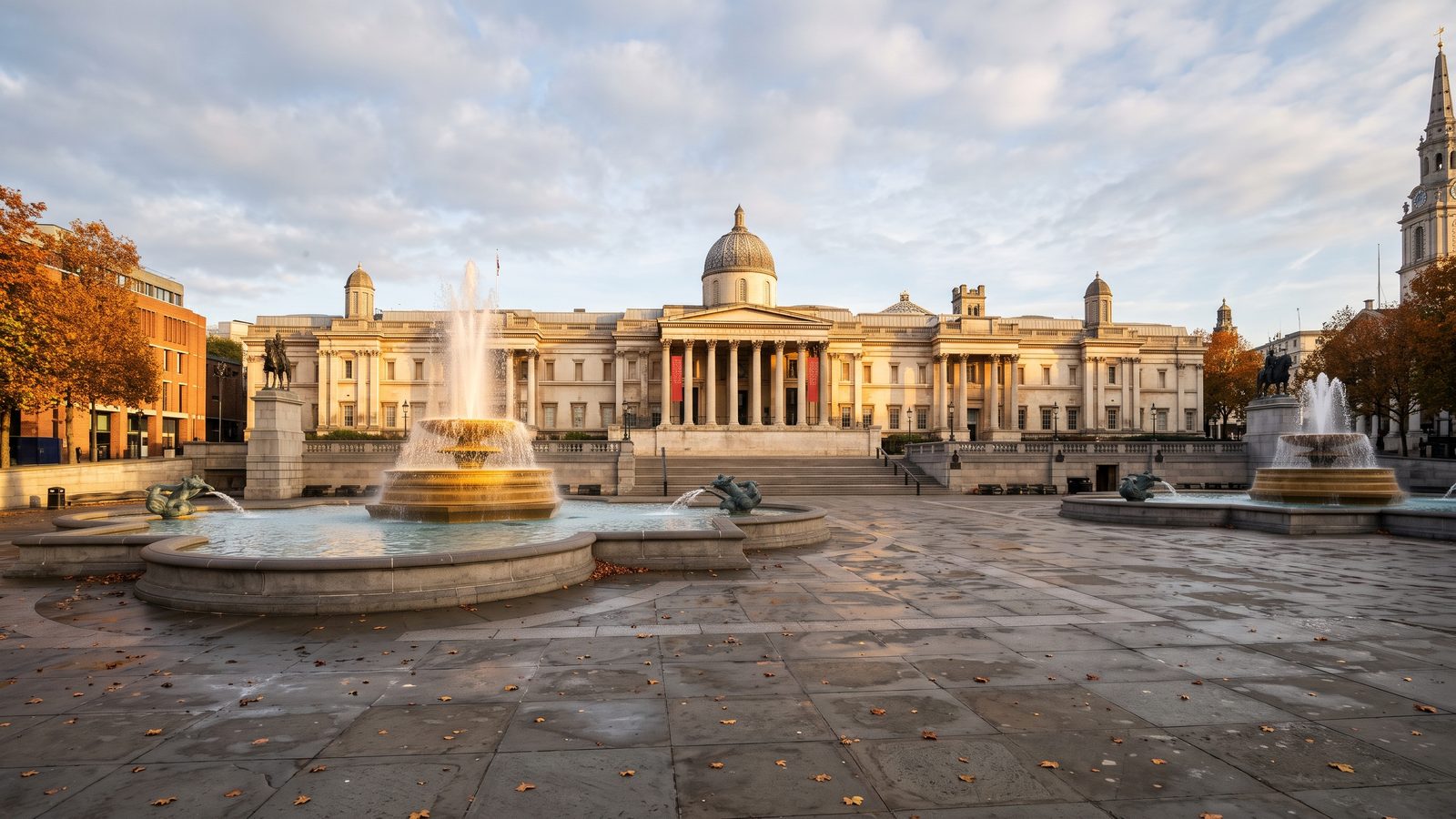
Welcome to Trafalgar Square, where the National Gallery has redefined art accessibility since opening its purpose-built home in 1838. Conceived to move world-class paintings from private estates into the public sphere, this institution invites you to explore the evolution of European artistic mastery. As you walk through these grand Classical Revival halls, you step into a museum built specifically for public education, aesthetic inspiration, and deep cultural dialogue across centuries.
On this self-guided audio tour, you will trace the museum's fascinating origins from 1824, admire its architectural dialogue from Portland stone porticos to the Sainsbury Wing, and learn how revolutionary painting techniques transformed human perception. Step inside to experience a priceless collection crafted to inspire every visitor.
What you'll hear on this tour
Stop 1. Evolution of Human Perception and Technical Mastery
You step into these hallowed halls not merely to observe paintings, but to trace the evolution of human perception. Notice how early masters meticulously layer tempera, creating luminous, jewel-like surfaces that convey spiritual narratives with inner light. As you move forward, you encounter the revolutionary shift to oil paint. This medium grants artists unprecedented fluidity, enabling them to render the subtle nuances of human skin, delicate fabrics, and rich atmosphere with breathtaking realism. In Baroque masterpieces, you discern dramatic plays of light and shadow designed to pull you directly into emotional climaxes. Every brushstroke reveals a deliberate language—a continuous conversation across centuries about beauty, truth, and the human condition.
Stop 2. Classical Grandeur and Postmodern Architectural Dialogue
As you absorb the grandeur of the main façade, you notice commanding Classical Revival architecture crafted from pale Portland stone. The central portico greets you with magnificent Corinthian columns, its fluted shafts and acanthus leaves asserting public accessibility. High above, distinctive pepper-pot domes cap the structure—a detail once fiercely ridiculed, yet now central to its unique character. Looking west, you see the Sainsbury Wing, a striking postmodern addition by Venturi, Scott Brown and Associates. Built in 1991, this wing creates a subtle architectural dialogue with William Wilkins’s 1838 design. You observe how different design eras speak to each other across Trafalgar Square, reflecting an evolving cultural institution.
Stop 3. From Pall Mall Residence to Public Institution
You trace the origins of this institution back to 1824, when the British government purchased 38 paintings from banker John Julius Angerstein. Unlike European museums founded on royal collections, this gallery represents a radical act: creating an art repository for everyone. Initially, you would have viewed these works inside Angerstein’s private residence on Pall Mall. As generous bequests and acquisitions rapidly expanded the collection, the temporary home proved far too small. You now stand before the grand, purpose-built structure designed by William Wilkins, opened in 1838. This move cemented the nation's commitment to public art education, ensuring world-class masterpieces remain permanently accessible to all.
Stop 4. Evolving Spaces Designed for Art Appreciation
You walk through a building that continuously adapts to its monumental mission. As you enter the Sainsbury Wing, you experience a space tailored specifically for early Renaissance works, providing optimal lighting and chronological context. The careful arrangement of galleries—from soaring main halls to intimate side rooms—guides your eyes and deepens your understanding of art history. You see that expanding the gallery was never just about wall space; it reflects a commitment to scholarly presentation and public engagement. Every room fosters contemplation rather than quick viewing. In this dynamic space, you experience the enduring democratic ideal of art made accessible to every visitor.
Stop 5. Temporary Exhibitions and Global Masterpiece Reunions
Beyond the permanent collection, you discover dynamic temporary exhibitions that redefine art history. These special shows gather rare works from global collections, offering you unique opportunities to view masterpieces reunited side-by-side. Imagine stepping into a focused Renaissance retrospective where drawings and paintings reveal an artist's complete evolution. Curators spend years organizing these curated narratives, securing unprecedented loans to highlight forgotten figures and hidden connections. These temporary displays provide a fresh counterpoint to the permanent collection's stability. As you explore these temporary galleries, you witness the institution pushing scholarly boundaries and sparking immense public curiosity with groundbreaking, once-in-a-lifetime presentations.
Stop 6. Democratizing Art and Shaping British Culture
You witness how the National Gallery fundamentally reshaped British culture by bringing masterpieces out of exclusive private estates into public view. This unprecedented access democratized art, fostering critical appreciation across all social classes. Aspiring artists gathered here to study European masters firsthand, directly refining their techniques and reshaping national taste. As you explore, you see how the collection acts as a vital educational bedrock, establishing a continuous dialogue between past and present. The gallery remains a vibrant public forum where diverse perspectives converge. It sparks intellectual curiosity and nurtures shared human creativity, proving that art belongs to the entire community.
Planning your visit
- Best time to go
- Weekday mornings right at opening, or Friday evenings during late opening hours for lighter crowds.
- Approximate duration
- about 2 hours
- Where to start
- Outside the central portico on Trafalgar Square, facing the main entrance.
Access and conditions change seasonally — check the official site before you go.
Frequently asked questions
Is National Gallery worth visiting?
Yes, the National Gallery is one of the world's premier art institutions, featuring an extraordinary collection of European masterpieces housed in an iconic Trafalgar Square building.
How long do you need at National Gallery?
Most visitors spend around 2 to 3 hours to comfortably view the main highlights of the collection.
How was the National Gallery founded?
It was founded in 1824 when the British government purchased 38 paintings from the estate of banker John Julius Angerstein to create a national collection for the public.
Keep exploring
Header image is an AI-generated illustration of National Gallery. AllTours.ai is an AI audio tour guide — point your camera at any landmark and hear its story.