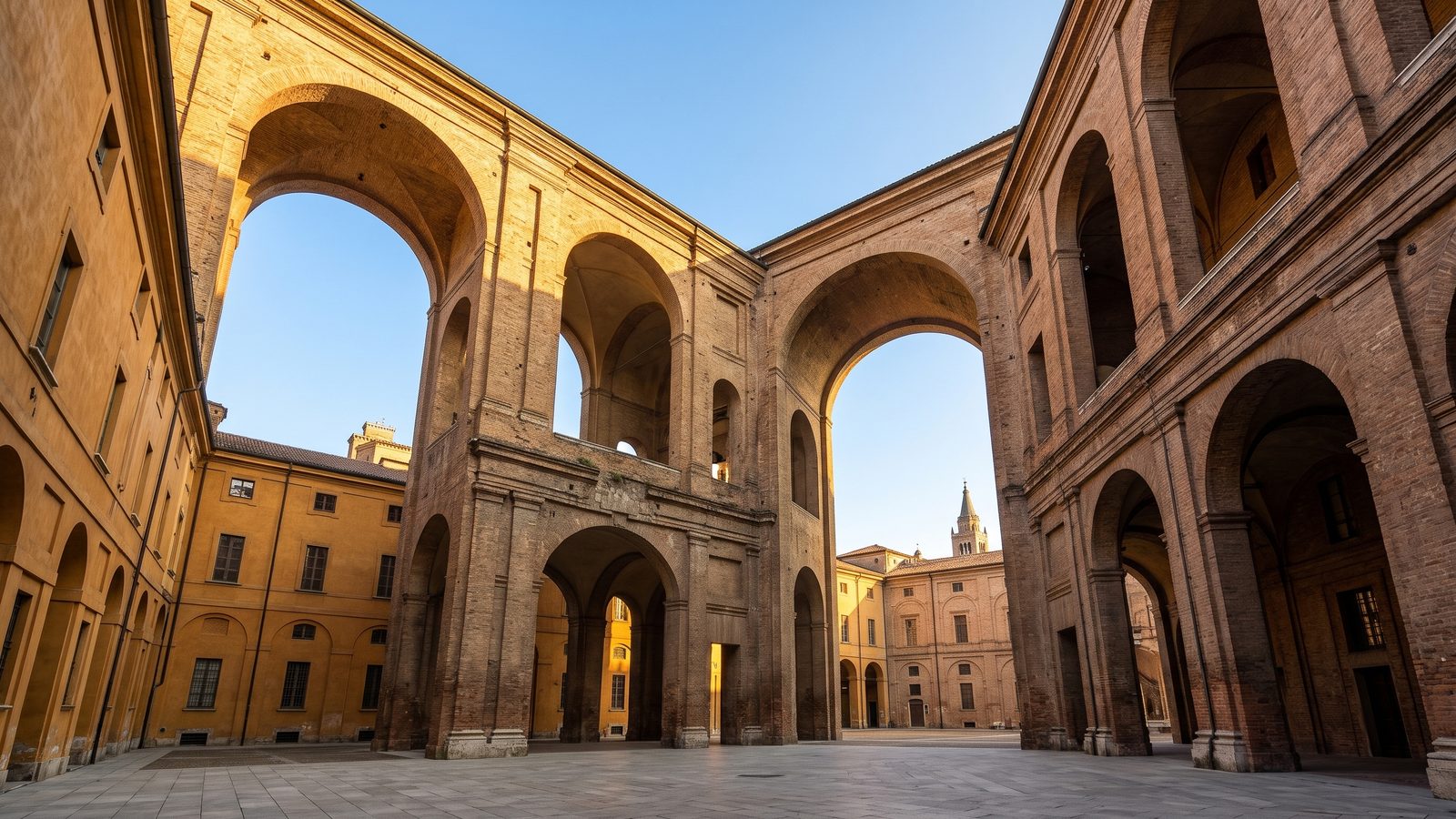
Welcome to Palazzo della Pilotta, the vast, unfinished crown jewel of Parma's architectural and cultural heritage. Originally conceived in the late sixteenth century as a grand service complex for the Farnese court, this sprawling brick monument houses world-class institutions including the National Gallery and the Biblioteca Palatina. As you explore its expansive courtyards and grand halls, you uncover centuries of regal ambition, artistic genius, and monumental history.
This self-guided audio tour walks you through the complex's extraordinary highlights. You will admire Renaissance masterpieces by Correggio and Parmigianino, gaze at Leonardo da Vinci's La Scapigliata, and discover how a building named after a ball game became Parma's cultural heart.
Listen to a sample
The opening of this tour, exactly as AllTours narrates it on site.
What you'll hear on this tour
Stop 1. Masterpieces of the National Gallery
You step directly into the National Gallery, the cultural core of the Pilotta complex. As you walk through its magnificent halls, you encounter centuries of artistic brilliance nurtured by the Farnese and Bourbon dynasties. You stand before ethereal masterpieces by Correggio and witness the revolutionary spirit of Parmigianino's Mannerist paintings. The crown jewel of your visit is Leonardo da Vinci's enigmatic work, La Scapigliata, a delicate and intriguing portrait that captures timeless human emotion. Every gallery room displays priceless treasures from ducal collections, transforming your walk into a journey through Italian art history and regal patronage.
Stop 2. Great Painters of the Parma School
You pause to focus on the extraordinary paintings that define Parma's artistic identity within the Galleria Nazionale. You admire Correggio's tender Madonna della Scodella, where luminous light brings divine characters into intimate, human warmth. Nearby, Parmigianino's mesmerizing Schiava Turca holds your gaze with her mysterious expression and delicate Mannerist elegance. As you study these canvases, you appreciate the discerning eye of the Farnese family, whose passion for collecting gathered masterpieces across generations. Each artwork creates an ongoing dialogue between light, color, and technique, revealing how this local school of painting forever altered European art.
Stop 3. Sanctuary of the Biblioteca Palatina
You enter the sacred silence of the Biblioteca Palatina, an astonishing sanctuary of knowledge established by Philip of Bourbon in the late eighteenth century. Designed by architect Ennemond Alexandre Petitot, these soaring neoclassical halls cradle over seven hundred thousand volumes. As you explore the grand rooms, you discover priceless illuminated manuscripts, rare ancient codices, and historical treasures. You also encounter the groundbreaking typography of Giambattista Bodoni, whose elegant print fonts revolutionized bookmaking. Surrounded by centuries of human intellect, you feel the profound reverence for scholarship that built this extraordinary library.
Stop 4. Austere Brick and Grand Scale
You step back to admire the imposing scale of this massive brick and stone complex. As you look across its vast internal courtyards, you notice the austere Renaissance design that prioritizes functional strength over grand classical decoration. Duke Ottavio Farnese originally conceived this monumental layout to house essential service facilities rather than a traditional ducal palace. The massive, unadorned facades showcase robust brickwork that reflects its original utilitarian purpose. Although the grand complex was never fully completed according to its original vision, its sprawling footprint and imposing structure remain an inspiring symbol of Farnese ambition.
Stop 5. From Farnese Ambition to Bombing Resilience
You trace the origins of this monumental palace back to 1583, when Duke Ottavio Farnese initiated its construction. You discover that it began as a colossal service wing for the neighboring Ducal Palace, designed to house armories, stables, and a court theatre. Its unusual name comes from pelota, an ancient Basque ball game once played in its open courtyards. As you walk through its surviving wings, you reflect on its dramatic past, including the tragic Allied bombings of 1944 that heavily damaged the structure, leading to extensive postwar reconstruction that saved this majestic monument for future generations.
Stop 6. Heart of Parma's Intellectual Legacy
You feel the vibrant pulse of Parma's artistic and intellectual legacy throughout these towering halls. You discover that Palazzo della Pilotta was never simply a government building or royal residence, but a thriving center for creative ambition. Under the generous patronage of the Farnese and Bourbon courts, this complex attracted legendary painters, visionary musicians, and brilliant scholars who shaped the identity of the Duchy. As you walk through its courtyards and galleries, you immerse yourself in a refined culture where beauty, drama, and knowledge were cultivated as the ultimate symbols of enlightened power.
Planning your visit
- Best time to go
- Morning or early afternoon on weekdays offers the quietest atmosphere for viewing the artworks.
- Approximate duration
- About 2 to 3 hours
- Where to start
- Begin inside the main courtyard of Palazzo della Pilotta near the entrance to the National Gallery.
Access and conditions change seasonally — check the official site before you go.
Frequently asked questions
Is Palazzo della Pilotta worth visiting?
Yes, Palazzo della Pilotta is one of Parma's top attractions, housing the National Gallery with works by Leonardo da Vinci, Correggio, and Parmigianino, alongside the majestic Biblioteca Palatina and Farnese Theatre.
How long do you need at Palazzo della Pilotta?
Most visitors spend between 2 and 3 hours exploring the complex, allowing enough time to tour the National Gallery, the historic library, and the interior courtyards.
Why is it called Palazzo della Pilotta?
The palace takes its name from pelota, a ball game that soldiers and courtiers played in its massive open courtyards during the Farnese era.
Keep exploring
Header image is an AI-generated illustration of Palazzo della Pilotta. AllTours.ai is an AI audio tour guide — point your camera at any landmark and hear its story.